



NSC-207895
Based on 2 publication(s) in Google Scholar
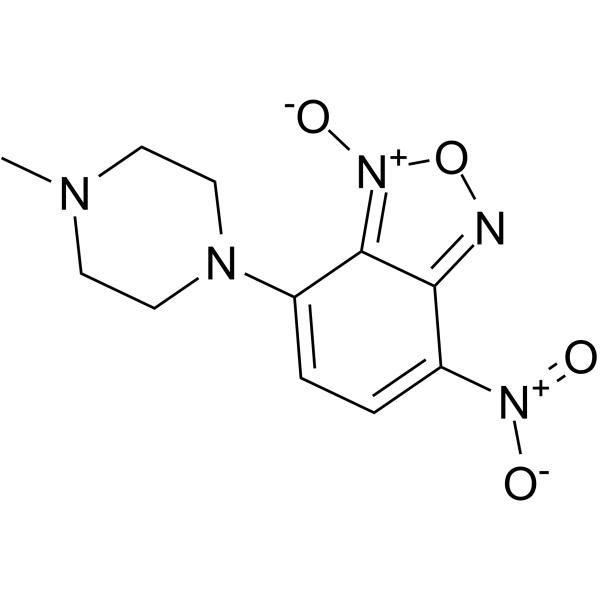
NSC-207895 (XI-006), a DNA damaging agent, is an anticancer agent and p53 activator.
Nur für Forschungszwecke. Wir verkaufen nicht an Patienten.
- Reinheit: 98.83%
- CAS. Nr.: 58131-57-0
- Formel: C11H13N5O4
- Molecular Weight:279.25
-
Speicherung:
4°C, protect from light
* In solvent : -80°C, 6 months; -20°C, 1 month (protect from light)

To place orders, for customer services and technical support, please contact: MedChemExpress USA
Tel: 609-228-6898 E-mail: [email protected] [email protected]


-
 Biologische Aktivität
-
Chemical Information
-
Lösungsmittel & Löslichkeit
- Reinheit & Dokumentation
- Verweise
-
 Help & FAQs


Publications Citing Use of MedChemExpress (MCE) NSC-207895
More Customer Validation & Images

-
WB


Biologische Aktivität
NSC-207895 (0.5 μM, 30 min), a MDM2 inhibitor, upregulates p53 protein levels[2].
NSC-207895, MDMX inhibitor, downregulates the expression of MDMX in AML cells at the mRNA and protein levels[3].
MedChemExpress (MCE) has not independently confirmed the accuracy of these methods. They are for reference only.
-
Cell Line:RAW 264.7 cells.
-
Concentration:0.5 μM.
-
Incubation Time:30 min (stimulated with LPS (100 ng/ml) for 6 h).
-
Result:Upregulated p53 protein levels.


Chemical Information
-
CAS. Nr. 58131-57-0
-
Appearance Solid
-
Molecular Weight 279.25
-
Formel C11H13N5O4
-
Color Brown to reddish brown
-
SMILES
O=[N+](C1=CC=C(N2CCN(C)CC2)C3=[N+]([O-])ON=C31)[O-]
-
Synonyms
XI-006
-
Versand
Room temperature in continental US; may vary elsewhere.
-
Speicherung
4°C, protect from light
* In solvent : -80°C, 6 months; -20°C, 1 month (protect from light)


Publications (2)
-
Journal Impact Factor
-
Most Recent
-
NPJ Precis Oncol
Cuproptosis-associated PDHA1 promotes sarcoma progression and immunotherapy responsiveness via the E2F1-PD-L1 axis: a multi-omics and clinical validation study. [Abstract]2026 Mar 6;10(1):156. PMID: 41792370 -
Arthritis Res Ther
Mechanical overloading-induced miR-325-3p reduction promoted chondrocyte senescence and exacerbated facet joint degeneration. [Abstract]2023 Apr 4;25(1):54. PMID: 37016437
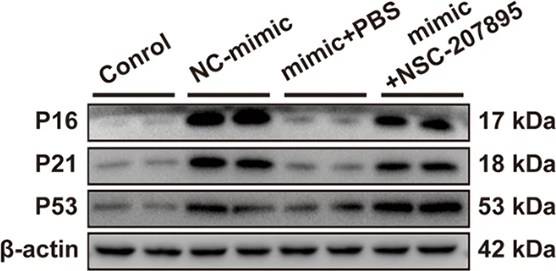
NSC-207895 purchased from MedChemExpress. Usage Cited in: Arthritis Res Ther. 2023 Apr 4;25(1):54. [Abstract]
NSC-207895 (0.5 μM; 6 h) inhibits miR-325-3p mimic-induced decreased expression of P16, P21 and P53 in chondrocyte cells.


Lösungsmittel & Löslichkeit
DMSO : 31.25 mg/mL (111.91 mM; ultrasonic and warming and heat to 60°C; Hygroscopic DMSO has a significant impact on the solubility of product, please use newly opened DMSO)
Please refer to the solubility information to select the appropriate solvent. Once prepared, please aliquot and store the solution to prevent product inactivation from repeated freeze-thaw cycles.
Storage method and period of stock solution: -80°C, 6 months; -20°C, 1 month (protect from light). When stored at -80°C, please use it within 6 months. When stored at -20°C, please use it within 1 month.
Please refer to the solubility information to select the appropriate solvent. Once prepared, please aliquot and store the solution to prevent product inactivation from repeated freeze-thaw cycles.
Storage method and period of stock solution: -80°C, 6 months; -20°C, 1 month (protect from light). When stored at -80°C, please use it within 6 months. When stored at -20°C, please use it within 1 month.
Konzentration (Stammlösung) × Volumen (Stammlösung) = Konzentration (Ziellösung) × Volumen (Ziellösung)
Select the appropriate dissolution method based on your experimental animal and administration route.
- For the following dissolution methods, please ensure to first prepare a clear stock solution using an In Vitro approach and then sequentially add co-solvents:
- To ensure reliable experimental results, the clarified stock solution can be appropriately stored based on storage conditions. As for the working solution for In Vivo experiments, it is recommended to prepare freshly and use it on the same day.
- The percentages shown for the solvents indicate their volumetric ratio in the final prepared solution. If precipitation or phase separation occurs during preparation, heat and/or sonication can be used to aid dissolution.
Add each solvent one by one: 10% DMSO 40% PEG300 5% Tween-80 45% Saline
Solubility: ≥ 2.08 mg/mL (7.45 mM); Clear solution
This protocol yields a clear solution of ≥ 2.08 mg/mL (saturation unknown).
Taking 1 mL working solution as an example, add 100 μL DMSO stock solution (20.8 mg/mL) to 400 μL PEG300, and mix evenly; then add 50 μL Tween-80 and mix evenly; then add 450 μL Saline to adjust the volume to 1 mL.
Preparation of Saline: Dissolve 0.9 g sodium chloride in ddH₂O and dilute to 100 mL to obtain a clear Saline solution.
Add each solvent one by one: 10% DMSO 90% (20% SBE-β-CD in Saline)
Solubility: 2.08 mg/mL (7.45 mM); Suspended solution; Need ultrasonic
This protocol yields a suspended solution of 2.08 mg/mL. Suspended solution can be used for oral and intraperitoneal injection.
Taking 1 mL working solution as an example, add 100 μL DMSO stock solution (20.8 mg/mL) to 900 μL 20% SBE-β-CD in Saline, and mix evenly.
Preparation of 20% SBE-β-CD in Saline (4°C, storage for one week): 2 g SBE-β-CD powder is dissolved in 10 mL Saline, completely dissolve until clear.
Please enter the basic information of animal experiments:
-
-
-
-
Recommended: Prepare an additional quantity of animals to account for potential losses during experiments.
Please enter your animal formula composition:
-
%DMSO +
Recommended: Keep the proportion of DMSO in working solution below 2% if your animal is weak.
-
%+
-
+%Tween-80 + +
-
%Saline +
The co-solvents required include: DMSO, . All of co-solvents are available by MedChemExpress (MCE). , Tween 80. All of co-solvents are available by MedChemExpress (MCE).
Working solution concentration: 0.22 mg/mL
Method for preparing stock solution: mg drug dissolved in μL DMSO. Stock solution concentration: mg/mL. * In solvent : -80°C, 6 months; -20°C, 1 month (protect from light)
1. Take μL DMSO stock solution;
2. Add μL .
μL , mix evenly;
3. Then add μL Tween 80, mix evenly;
4. Then add μL
Please ensure that the stock solution in the first step is dissolved to a clear state, and add co-solvents in sequence. You can use ultrasonic heating (ultrasonic cleaner, recommended frequency 20-40 kHz), vortexing, etc. to assist dissolution.


Reinheit & Dokumentation
-
Data Sheet (278 KB)
-
SDS (604 KB)
- English - EN (604 KB)
- Français - FR (604 KB)
- Deutsch - DE (604 KB)
- Norwegian - NO (604 KB)
- Español - ES (604 KB)
- Swedish - SV (604 KB)
- Italian - IT (604 KB)
- Korean - KR (604 KB)
- Portuguese - PT (604 KB)
-
Handling Instructions (2659 KB)
Verweise
[1]. Laura Kapitzky, et al. Cross-species chemogenomic profiling reveals evolutionarily conserved drug mode of action. Mol Syst Biol. 2010 Dec 21;6:451. [Content Brief]
[2]. Erdenezaya Odkhuu, et al. Lipopolysaccharide downregulates the expression of p53 through activation of MDM2 and enhances activation of nuclear factor-kappa B. Immunobiology. 2015 Jan;220(1):136-41. [Content Brief]
[3]. Luis A Carvajal, et al. Dual inhibition of MDMX and MDM2 as a therapeutic strategy in leukemia. Sci Transl Med. 2018 Apr 11;10(436):eaao3003. [Content Brief]


Complete Stock Solution Preparation Table
Please refer to the solubility information to select the appropriate solvent. Once prepared, please aliquot and store the solution to prevent product inactivation from repeated freeze-thaw cycles.
Storage method and period of stock solution: -80°C, 6 months; -20°C, 1 month (protect from light). When stored at -80°C, please use it within 6 months. When stored at -20°C, please use it within 1 month.
| Optional Solvent | Concentration Solvent Mass | 1 mg | 5 mg | 10 mg | 25 mg |
|---|---|---|---|---|---|
| DMSO | 1 mM | 3.5810 mL | 17.9051 mL | 35.8102 mL | 89.5255 mL |
| 5 mM | 0.7162 mL | 3.5810 mL | 7.1620 mL | 17.9051 mL | |
| 10 mM | 0.3581 mL | 1.7905 mL | 3.5810 mL | 8.9526 mL | |
| 15 mM | 0.2387 mL | 1.1937 mL | 2.3873 mL | 5.9684 mL | |
| 20 mM | 0.1791 mL | 0.8953 mL | 1.7905 mL | 4.4763 mL | |
| 25 mM | 0.1432 mL | 0.7162 mL | 1.4324 mL | 3.5810 mL | |
| 30 mM | 0.1194 mL | 0.5968 mL | 1.1937 mL | 2.9842 mL | |
| 40 mM | 0.0895 mL | 0.4476 mL | 0.8953 mL | 2.2381 mL | |
| 50 mM | 0.0716 mL | 0.3581 mL | 0.7162 mL | 1.7905 mL | |
| 60 mM | 0.0597 mL | 0.2984 mL | 0.5968 mL | 1.4921 mL | |
| 80 mM | 0.0448 mL | 0.2238 mL | 0.4476 mL | 1.1191 mL | |
| 100 mM | 0.0358 mL | 0.1791 mL | 0.3581 mL | 0.8953 mL |


NSC-207895 Related Classifications
HY-14714 Related Classifications
 Powered by Bioz