



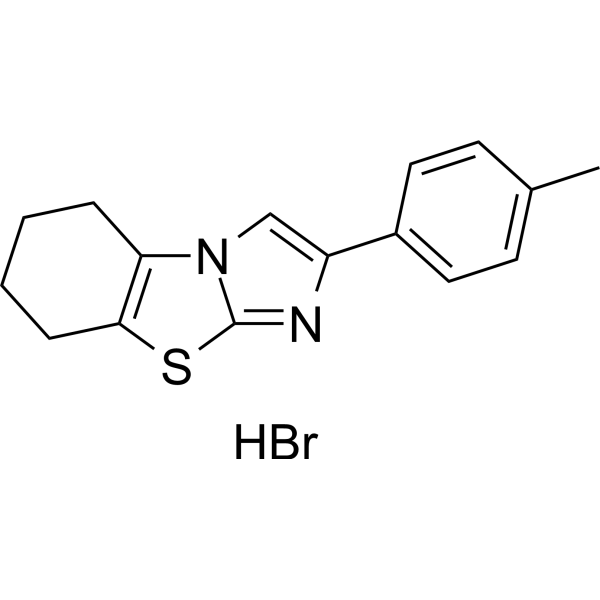
NSC 146109 hydrochloride
Based on 2 publication(s) in Google Scholar
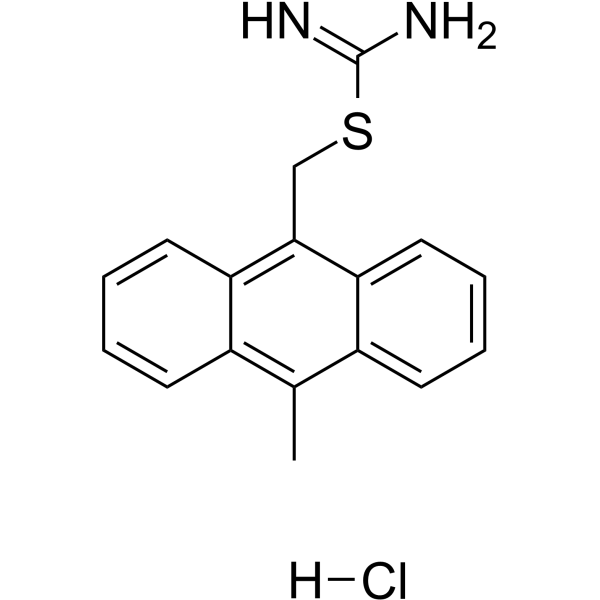
NSC 146109 hydrochloride (XI-011 hydrochloride) is a p53 activator and MDMX inhibitor. NSC 146109 hydrochloride inhibits MDMX gene transcription, downregulates MDMX mRNA and protein levels, stabilizes p53 and activates the transcriptional activity of p53. NSC 146109 hydrochloride induces cancer cell apoptosis (apoptosis) and inhibits the growth of transformed cells. NSC 146109 hydrochloride inhibits the growth of xenograft tumors. NSC 146109 hydrochloride can be used in research related to breast cancer and cervical cancer.
For research use only. We do not sell to patients.
- Purity: 99.89%
- CAS No.: 59474-01-0
- Formula: C17H17ClN2S
- Molecular Weight:316.85
-
Storage:
4°C, sealed storage, away from moisture
* In solvent : -80°C, 6 months; -20°C, 1 month (sealed storage, away from moisture)

To place orders, for customer services and technical support, please contact: MedChemExpress USA
Tel: 609-228-6898 E-mail: [email protected] [email protected]


-
 Biological Activity
-
Chemical Information
-
Solvent & Solubility
- Purity & Documentation
- References
-
 Help & FAQs


Publications Citing Use of MedChemExpress (MCE) NSC 146109 hydrochloride
More

Biological Activity
Description
In Vitro
NSC 146109 hydrochloride (0-1 μM; 16 h) activates p53 and p21 in MCF-7 cells, and upregulates the mRNA levels of p53 target genes (p21, PUMA, BAX, PIG3)[1].
NSC 146109 hydrochloride (0.5 μM; 16 h) increases the stability of p53 protein in MCF-7 cells[1].
NSC 146109 hydrochloride (0-1 μM; 1-5 days) induces apoptosis in MCF-7 cells and triggers dose-dependent cleavage of PARP[1].
NSC 146109 hydrochloride (0-1 μM; 2-24 h) downregulates MDMX protein levels, activates p53, inhibits MDMX promoter activity, and reduces MDMX mRNA levels in MCF-7 cells[1].
NSC 146109 hydrochloride (0-1 μM; 3-4 days) reduces the viability of wild-type p53 breast cancer cells (MCF-7, ZR-75-1, ZR-75-30, MDA-MB-175VII) in a dose-dependent manner, and inhibits the viability of human cervical cancer cells HeLa, Siha and Caski, with the strongest effect on HeLa cells[1].
NSC 146109 hydrochloride (0.5-1.0 μM; 24 h) significantly inhibits long-term colony formation of human cervical cancer cell lines HeLa, Siha and Caski[2].
NSC 146109 hydrochloride (0.5-1.0 μM; 24-72 h) induces apoptosis in HeLa cells in a time- and concentration-dependent manner[2].
NSC 146109 hydrochloride (0.5-1.0 μM; 24 h) upregulates the protein levels of cleaved PARP, p53, PUMA and p21, downregulates the protein level of MDMX in HeLa, Siha and Caski cells, and enhances the stability of p53 protein in HeLa cells[2].
NSC 146109 hydrochloride (0.5-1.0 μM; 24 h) upregulates the mRNA expression of p53 target genes PUMA, p21, BAX and PIG3 in a concentration-dependent manner in HeLa cancer cells[2].
NSC 146109 hydrochloride (0.5-1.0 μM; 72 h) significantly enhances the cytotoxicity of Cisplatin (HY-17394) against human cervical cancer HeLa cells[2].
NSC 146109 hydrochloride (0.5-1.0 μM; 24 h) enhances the Cisplatin-induced upregulation of cleaved PARP and p53 expression, as well as the downregulation of MDMX expression, in human cervical cancer HeLa cells[2].
NSC 146109 hydrochloride (0.5-1.0 μM) enhances the Cisplatin-induced upregulation of mRNA expression of PUMA, p21, BAX and PIG3 in human cervical cancer HeLa cells[2].
MedChemExpress (MCE) has not independently confirmed the accuracy of these methods. They are for reference only.
-
Cell Line:wild-type p53 MCF-7 breast cancer cells
-
Concentration:0.1 μM, 0.2 μM, 0.5 μM, 1 μM
-
Incubation Time:16 h
-
Result:Increased cellular p53 protein levels as efficiently as known p53 activators Nutlin-3a and RITA.
Caused a dose-dependent increase in p21 protein levels.
-
Cell Line:wild-type p53 MCF-7 breast cancer cells
-
Concentration:0.1 μM, 0.2 μM, 0.5 μM, 1.0 μM
-
Incubation Time:16 h
-
Result:Induced dose-dependent increases in mRNA levels of the p53 target genes p21, PUMA, BAX, and PIG3, with statistically significant increases relative to DMSO control at all tested concentrations.
Achieved the greatest increase for PIG3, with a relative mRNA amount of 33.41 at 1.0 μM.
-
Cell Line:wild-type p53 MCF-7 breast cancer cells
-
Concentration:0.5 μM (NSC 146109 pre-incubation); 100 μg/mL (Cycloheximide (HY-12320))
-
Incubation Time:16 h (NSC 146109 pre-incubation); 0-3 h (Cycloheximide)
-
Result:Extended the half-life of p53 protein significantly, as shown by sustained p53 levels over the 3-h Cycloheximide treatment period compared to the rapid decline in untreated control cells.
-
Cell Line:wild-type p53 MCF-7 breast cancer cells
-
Concentration:0.5 μM
-
Incubation Time:24 h, 48 h, 1-5 days
-
Result:Increased the sub-G0/G1 (apoptotic) cell population to 18.1% after 24 hours of treatment (from 2.04% in control).
Increased the sub-G0/G1 (apoptotic) cell population to 17.7% after 48 hours of treatment (from 1.76% in control).
Caused over 40% of MCF-7 cells to be apoptotic after 5 days of treatment, compared to less than 10% in DMSO control.
-
Cell Line:wild-type p53 MCF-7 breast cancer cells
-
Concentration:0.2 μM, 0.5 μM, 1.0 μM
-
Incubation Time:48 h
-
Result:Caused a dose-dependent increase in TUNEL-positive apoptotic cells, with approximately 2% positive cells at 0.2 μM, 6% at 0.5 μM, and 7% at 1.0 μM, compared to less than 1% in DMSO control.
-
Cell Line:wild-type p53 MCF-7 breast cancer cells
-
Concentration:0.1 μM, 0.2 μM, 0.5 μM, 1.0 μM
-
Incubation Time:2 days
-
Result:Induced dose-dependent cleavage of PARP, a biochemical marker of apoptosis, with increasing levels of cleaved PARP seen at higher concentrations of the compound.
-
Cell Line:wild-type p53 MCF-7 breast cancer cells
-
Concentration:0.1 μM, 0.25 μM, 0.5 μM, 1.0 μM (16 h incubation); 0.5 μM (time-course incubation)
-
Incubation Time:16 h; 2-24 h
-
Result:Caused dose-dependent downregulation of MDMX protein levels, with concurrent dose-dependent upregulation of p53 and p21 protein levels.
Showed MDMX levels began decreasing 4-8 hours after treatment, coinciding with the onset of p53 activation.
-
Cell Line:wild-type p53 MCF-7 breast cancer cells
-
Concentration:0.1 μM, 0.2 μM, 0.5 μM
-
Incubation Time:16 h
-
Result:Caused a dose-dependent decrease in MDMX mRNA levels, with relative mRNA level reduced to approximately 0.5 at 0.5 μM, compared to 1.0 in control.
-
Cell Line:wild-type p53 breast cancer cells (MCF-7, ZR-75-1, ZR-75-30, MDA-MB-175VII)
-
Concentration:0.2 μM, 0.4 μM, 0.6 μM, 0.8 μM, 1.0 μM
-
Incubation Time:4 days
-
Result:Caused a dose-dependent decrease in cell viability in all tested cell lines.
Reduced viability to ~10% at 1.0 μM in MCF-7 cells (high MDMX expression).
Left viabilities at ~20%, ~40%, and ~20% respectively at 1.0 μM in ZR-75-1, ZR-75-30, and MDA-MB-175VII cells (low MDMX expression).
-
Cell Line:HeLa, Siha, Caski human cervical cancer cells
-
Concentration:0, 0.1, 1, 10, 100 μM
-
Incubation Time:72 h
-
Result:Dose-dependently reduced cell viability in all three cervical cancer cell lines, with the highest proliferation inhibition observed in HeLa cells.
In Vivo
MedChemExpress (MCE) has not independently confirmed the accuracy of these methods. They are for reference only.
-
Animal Model:BALB/c-nude (female, 6-7 weeks old, subcutaneous HeLa cell xenograft)[2]
-
Dosage:10 mg/kg
-
Administration:i.p.; three times a week; 18 days
-
Result:Reduced mean tumor weight to 0.41 g.
Achieved a tumor growth inhibition rate of 49.2%.
Significantly reduced tumor volume relative to control.
Caused no apparent toxicity in treated mice.


Chemical Information
-
CAS No. 59474-01-0
-
Appearance Solid
-
Molecular Weight 316.85
-
Formula C17H17ClN2S
-
Color White to yellow
-
SMILES
[H]Cl.NC(SCC1=C2C=CC=CC2=C(C)C3=CC=CC=C13)=N
-
Synonyms
XI-011 hydrochloride
-
Shipping
Room temperature in continental US; may vary elsewhere.
-
Storage
4°C, sealed storage, away from moisture
* In solvent : -80°C, 6 months; -20°C, 1 month (sealed storage, away from moisture)


Publications (2)
-
Journal Impact Factor
-
Most Recent
-
Cell Death Dis
MDM4 inhibits ferroptosis in p53 mutant colon cancer via regulating TRIM21/GPX4 expression. [Abstract]2024 Nov 14;15(11):825. PMID: 39543140 -
Eur J Med Res
2024 Jan 27;29(1):79. PMID: 38281029


Solvent & Solubility
In Vitro:
DMSO : 83.33 mg/mL (263.00 mM; ultrasonic and warming and heat to 60°C; Hygroscopic DMSO has a significant impact on the solubility of product, please use newly opened DMSO)
Please refer to the solubility information to select the appropriate solvent. Once prepared, please aliquot and store the solution to prevent product inactivation from repeated freeze-thaw cycles.
Storage method and period of stock solution: -80°C, 6 months; -20°C, 1 month (sealed storage, away from moisture). When stored at -80°C, please use it within 6 months. When stored at -20°C, please use it within 1 month.
Please refer to the solubility information to select the appropriate solvent. Once prepared, please aliquot and store the solution to prevent product inactivation from repeated freeze-thaw cycles.
Storage method and period of stock solution: -80°C, 6 months; -20°C, 1 month (sealed storage, away from moisture). When stored at -80°C, please use it within 6 months. When stored at -20°C, please use it within 1 month.
Concentration (start) × Volume (start) = Concentration (final) × Volume (final)
In Vivo:
Select the appropriate dissolution method based on your experimental animal and administration route.
- For the following dissolution methods, please ensure to first prepare a clear stock solution using an In Vitro approach and then sequentially add co-solvents:
- To ensure reliable experimental results, the clarified stock solution can be appropriately stored based on storage conditions. As for the working solution for In Vivo experiments, it is recommended to prepare freshly and use it on the same day.
- The percentages shown for the solvents indicate their volumetric ratio in the final prepared solution. If precipitation or phase separation occurs during preparation, heat and/or sonication can be used to aid dissolution.
Add each solvent one by one: 10% DMSO 40% PEG300 5% Tween-80 45% Saline
Solubility: ≥ 2.08 mg/mL (6.56 mM); Clear solution
This protocol yields a clear solution of ≥ 2.08 mg/mL (saturation unknown).
Taking 1 mL working solution as an example, add 100 μL DMSO stock solution (20.8 mg/mL) to 400 μL PEG300, and mix evenly; then add 50 μL Tween-80 and mix evenly; then add 450 μL Saline to adjust the volume to 1 mL.
Preparation of Saline: Dissolve 0.9 g sodium chloride in ddH₂O and dilute to 100 mL to obtain a clear Saline solution.
Add each solvent one by one: 10% DMSO 90% (20% SBE-β-CD in Saline)
Solubility: ≥ 2.08 mg/mL (6.56 mM); Clear solution
This protocol yields a clear solution of ≥ 2.08 mg/mL (saturation unknown).
Taking 1 mL working solution as an example, add 100 μL DMSO stock solution (20.8 mg/mL) to 900 μL 20% SBE-β-CD in Saline, and mix evenly.
Preparation of 20% SBE-β-CD in Saline (4°C, storage for one week): 2 g SBE-β-CD powder is dissolved in 10 mL Saline, completely dissolve until clear.
In Vivo Dissolution Calculator
Please enter the basic information of animal experiments:
-
-
-
-
Recommended: Prepare an additional quantity of animals to account for potential losses during experiments.
Please enter your animal formula composition:
-
%DMSO +
Recommended: Keep the proportion of DMSO in working solution below 2% if your animal is weak.
-
%+
-
+%Tween-80 + +
-
%Saline +
The co-solvents required include: DMSO, . All of co-solvents are available by MedChemExpress (MCE). , Tween 80. All of co-solvents are available by MedChemExpress (MCE).
Working solution concentration: 0.22 mg/mL
Method for preparing stock solution: mg drug dissolved in μL DMSO. Stock solution concentration: mg/mL. * In solvent : -80°C, 6 months; -20°C, 1 month (sealed storage, away from moisture)
1. Take μL DMSO stock solution;
2. Add μL .
μL , mix evenly;
3. Then add μL Tween 80, mix evenly;
4. Then add μL
Please ensure that the stock solution in the first step is dissolved to a clear state, and add co-solvents in sequence. You can use ultrasonic heating (ultrasonic cleaner, recommended frequency 20-40 kHz), vortexing, etc. to assist dissolution.


Purity & Documentation
-
Data Sheet (289 KB)
-
SDS (480 KB)
- English - EN (480 KB)
- Français - FR (480 KB)
- Deutsch - DE (480 KB)
- Norwegian - NO (480 KB)
- Español - ES (480 KB)
- Swedish - SV (480 KB)
- Italian - IT (480 KB)
- Korean - KR (480 KB)
- Portuguese - PT (480 KB)
-
Handling Instructions (2659 KB)
References
[1]. Wang H, et al. A small-molecule p53 activator induces apoptosis through inhibiting MDMX expression in breast cancer cells. Neoplasia. 2011 Jul;13(7):611-9. [Content Brief]
[2]. Zhang J, et al. A small-molecule inhibitor of MDMX suppresses cervical cancer cells via the inhibition of E6-E6AP-p53 axis. Pharmacol Res. 2022;177:106128. [Content Brief]


Complete Stock Solution Preparation Table
Please refer to the solubility information to select the appropriate solvent. Once prepared, please aliquot and store the solution to prevent product inactivation from repeated freeze-thaw cycles.
Storage method and period of stock solution: -80°C, 6 months; -20°C, 1 month (sealed storage, away from moisture). When stored at -80°C, please use it within 6 months. When stored at -20°C, please use it within 1 month.
| Optional Solvent | Concentration Solvent Mass | 1 mg | 5 mg | 10 mg | 25 mg |
|---|---|---|---|---|---|
| DMSO | 1 mM | 3.1561 mL | 15.7803 mL | 31.5607 mL | 78.9017 mL |
| 5 mM | 0.6312 mL | 3.1561 mL | 6.3121 mL | 15.7803 mL | |
| 10 mM | 0.3156 mL | 1.5780 mL | 3.1561 mL | 7.8902 mL | |
| 15 mM | 0.2104 mL | 1.0520 mL | 2.1040 mL | 5.2601 mL | |
| 20 mM | 0.1578 mL | 0.7890 mL | 1.5780 mL | 3.9451 mL | |
| 25 mM | 0.1262 mL | 0.6312 mL | 1.2624 mL | 3.1561 mL | |
| 30 mM | 0.1052 mL | 0.5260 mL | 1.0520 mL | 2.6301 mL | |
| 40 mM | 0.0789 mL | 0.3945 mL | 0.7890 mL | 1.9725 mL | |
| 50 mM | 0.0631 mL | 0.3156 mL | 0.6312 mL | 1.5780 mL | |
| 60 mM | 0.0526 mL | 0.2630 mL | 0.5260 mL | 1.3150 mL | |
| 80 mM | 0.0395 mL | 0.1973 mL | 0.3945 mL | 0.9863 mL | |
| 100 mM | 0.0316 mL | 0.1578 mL | 0.3156 mL | 0.7890 mL |


NSC 146109 hydrochloride Related Classifications
HY-108638 Related Classifications
 Powered by Bioz