



Divarasib adipate
Based on 6 publication(s) in Google Scholar
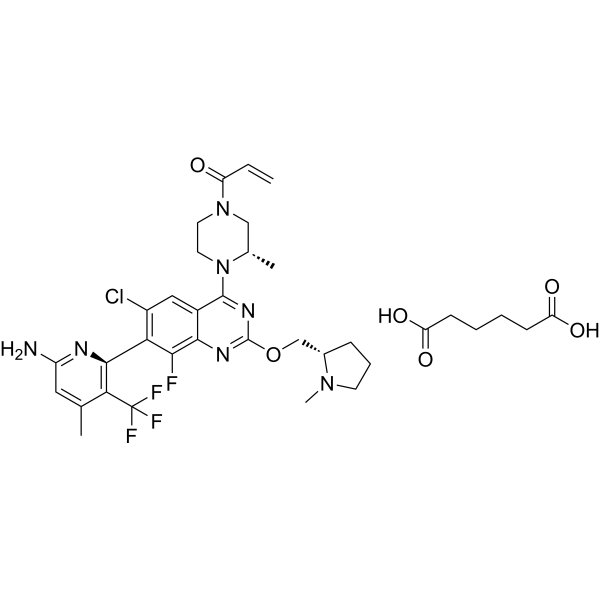
Divarasib (GDC-6036) adipate is an orally active, selective KRASG12C inhibitor with an IC50 of <0.01 μM. Divarasib adipate covalently binds Cys12 in GDP-bound KRASG12C, occupies the switch II pocket, blocks GTP binding and SOS-mediated reactivation, and inhibits oncogenic KRAS signaling. Divarasib adipate induces tumor shrinkage and robust tumor growth inhibition in KRASG12C-positive models and cancer cells. Divarasib adipate can be used for the research of non-small cell lung cancer, colorectal adenocarcinoma, pancreatic ductal adenocarcinoma, and other KRASG12C-mutated solid tumors.
For research use only. We do not sell to patients.
- Purity : 99.20%
- CAS No.: 2762240-36-6
- Formula: C35H42ClF4N7O6
- Molecular Weight:768.20
-
Storage:Powder -20°C, 3 years , 4°C, 2 years ; In solvent -80°C, 6 months , -20°C, 1 month

To place orders, for customer services and technical support, please contact: MedChemExpress USA
Tel: 609-228-6898 E-mail: [email protected] [email protected]


-
 Biological Activity
-
Chemical Information
-
Solvent & Solubility
- Purity & Documentation
- References
-
 Help & FAQs


Publications Citing Use of MedChemExpress (MCE) Divarasib adipate
More Customer Validation & Images

-
Cell Proliferation/Viability Assay
-
IP
-
Cell Proliferation/Viability Assay
-
Bio/Physico-chemical Assay


Biological Activity
Description
IC50 & Target
[1]|
K-Ras(G12C) <0.01 μM (IC50) |
In Vitro
Divarasib (20 μM; overnight at room temperature) adipate achieves complete or near-complete covalent binding to purified KRASG12C protein[1].
Divarasib (18 h) adipate potently inhibits SOS1-mediated nucleotide exchange on purified KRASG12C protein with a Kd of 0.0024 nM[2].
Divarasib (18 h) adipate alkylates KRASG12C in 2D-cultured HCC1171 cells with an IC50 of 2.2 nM[2].
Divarasib (18 h) adipate alkylates KRASG12C in 3D-cultured HCC1171 cells with an IC50 of 0.42 nM, showing improved potency compared to 2D culture and approved inhibitors[2].
Divarasib (7 days) adipate inhibits viability across a panel of 19 KRASG12C-positive cell lines with a geometric mean IC50 of 0.56 nM and shows 9200-fold selectivity over non-KRASG12C cells[2].
Divarasib (10 nM; 4 h) adipate is highly selective for KRASG12C in HCC1171 cells, with no significant off-target cysteine reactivity detected among 11,042 quantified sites[2].
MedChemExpress (MCE) has not independently confirmed the accuracy of these methods. They are for reference only.
In Vivo
Divarasib (0.1-50 mg/kg; p.o.; daily; 21 days) adipate induces tumor stasis or regression in KRASG12C-positive NCI-H358 NSCLC xenografts, with an ED50 of 2.0 mg/kg and ED90 of 13 mg/kg for tumor growth inhibition, and achieves robust target engagement and pathway suppression at a dose of 10 mg/kg[2].
Divarasib (0.7-100 mg/kg; p.o.; daily; 21 days) adipate induces tumor stasis at a dose of 100 mg/kg in KRASG12C-positive NCI-H2122 NSCLC xenografts, with an ED50 of 6.3 mg/kg and ED90 of 21 mg/kg for tumor growth inhibition, and achieves pathway suppression at higher doses compared to the more sensitive NCI-H358 model[2].
MedChemExpress (MCE) has not independently confirmed the accuracy of these methods. They are for reference only.
-
Animal Model:C.B-17 SCID (Inbred; female; 20−21 weeks old; average weight 24.1 g; human NSCLC NCI-H2030.X1.1 cells implanted subcutaneously)[1]
-
Dosage:10 mg/kg; 25 mg/kg; 100 mg/kg
-
Administration:p.o.; daily; 7 days
-
Result:Achieved dose-dependent KRAS G12C target engagement at 2, 8, and 24 h post-last dose.
Reached over 90% KRAS G12C engagement with the 100 mg/kg dose.
Correlated KRAS G12C engagement with percent change in tumor volume from day 0 to day 7, with the greatest tumor shrinkage observed in the 100 mg/kg dose group.
-
Animal Model:C.B-17 SCID (Inbred) (female)[2]
-
Dosage:0.1 mg/kg; 1 mg/kg; 5 mg/kg; 15 mg/kg; 50 mg/kg; 10 mg/kg (single dose)
-
Administration:p.o.; daily; 21 days; p.o.; single dose
-
Result:Slowed tumor growth at 0.1 mg/kg and 1 mg/kg.
Induced tumor stasis at 5 mg/kg.
Induced tumor regression at 15 mg/kg and 50 mg/kg.
Achieved an ED50 of 2.0 mg/kg and ED90 of 13 mg/kg for tumor growth inhibition.
Achieved ~95% suppression of MAPK target genes DUSP6 and SPRY4, ~75% KRAS G12C alkylation, and 0.2 nM free drug concentration in tumors 8 hours post a single 10 mg/kg dose.
Achieved an alkylation ED50 of 6.6 mg/kg.


Chemical Information
-
CAS No. 2762240-36-6
-
Appearance Solid
-
Molecular Weight 768.20
-
Formula C35H42ClF4N7O6
-
Color White to off-white
-
SMILES
NC1=N[C@]([C@]2=C(C=C3C(N=C(N=C3N4[C@H](CN(CC4)C(C=C)=O)C)OC[C@H]5N(CCC5)C)=C2F)Cl)=C(C(C)=C1)C(F)(F)F.O=C(CCCCC(O)=O)O
-
Synonyms
GDC-6036 adipate
-
Shipping
Room temperature in continental US; may vary elsewhere.
-
Storage
Powder -20°C 3 years 4°C 2 years In solvent -80°C 6 months -20°C 1 month


Publications (6)
-
Journal Impact Factor
-
Most Recent
-
Ann Oncol
Genomic landscape of clinically acquired resistance alterations in patients treated with KRASG12C inhibitors. [Abstract]2025 Jun;36(6):682-692. PMID: 39914665
Divarasib adipate purchased from MedChemExpress. Usage Cited in: Ann Oncol. 2025 Jun;36(6):682-692. [Abstract]
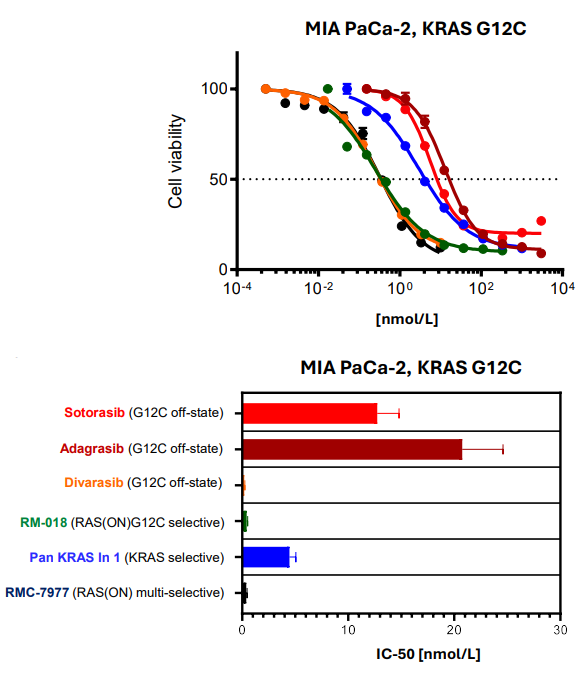
Divarasib exhibited a half-maximal inhibitory concentration (IC50) of 0.19 nmol/L in the MIA PaCa‑2 cell line harboring only the single KRASG12C mutation.
-
Cell
2024 Oct 31;187(22):6379-6392.e17. PMID: 39255801
Divarasib adipate purchased from MedChemExpress. Usage Cited in: Cell. 2024 Oct 31;187(22):6379-6392.e17. [Abstract]
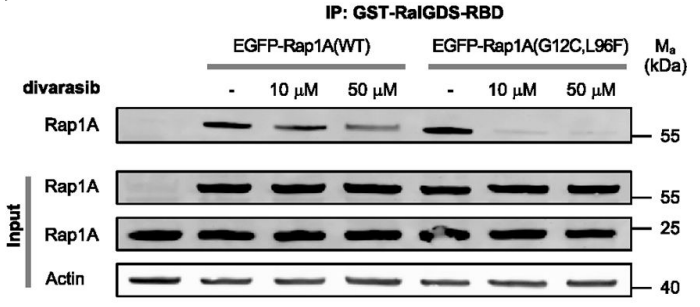
IP of active GTP-bound Rap1 using GST-RalGDS-RBD of HeLa cells transiently overexpressing EGFP-Rap1A(WT) and EGFP-Rap1A(G12C, L96F) and treated with different concentrations of Divarasib (10-50 μM; 12 h). The results showed that treatment with Divarasib effectively inhibited the activity of Rap1A(G12C, L96F).
Divarasib adipate purchased from MedChemExpress. Usage Cited in: Cell. 2024 Oct 31;187(22):6379-6392.e17. [Abstract]
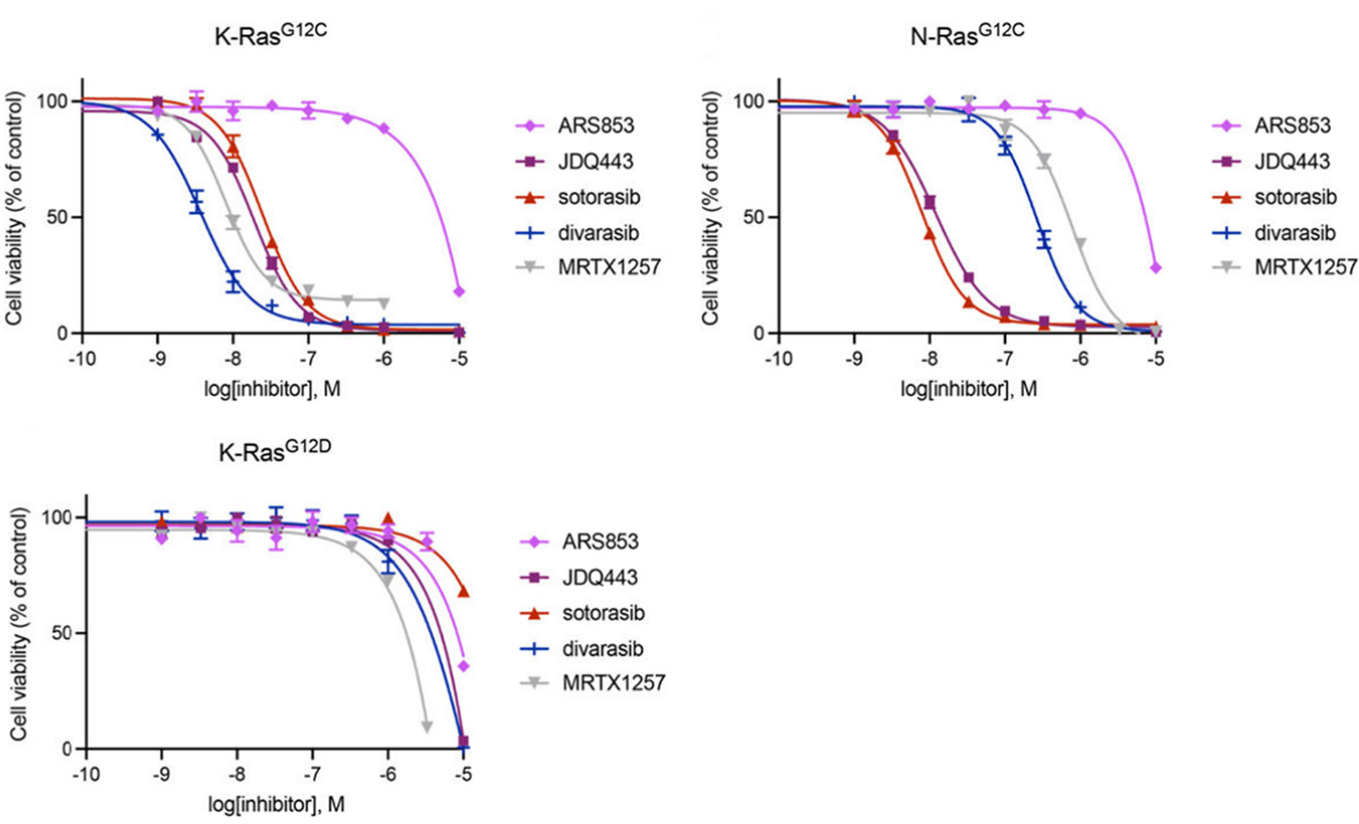
Relative growth of MOLM-13-KRAS-G12C, MOLM-13-NRAS-G12C, and MOLM-13-KRAS-G12D cells after treatment with K-Ras(G12C) inhibitors (Divarasib et al.) for 72 h.
Divarasib adipate purchased from MedChemExpress. Usage Cited in: Cell. 2024 Oct 31;187(22):6379-6392.e17. [Abstract]
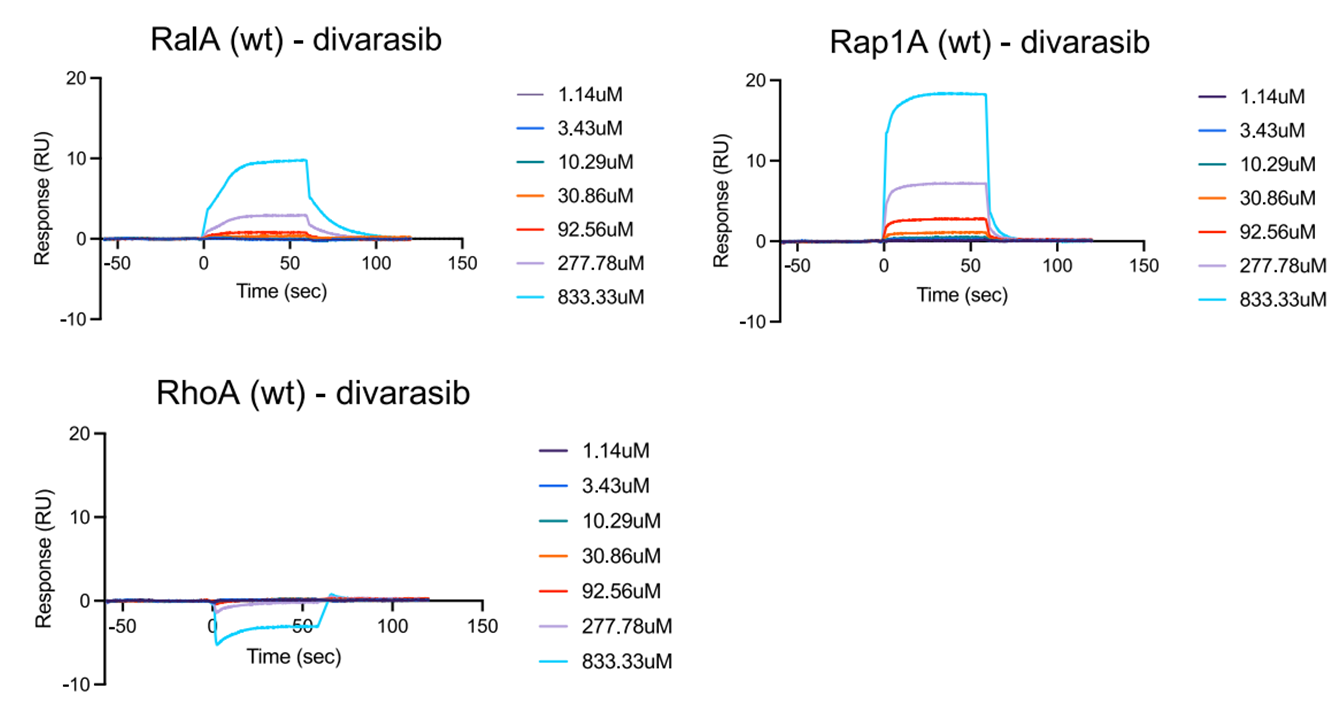
Surface plasmon resonance experiment with Divarasib and RalA(WT), Rap1A(WT), and RhoA(WT). The results showed that Divarasib bound reversely to both RalA(WT) and Rap1A(WT), whereas no binding to RhoA(WT) was detected.
-
Cancer Discov
Sotorasib is a pan-RASG12C inhibitor capable of driving clinical response in NRASG12C cancers. [Abstract]2024 May 1;14(5):727-736. PMID: 38236605 -
Nat Cancer
The MEK-RAF molecular glue IK-595 has potent antitumor activity across RAS/MAPK pathway-altered cancers. [Abstract]2026 Jan;7(1):116-130. PMID: 41482524 -
ACS Omega
Application and Cross-Validation of a High-Throughput SPR Method for Characterizing Covalent Binding Ligands. [Abstract]2025 Jul 4;10(27):29637-29646. PMID: 40687013 -


Solvent & Solubility
In Vitro:
DMSO : 100 mg/mL (130.17 mM; Need ultrasonic; Hygroscopic DMSO has a significant impact on the solubility of product, please use newly opened DMSO)
Please refer to the solubility information to select the appropriate solvent. Once prepared, please aliquot and store the solution to prevent product inactivation from repeated freeze-thaw cycles.
Storage method and period of stock solution: -80°C, 6 months; -20°C, 1 month. When stored at -80°C, please use it within 6 months. When stored at -20°C, please use it within 1 month.
Please refer to the solubility information to select the appropriate solvent. Once prepared, please aliquot and store the solution to prevent product inactivation from repeated freeze-thaw cycles.
Storage method and period of stock solution: -80°C, 6 months; -20°C, 1 month. When stored at -80°C, please use it within 6 months. When stored at -20°C, please use it within 1 month.
Concentration (start) × Volume (start) = Concentration (final) × Volume (final)
In Vivo:
Select the appropriate dissolution method based on your experimental animal and administration route.
- For the following dissolution methods, please ensure to first prepare a clear stock solution using an In Vitro approach and then sequentially add co-solvents:
- To ensure reliable experimental results, the clarified stock solution can be appropriately stored based on storage conditions. As for the working solution for In Vivo experiments, it is recommended to prepare freshly and use it on the same day.
- The percentages shown for the solvents indicate their volumetric ratio in the final prepared solution. If precipitation or phase separation occurs during preparation, heat and/or sonication can be used to aid dissolution.
Add each solvent one by one: 10% DMSO 40% PEG300 5% Tween-80 45% Saline
Solubility: ≥ 5 mg/mL (6.51 mM); Clear solution
This protocol yields a clear solution of ≥ 5 mg/mL (saturation unknown).
Taking 1 mL working solution as an example, add 100 μL DMSO stock solution (50.0 mg/mL) to 400 μL PEG300, and mix evenly; then add 50 μL Tween-80 and mix evenly; then add 450 μL Saline to adjust the volume to 1 mL.
Preparation of Saline: Dissolve 0.9 g sodium chloride in ddH₂O and dilute to 100 mL to obtain a clear Saline solution.
Add each solvent one by one: 10% DMSO 90% (20% SBE-β-CD in Saline)
Solubility: ≥ 5 mg/mL (6.51 mM); Clear solution
This protocol yields a clear solution of ≥ 5 mg/mL (saturation unknown).
Taking 1 mL working solution as an example, add 100 μL DMSO stock solution (50.0 mg/mL) to 900 μL 20% SBE-β-CD in Saline, and mix evenly.
Preparation of 20% SBE-β-CD in Saline (4°C, storage for one week): 2 g SBE-β-CD powder is dissolved in 10 mL Saline, completely dissolve until clear.
In Vivo Dissolution Calculator
Please enter the basic information of animal experiments:
-
-
-
-
Recommended: Prepare an additional quantity of animals to account for potential losses during experiments.
Please enter your animal formula composition:
-
%DMSO +
Recommended: Keep the proportion of DMSO in working solution below 2% if your animal is weak.
-
%+
-
+%Tween-80 + +
-
%Saline +
The co-solvents required include: DMSO, . All of co-solvents are available by MedChemExpress (MCE). , Tween 80. All of co-solvents are available by MedChemExpress (MCE).
Working solution concentration: 0.22 mg/mL
Method for preparing stock solution: mg drug dissolved in μL DMSO. Stock solution concentration: mg/mL.
1. Take μL DMSO stock solution;
2. Add μL .
μL , mix evenly;
3. Then add μL Tween 80, mix evenly;
4. Then add μL
Please ensure that the stock solution in the first step is dissolved to a clear state, and add co-solvents in sequence. You can use ultrasonic heating (ultrasonic cleaner, recommended frequency 20-40 kHz), vortexing, etc. to assist dissolution.


Purity & Documentation
-
Data Sheet (278 KB)
-
SDS (251 KB)
- English - EN (251 KB)
- Français - FR (251 KB)
- Deutsch - DE (251 KB)
- Norwegian - NO (251 KB)
- Español - ES (251 KB)
- Swedish - SV (251 KB)
- Italian - IT (251 KB)
- Korean - KR (251 KB)
- Portuguese - PT (251 KB)
-
Handling Instructions (2659 KB)
References
[1]. Meng L, et al. Assessment of KRAS G12C Target Engagement by a Covalent Inhibitor in Tumor Biopsies Using an Ultra-Sensitive Immunoaffinity 2D-LC-MS/MS Approach. Anal Chem. 2022 Sep 20;94(37):12927-12933. [Content Brief]
[2]. Endres NF, et al. Discovery and Characterization of Divarasib (GDC-6036), a Potent Covalent Inhibitor of KRAS G12C. J Med Chem. 2026;69(5):5147-5165. [Content Brief]
[3]. Brazel D, et al. Divarasib in the Evolving Landscape of KRAS G12C Inhibitors for NSCLC. Target Oncol. 2024;19(3):297-301. [Content Brief]


Complete Stock Solution Preparation Table
Please refer to the solubility information to select the appropriate solvent. Once prepared, please aliquot and store the solution to prevent product inactivation from repeated freeze-thaw cycles.
Storage method and period of stock solution: -80°C, 6 months; -20°C, 1 month. When stored at -80°C, please use it within 6 months. When stored at -20°C, please use it within 1 month.
| Optional Solvent | Concentration Solvent Mass | 1 mg | 5 mg | 10 mg | 25 mg |
|---|---|---|---|---|---|
| DMSO | 1 mM | 1.3017 mL | 6.5087 mL | 13.0174 mL | 32.5436 mL |
| 5 mM | 0.2603 mL | 1.3017 mL | 2.6035 mL | 6.5087 mL | |
| 10 mM | 0.1302 mL | 0.6509 mL | 1.3017 mL | 3.2544 mL | |
| 15 mM | 0.0868 mL | 0.4339 mL | 0.8678 mL | 2.1696 mL | |
| 20 mM | 0.0651 mL | 0.3254 mL | 0.6509 mL | 1.6272 mL | |
| 25 mM | 0.0521 mL | 0.2603 mL | 0.5207 mL | 1.3017 mL | |
| 30 mM | 0.0434 mL | 0.2170 mL | 0.4339 mL | 1.0848 mL | |
| 40 mM | 0.0325 mL | 0.1627 mL | 0.3254 mL | 0.8136 mL | |
| 50 mM | 0.0260 mL | 0.1302 mL | 0.2603 mL | 0.6509 mL | |
| 60 mM | 0.0217 mL | 0.1085 mL | 0.2170 mL | 0.5424 mL | |
| 80 mM | 0.0163 mL | 0.0814 mL | 0.1627 mL | 0.4068 mL | |
| 100 mM | 0.0130 mL | 0.0651 mL | 0.1302 mL | 0.3254 mL |


Divarasib adipate Related Classifications
HY-145928B Related Classifications
 Powered by Bioz