



Anguizole
Based on 2 publication(s) in Google Scholar
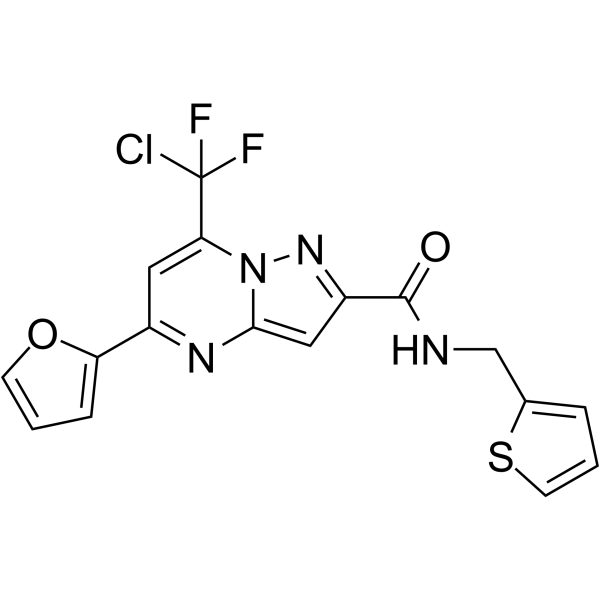
Anguizole is an HCV NS4B inhibitor. Anguizole interacts with NS4B-AH2, inhibits AH2 lipid vesicle aggregation, disrupts NS4B dimerization/multimerization and impairs NS4B-NS5A interaction. Anguizole exhibits little host cell toxicity. Anguizole can be used for the research of HCV infection.
For research use only. We do not sell to patients.
- Purity: 99.53%
- CAS No.: 442666-98-0
- Formula: C17H11ClF2N4O2S
- Molecular Weight:408.81
-
Storage:Powder -20°C, 3 years , 4°C, 2 years ; In solvent -80°C, 2 years , -20°C, 1 year

To place orders, for customer services and technical support, please contact: MedChemExpress USA
Tel: 609-228-6898 E-mail: [email protected] [email protected]


-
 Biological Activity
-
Chemical Information
-
Solvent & Solubility
- Purity & Documentation
- References
-
 Help & FAQs


Publications Citing Use of MedChemExpress (MCE) Anguizole
More

Biological Activity
|
Cell Line

|
Type | Value | Description | References |
|---|---|---|---|---|
| Huh-7 | CC50 |
>50 μM
Compound: Anguizole
|
Cytotoxicity against human HuH7 cells infected with HCV genotype 1b after 48 hrs by WST-1 assay
Cytotoxicity against human HuH7 cells infected with HCV genotype 1b after 48 hrs by WST-1 assay
|
[PMID: 26241789] |
| Huh-7 | EC50 |
0.31 μM
Compound: Anguizole
|
Antiviral activity against HCV genotype 1b infected in Huh7 cells assessed as inhibition of viral replication after 48 hrs by luciferase reporter-based viral replicon assay
Antiviral activity against HCV genotype 1b infected in Huh7 cells assessed as inhibition of viral replication after 48 hrs by luciferase reporter-based viral replicon assay
|
[PMID: 26241789] |
| Huh-7 | EC50 |
0.56 μM
Compound: Anguizole
|
Antiviral activity against HCV genotype 1a infected in Huh7 cells assessed as inhibition of viral replication after 48 hrs by luciferase reporter-based viral replicon assay
Antiviral activity against HCV genotype 1a infected in Huh7 cells assessed as inhibition of viral replication after 48 hrs by luciferase reporter-based viral replicon assay
|
[PMID: 26241789] |
| Huh-7 | EC50 |
0.63 μM
Compound: Anguizole
|
Antiviral activity against HCV infected in human HuH7 cells assessed as inhibition of viral replication after 72 hrs by ELISA-based viral replicon assay
Antiviral activity against HCV infected in human HuH7 cells assessed as inhibition of viral replication after 72 hrs by ELISA-based viral replicon assay
|
[PMID: 26241789] |
| Huh-7 | EC50 |
450 nM
Compound: 1e
|
Antiviral activity against wild type HCV genotype 1b infected in human HuH7 cells after 48 hrs by luciferase reporter gene assay
Antiviral activity against wild type HCV genotype 1b infected in human HuH7 cells after 48 hrs by luciferase reporter gene assay
|
[PMID: 24900511] |
| Huh-7 | EC50 |
740 nM
Compound: 1e
|
Antiviral activity against wild type HCV genotype 1a infected in human HuH7 cells after 48 hrs by luciferase reporter gene assay
Antiviral activity against wild type HCV genotype 1a infected in human HuH7 cells after 48 hrs by luciferase reporter gene assay
|
[PMID: 24900511] |
| Sf9 | IC50 |
22 nM
Compound: 1e
|
Displacement of [3H]-3-(1-(3-chloro-6-isopropyl-8-(trifluoromethyl)imidazo[1,2-a]pyridine-2-carbonyl)piperidin-4-yl)oxazolidin-2-one from HCV genotype 1b His6-tagged NS4B expressed in baculovirus infected Sf9 cells after overnight incubation
Displacement of [3H]-3-(1-(3-chloro-6-isopropyl-8-(trifluoromethyl)imidazo[1,2-a]pyridine-2-carbonyl)piperidin-4-yl)oxazolidin-2-one from HCV genotype 1b His6-tagged NS4B expressed in baculovirus infected Sf9 cells after overnight incubation
|
[PMID: 24900511] |
Anguizole (0.097-50 μM; 48 h) potently inhibits genotype 1b HCV replication in Huh7-derived ET cells with an EC50 of 310 nM, inhibits genotype 1a replication with an EC50 of 560 nM, has no activity against genotype 2a replication at concentrations up to 50 μM, and exhibits no significant cytotoxicity at concentrations up to 50 μM[1].
Anguizole (0.001-10.24 μM; 5 days) inhibits wild-type genotype 1b HCV replication in Huh7.5 cells with an EC50 of 0.20 μM, while the NS4BH94R mutant replicon shows reduced sensitivity with an EC50 of 7.5 μM[1].
Anguizole (5 μM; 48 h) specifically alters the subcellular distribution of NS4B-GFP, and H94R mutant NS4B-GFP in Huh7.5 cells[1].
Anguizole (26 μM) specifically inhibits the lipid vesicle aggregation activity of the NS4B AH2 peptide in a cell-free DLS assay[1].
Anguizole (0.5-2 μM; 3 weeks) potently inhibits genotype 1b HCV replication in Huh7 cells with an EC50 of 454 nM, without significant cytotoxicity at tested concentrations[2].
Anguizole (2.5-20 μM; 1 day) inhibits NS4B dimerization/multimerization in Huh7 cells, with half-maximal inhibition at approximately 5 μM[2].
Anguizole (10 μM; 3 days) alters the subcellular localization of NS4B-GFP to an elongated pattern in Huh7 cells when NS4B is expressed alone, but does not affect NS4B localization when expressed in the context of an HCV subgenomic replicon[2].
Anguizole (0.1-10 μM; 2 days) disrupts the interaction between NS4B and NS5A in Huh7 cells, with half-maximal inhibition at approximately 1.1 μM[2].
MedChemExpress (MCE) has not independently confirmed the accuracy of these methods. They are for reference only.
-
Cell Line:Huh7
-
Concentration:2.5; 5; 10; 20 μM
-
Incubation Time:1 day
-
Result:Reduced the level of dimeric NS4B in a dose-dependent manner without significantly affecting monomeric NS4B.
Blocked dimeric NS4B formation by half at approximately 5 μM.
-
Cell Line:Huh7
-
Concentration:10 μM
-
Incubation Time:3 days
-
Result:Induced an aberrant elongated subcellular localization pattern in approximately 63% of NS4B-GFP positive cells, compared to the punctate pattern seen in DMSO-treated cells.
Did not alter the typical distinct punctate foci localization of NS4B expressed in the context of the HCV subgenomic replicon.


Chemical Information
-
CAS No. 442666-98-0
-
Appearance Solid
-
Molecular Weight 408.81
-
Formula C17H11ClF2N4O2S
-
Color Light yellow to yellow
-
SMILES
FC(Cl)(C1=CC(C2=CC=CO2)=NC3=CC(C(NCC4=CC=CS4)=O)=NN31)F
-
Shipping
Room temperature in continental US; may vary elsewhere.
-
Storage
Powder -20°C 3 years 4°C 2 years In solvent -80°C 2 years -20°C 1 year


Publications (2)
-
Journal Impact Factor
-
Most Recent
-
Arch Virol
Current and future therapies for hepatitis C virus infection: from viral proteins to host targets. [Abstract]2014 May;159(5):831-46. PMID: 23979177 -


Solvent & Solubility
DMSO : 50 mg/mL (122.31 mM; Need ultrasonic; Hygroscopic DMSO has a significant impact on the solubility of product, please use newly opened DMSO)
Please refer to the solubility information to select the appropriate solvent. Once prepared, please aliquot and store the solution to prevent product inactivation from repeated freeze-thaw cycles.
Storage method and period of stock solution: -80°C, 2 years; -20°C, 1 year. When stored at -80°C, please use it within 2 years. When stored at -20°C, please use it within 1 year.
Please refer to the solubility information to select the appropriate solvent. Once prepared, please aliquot and store the solution to prevent product inactivation from repeated freeze-thaw cycles.
Storage method and period of stock solution: -80°C, 2 years; -20°C, 1 year. When stored at -80°C, please use it within 2 years. When stored at -20°C, please use it within 1 year.
Concentration (start) × Volume (start) = Concentration (final) × Volume (final)
Select the appropriate dissolution method based on your experimental animal and administration route.
- For the following dissolution methods, please ensure to first prepare a clear stock solution using an In Vitro approach and then sequentially add co-solvents:
- To ensure reliable experimental results, the clarified stock solution can be appropriately stored based on storage conditions. As for the working solution for In Vivo experiments, it is recommended to prepare freshly and use it on the same day.
- The percentages shown for the solvents indicate their volumetric ratio in the final prepared solution. If precipitation or phase separation occurs during preparation, heat and/or sonication can be used to aid dissolution.
Please enter the basic information of animal experiments:
-
-
-
-
Recommended: Prepare an additional quantity of animals to account for potential losses during experiments.
Please enter your animal formula composition:
-
%DMSO +
Recommended: Keep the proportion of DMSO in working solution below 2% if your animal is weak.
-
%+
-
+%Tween-80 + +
-
%Saline +
The co-solvents required include: DMSO, . All of co-solvents are available by MedChemExpress (MCE). , Tween 80. All of co-solvents are available by MedChemExpress (MCE).
Working solution concentration: 0.22 mg/mL
Method for preparing stock solution: mg drug dissolved in μL DMSO. Stock solution concentration: mg/mL.
1. Take μL DMSO stock solution;
2. Add μL .
μL , mix evenly;
3. Then add μL Tween 80, mix evenly;
4. Then add μL
Please ensure that the stock solution in the first step is dissolved to a clear state, and add co-solvents in sequence. You can use ultrasonic heating (ultrasonic cleaner, recommended frequency 20-40 kHz), vortexing, etc. to assist dissolution.


Purity & Documentation
-
Data Sheet (280 KB)
-
SDS (251 KB)
- English - EN (251 KB)
- Français - FR (251 KB)
- Deutsch - DE (251 KB)
- Norwegian - NO (251 KB)
- Español - ES (251 KB)
- Swedish - SV (251 KB)
- Italian - IT (251 KB)
- Korean - KR (251 KB)
- Portuguese - PT (251 KB)
-
Handling Instructions (2659 KB)
References
[1]. Bryson PD, et al. A small molecule inhibits HCV replication and alters NS4B's subcellular distribution. Antiviral Res. 2010;87(1):1-8. [Content Brief]
[2]. Choi M, et al. A hepatitis C virus NS4B inhibitor suppresses viral genome replication by disrupting NS4B's dimerization/multimerization as well as its interaction with NS5A. Virus Genes. 2013;47(3):395-407. [Content Brief]
[3]. Delang L, et al. Hepatitis C virus-specific directly acting antiviral drugs. Curr Top Microbiol Immunol. 2013;369:289-320. [Content Brief]


Complete Stock Solution Preparation Table
Please refer to the solubility information to select the appropriate solvent. Once prepared, please aliquot and store the solution to prevent product inactivation from repeated freeze-thaw cycles.
Storage method and period of stock solution: -80°C, 2 years; -20°C, 1 year. When stored at -80°C, please use it within 2 years. When stored at -20°C, please use it within 1 year.
| Optional Solvent | Concentration Solvent Mass | 1 mg | 5 mg | 10 mg | 25 mg |
|---|---|---|---|---|---|
| DMSO | 1 mM | 2.4461 mL | 12.2306 mL | 24.4612 mL | 61.1531 mL |
| 5 mM | 0.4892 mL | 2.4461 mL | 4.8922 mL | 12.2306 mL | |
| 10 mM | 0.2446 mL | 1.2231 mL | 2.4461 mL | 6.1153 mL | |
| 15 mM | 0.1631 mL | 0.8154 mL | 1.6307 mL | 4.0769 mL | |
| 20 mM | 0.1223 mL | 0.6115 mL | 1.2231 mL | 3.0577 mL | |
| 25 mM | 0.0978 mL | 0.4892 mL | 0.9784 mL | 2.4461 mL | |
| 30 mM | 0.0815 mL | 0.4077 mL | 0.8154 mL | 2.0384 mL | |
| 40 mM | 0.0612 mL | 0.3058 mL | 0.6115 mL | 1.5288 mL | |
| 50 mM | 0.0489 mL | 0.2446 mL | 0.4892 mL | 1.2231 mL | |
| 60 mM | 0.0408 mL | 0.2038 mL | 0.4077 mL | 1.0192 mL | |
| 80 mM | 0.0306 mL | 0.1529 mL | 0.3058 mL | 0.7644 mL | |
| 100 mM | 0.0245 mL | 0.1223 mL | 0.2446 mL | 0.6115 mL |


Anguizole Related Classifications
HY-13321 Related Classifications
 Powered by Bioz