



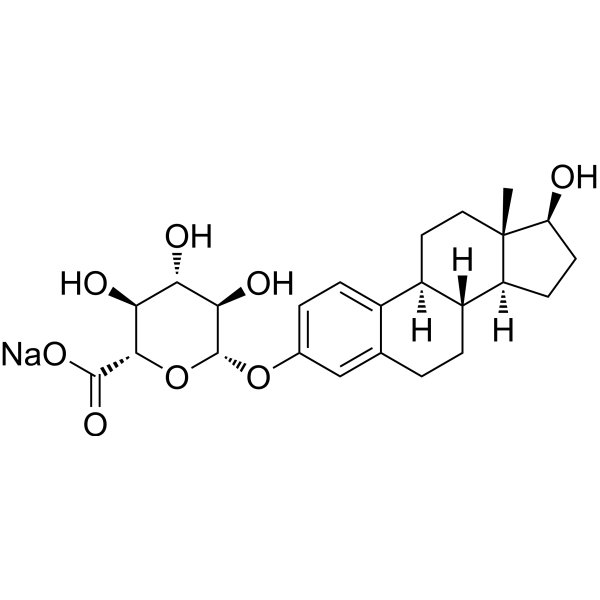
Estradiol 3-glucuronide sodium
Based on 1 publication(s) in Google Scholar
Estradiol 3-glucuronide sodium is an estrogen metabolite, which is a glucuronide conjugate formed by the catalysis of uridine diphosphate glucuronosyltransferase in tissues such as the liver from Estradiol (HY-B0141). Estradiol 3-glucuronide sodium is a potent substrate of Mrp2, with an S50 of 55.7 μM. Estradiol 3-glucuronide sodium achieves hepatobiliary transport in hepatocytes through basolateral uptake via OATP1B1, OATP1B3 and OATP2B1, as well as apical efflux via MRP2 and BCRP.
For research use only. We do not sell to patients.
- Purity: 98%
- CAS No.: 14982-12-8
- Formula: C24H31NaO8
- Molecular Weight:470.49
-
Storage:Powder -20°C, 3 years ; In solvent -80°C, 6 months , -20°C, 1 month

To place orders, for customer services and technical support, please contact: MedChemExpress USA
Tel: 609-228-6898 E-mail: [email protected] [email protected]


-
 Biological Activity
-
Chemical Information
- Purity & Documentation
- References
-
 Help & FAQs




Publications Citing Use of MedChemExpress (MCE) Estradiol 3-glucuronide sodium
MoreAll Endogenous Metabolite Isoforms
More

Biological Activity
Description
In Vitro
Estradiol 3-glucuronide (1-5 μM; 2 minutes) sodium is a substrate for OATP1B1, OATP1B3, and OATP2B1 in transfected HEK293T cells, with OATP2B1 exhibiting the highest transport efficiency (Vmax/Km = 33.2) and acting as the primary transporter at low concentrations[2].
Estradiol 3-glucuronide (5 μM; 2 minutes) sodium uptake by OATP1B1, OATP1B3, and OATP2B1 in transfected HEK293T cells is differentially inhibited by known OATP substrates/inhibitors, with estrone-3-sulfate showing the strongest inhibitory effect on OATP1B1-mediated uptake (IC50 = 0.05 μM)[2].
Estradiol 3-glucuronide (50 μM; 2 minutes) sodium weakly to moderately inhibits OATP1B3-, OATP2B1-mediated estrone-3-sulfate uptake and OATP1B1-, OATP1B3-, OATP2B1-mediated Rosuvastatin (HY-17504A) uptake in transfected HEK293T cells[2].
Estradiol 3-glucuronide (30-110 nM; up to 20 min) sodium is a substrate of rat Mrp2 expressed in Sf9 cell membrane vesicles, with an S50 of 55.7 μM and slight negative cooperativity in transport[1].
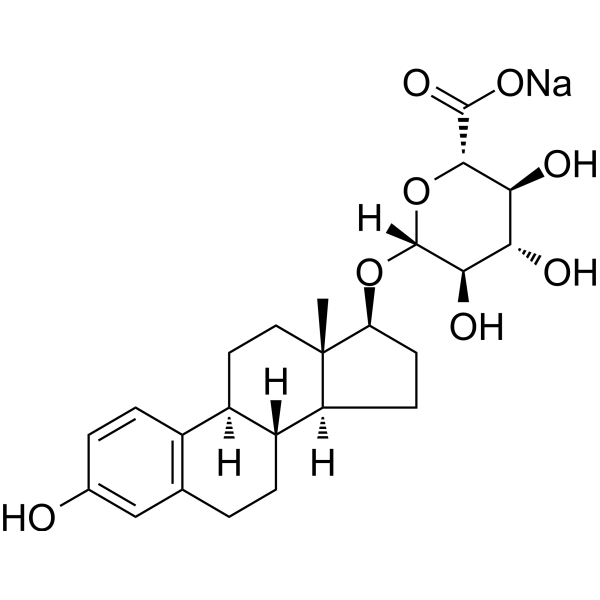
Estradiol 3-glucuronide (0.4-400 μM) sodium competitively and completely inhibits rat Mrp2-mediated transport of Estradiol 17-glucuronide in Sf9 cell membrane vesicles with an IC50 of 14.2 μM[1].
MedChemExpress (MCE) has not independently confirmed the accuracy of these methods. They are for reference only.
In Vivo
MedChemExpress (MCE) has not independently confirmed the accuracy of these methods. They are for reference only.


Chemical Information
-
CAS No. 14982-12-8
-
Appearance Solid
-
Molecular Weight 470.49
-
Formula C24H31NaO8
-
Color White to off-white
-
SMILES
C[C@@]12[C@](CC[C@@H]2O)([H])[C@@]3([H])[C@@](CC1)([H])C4=CC=C(O[C@@H]5O[C@@H]([C@H]([C@@H]([C@H]5O)O)O)C(O[Na])=O)C=C4CC3
-
Shipping
Room temperature in continental US; may vary elsewhere.
-
Storage
Powder -20°C 3 years In solvent -80°C 6 months -20°C 1 month


Publications (1)
-
Journal Impact Factor
-
Most Recent


Purity & Documentation
-
Data Sheet (273 KB)
-
SDS (393 KB)
- English - EN (393 KB)
- Français - FR (393 KB)
- Deutsch - DE (393 KB)
- Norwegian - NO (393 KB)
- Español - ES (393 KB)
- Swedish - SV (393 KB)
- Italian - IT (393 KB)
- Korean - KR (393 KB)
- Portuguese - PT (393 KB)
-
Handling Instructions (2659 KB)
References
[1]. Gerk PM, et al. Estradiol 3-glucuronide is transported by the multidrug resistance-associated protein 2 but does not activate the allosteric site bound by estradiol 17-glucuronide. Drug Metab Dispos. 2004;32(10):1139-1145. [Content Brief]
[2].
Li L, et al. Hepatic uptake of estradiol-3-glucuronide and estradiol-3-sulfate-17β-glucuronide by human organic anion transporting polypeptides 1B1, 1B3, and 2B1. Drug Metab Dispos. 2025 Sep;53(9):100132.
[Content Brief]
[3].
Nambara T, et al. A direct radioimmunoassay of estradiol 3-glucuronide using specific antiserum. Chem Pharm Bull (Tokyo). 1983 Oct;31(10):3583-8.
[Content Brief]

Calculators
Concentration (start) × Volume (start) = Concentration (final) × Volume (final)


Estradiol 3-glucuronide sodium Related Classifications
HY-N7755 Related Classifications
 Powered by Bioz