



FAZ-3780
Based on 3 publication(s) in Google Scholar
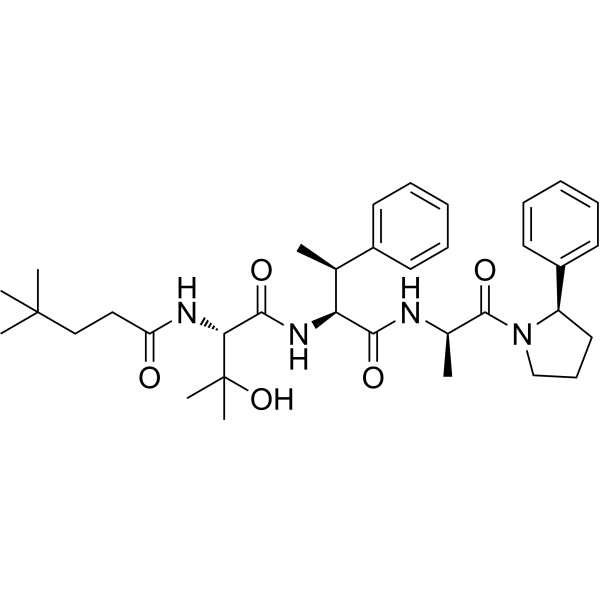
FAZ-3780 is an inhibitor that binds to the NTF2L domain of G3BP1/2. FAZ-3780 binds to the NTF2L nsP3 of G3BP1 with high affinity, with a Kd of 0.15 μM and a Pep-FRET IC50 of 0.7 μM. FAZ-3780 targets the protein-protein interaction domain of G3BP1/2, and specifically inhibits the co-condensation of G3BP1, caprin 1 and RNA in vitro. FAZ-3780 inhibits stress granule formation and disassembles pre-formed stress granules. FAZ-3780 can be used in studies related to cancer and neurodegenerative diseases.
연구목적의 판매만을 진행합니다. 환자를 대상으로 한 판매는 하지 않습니다.
- Purity : 99.68%
- CAS No.: 3036029-78-1
- 화학식: C35H50N4O5
- 분자량:606.80
-
보관:
-20°C, sealed storage, away from moisture
* In solvent : -80°C, 6 months; -20°C, 1 month (sealed storage, away from moisture)

To place orders, for customer services and technical support, please contact: MedChemExpress USA
Tel: 609-228-6898 E-mail: [email protected] [email protected]


-
 Biological Activity
-
Chemical Information
-
용액&용해도
- Protocol
- 순도&문서
- References
-
 Help & FAQs


Publications Citing Use of MedChemExpress (MCE) FAZ-3780
MoreAll DNA/RNA Synthesis Isoforms
More

Biological Activity
제품 설명
In Vitro
FAZ-3780 (G3Ib) (5-50 μM; 2 h) dose-dependently disrupts the interactions between G3BP1 and endogenous caprin 1 as well as USP10 in U2OS cell lysates[1].
FAZ-3780 (25-50 μM; 2 h) disrupts the interaction between the isolated NTF2L domain of G3BP1 and endogenous caprin 1 and USP10 in HEK293T cell lysates[1].
FAZ-3780 (0.001-100 μM; 70 min) potently inhibits the in vitro co-condensation of human G3BP1, caprin 1 and RNA, with an IC50 of 3.450 μM[1].
FAZ-3780 (5-50 μM; 50 min) inhibits sodium arsenite-induced stress granule formation in U2OS/HeLa G3BP1-GFP cells, rapidly disassembles stress granules, and prevents the localization of TDP-43 to stress granules[1].
FAZ-3780 (5-50 μM; 24 h) exhibits sustained and potent inhibitory activity against sodium arsenite-induced stress granule formation in U2OS cells[1].
FAZ-3780 (50 μM; 50 min) inhibits heat shock-induced stress granule formation in U2OS G3BP1-GFP cells and rapidly disassembles pre-formed heat shock-induced stress granules in cells[1].
MedChemExpress (MCE) has not independently confirmed the accuracy of these methods. They are for reference only.
-
Cell Line:U2OS cells stably expressing G3BP1-GFP
-
Concentration:5, 20, 50 μM
-
Incubation Time:2 h
-
Result:Resulted in a dose-dependent reduction of
the interaction between G3BP1 and both endogenous caprin
1 and endogenous USP10.
-
Cell Line:HEK293T cells expressing GFP-NTF2L
-
Concentration:25, 50 μM
-
Incubation Time:2 h
-
Result:Disrupted the interaction of the isolated NTF2L domain of G3BP1 with endogenous caprin 1 and USP10.
-
Cell Line:U2OS/Hela G3BP1-GFP cells
-
Concentration:5, 20, 50 μM
-
Incubation Time:50 min
-
Result:Inhibited sodium arsenite-induced G3BP1-GFP signal.
Inhibited heat shock-induced G3BP1-GFP signal.
Rapidly disassembled preformed sodium arsenite-induced G3BP1-GFP signal.
Rapidly disassembled preformed heat shock-induced G3BP1-GFP signal.


Chemical Information
-
CAS No. 3036029-78-1
-
Appearance Solid
-
분자량 606.80
-
화학식 C35H50N4O5
-
Color White to off-white
-
SMILES
O=C(N[C@H](C)C(N1CCC[C@@H]1C2=CC=CC=C2)=O)[C@@H](NC([C@H](C(C)(C)O)NC(CCC(C)(C)C)=O)=O)[C@@H](C)C3=CC=CC=C3
-
선적
Room temperature in continental US; may vary elsewhere.
-
보관
-20°C, sealed storage, away from moisture
* In solvent : -80°C, 6 months; -20°C, 1 month (sealed storage, away from moisture)


Publications (3)
-
Journal Impact Factor
-
Most Recent
-
Nat Cell Biol
2026 Jun;28(6):1204-1218. PMID: 42174134 -
EMBO J
2024 Dec;43(24):6410-6443. PMID: 39533058 -
bioRxiv
Processing bodies promote lysosomal quality control and cell survival during recovery from lysosomal damage. [Abstract]2025 Aug 30:2025.08.27.672666. PMID: 40909692


용액&용해도
In Vitro:
DMSO : 50 mg/mL (82.40 mM; Need ultrasonic; Hygroscopic DMSO has a significant impact on the solubility of product, please use newly opened DMSO)
Please refer to the solubility information to select the appropriate solvent. Once prepared, please aliquot and store the solution to prevent product inactivation from repeated freeze-thaw cycles.
Storage method and period of stock solution: -80°C, 6 months; -20°C, 1 month (sealed storage, away from moisture). When stored at -80°C, please use it within 6 months. When stored at -20°C, please use it within 1 month.
Please refer to the solubility information to select the appropriate solvent. Once prepared, please aliquot and store the solution to prevent product inactivation from repeated freeze-thaw cycles.
Storage method and period of stock solution: -80°C, 6 months; -20°C, 1 month (sealed storage, away from moisture). When stored at -80°C, please use it within 6 months. When stored at -20°C, please use it within 1 month.
Concentration (start) × Volume (start) = Concentration (final) × Volume (final)


순도&문서
-
Data Sheet (277 KB)
-
SDS (252 KB)
- English - EN (252 KB)
- Français - FR (252 KB)
- Deutsch - DE (252 KB)
- Norwegian - NO (252 KB)
- Español - ES (252 KB)
- Swedish - SV (252 KB)
- Italian - IT (252 KB)
- Korean - KR (252 KB)
- Portuguese - PT (252 KB)
-
Handling Instructions (2659 KB)
References


Complete Stock Solution Preparation Table
Please refer to the solubility information to select the appropriate solvent. Once prepared, please aliquot and store the solution to prevent product inactivation from repeated freeze-thaw cycles.
Storage method and period of stock solution: -80°C, 6 months; -20°C, 1 month (sealed storage, away from moisture). When stored at -80°C, please use it within 6 months. When stored at -20°C, please use it within 1 month.
| Optional Solvent | Concentration Solvent Mass | 1 mg | 5 mg | 10 mg | 25 mg |
|---|---|---|---|---|---|
| DMSO | 1 mM | 1.6480 mL | 8.2399 mL | 16.4799 mL | 41.1997 mL |
| 5 mM | 0.3296 mL | 1.6480 mL | 3.2960 mL | 8.2399 mL | |
| 10 mM | 0.1648 mL | 0.8240 mL | 1.6480 mL | 4.1200 mL | |
| 15 mM | 0.1099 mL | 0.5493 mL | 1.0987 mL | 2.7466 mL | |
| 20 mM | 0.0824 mL | 0.4120 mL | 0.8240 mL | 2.0600 mL | |
| 25 mM | 0.0659 mL | 0.3296 mL | 0.6592 mL | 1.6480 mL | |
| 30 mM | 0.0549 mL | 0.2747 mL | 0.5493 mL | 1.3733 mL | |
| 40 mM | 0.0412 mL | 0.2060 mL | 0.4120 mL | 1.0300 mL | |
| 50 mM | 0.0330 mL | 0.1648 mL | 0.3296 mL | 0.8240 mL | |
| 60 mM | 0.0275 mL | 0.1373 mL | 0.2747 mL | 0.6867 mL | |
| 80 mM | 0.0206 mL | 0.1030 mL | 0.2060 mL | 0.5150 mL |


FAZ-3780 Related Classifications
HY-162289 Related Classifications
 Powered by Bioz