



GW 848687X
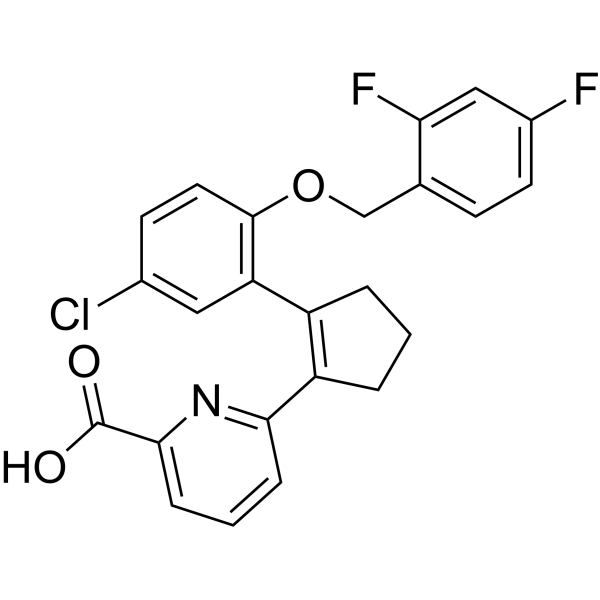
GW 848687X is a selective, orally active prostaglandin EP1 receptor antagonist for the inhibition of inflammatory pain. The oral bioavailability of GW 848687X was 54% in rats and 53% in dogs. GW 848687X has a half-life of 2 hours and has inhibitory potential for both acute and chronic pain.
For research use only. We do not sell to patients.
- CAS No.: 612831-24-0
- Formula: C24H18ClF2NO3
- Molecular Weight:441.85
-
Storage:
Please store the product under the recommended conditions in the Certificate of Analysis.

To place orders, for customer services and technical support, please contact: MedChemExpress USA
Tel: 609-228-6898 E-mail: [email protected] [email protected]


-
 Biological Activity
-
Chemical Information
- Protocols
- Purity & Documentation
- References
-
 Help & FAQs




Biological Activity
Description
In Vivo
MedChemExpress (MCE) has not independently confirmed the accuracy of these methods. They are for reference only.
-
Animal Model:FCA induced joint pain model of inflammatory pain[1]
-
Dosage:30mg/kg
-
Administration:po; twice daily for 5 days
-
Result:Completely reversed pain sensation in rats and had anti-pain effects.


Chemical Information
-
CAS No. 612831-24-0
-
Molecular Weight 441.85
-
Formula C24H18ClF2NO3
-
SMILES
O=C(C1=CC=CC(C2=C(CCC2)C3=C(OCC4=CC=C(C=C4F)F)C=CC(Cl)=C3)=N1)O
-
Shipping
Room temperature in continental US; may vary elsewhere.
-
Storage
Please store the product under the recommended conditions in the Certificate of Analysis.

Protocols
-
Protocol for Pharmacokinetic Study
Pharmacokinetic studies quantify how an organism handles a drug over time through absorption, distribution, metabolism, and excretion, and the core experimental readout is the concentration-time profile of parent drug and, when relevant, metabolites in biological matrices such as plasma, whole blood, urine, bile, or tissue. Pharmacokinetic analysis links dose, route, exposure, clearance, half-life, distribution, bioavailability, and systemic exposure to drug efficacy and toxicity hypotheses rather than measuring a signaling pathway directly. The literature links pharmacokinetics to drug-development phenotypes by showing that drug metabolism and pharmacokinetics influence compound progression, exposure-response interpretation, safety margins, dosing strategy, and failure risk during discovery and development. DMPK science contributes to compound optimization by integrating physicochemical properties, in vitro metabolism, transporter behavior, in vivo exposure, and pharmacodynamic contex
-
Formalin-Induced Paw Inflammation/Nociceptive Inflammation
The formalin-induced paw inflammation/nociceptive test is a chemical persistent pain model in rodents in which subcutaneous injection of formalin into the hind paw produces spontaneous nocifensive behaviors such as flinching and licking. The response is classically biphasic, consisting of an early acute phase (Phase I) reflecting direct activation of peripheral nociceptors (particularly C-fiber afferents), followed by a later prolonged phase (Phase II) associated with central sensitization in the spinal dorsal horn driven by sustained afferent input and inflammatory signaling. This model is widely used to evaluate analgesic and anti-inflammatory interventions because it captures both peripheral nociception and central sensitization processes within a single assay system.


Purity & Documentation
References
[1]. Giblin GM, et al. The discovery of 6-[2-(5-chloro-2-{[(2,4-difluorophenyl)methyl]oxy}phenyl)-1-cyclopenten-1-yl]-2-pyridinecarboxylic acid, GW848687X, a potent and selective prostaglandin EP1 receptor antagonist for the treatment of inflammatory pain. Bioorg Med Chem Lett. 2007 Jan 15;17(2):385-9. [Content Brief]

Calculators
Concentration (start) × Volume (start) = Concentration (final) × Volume (final)


GW 848687X Related Classifications
HY-14466 Related Classifications
 Powered by Bioz