



Helenalin
Based on 6 publication(s) in Google Scholar
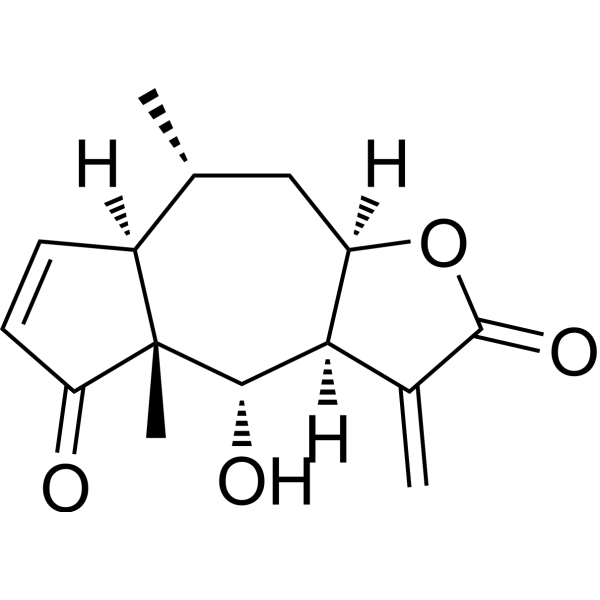
Helenalin is an anti-inflammatory sesquiterpene lactone. Helenalin selectively inhibits transcription factor NF-κB by directly targeting p65. Helenalin has alkylating activity, targets the cysteine sulfhydryl groups in the p65 subunit of NF-κB, thereby inhibits its DNA binding.
For research use only. We do not sell to patients.
- Purity : 99.90%
- CAS No.: 6754-13-8
- Formula: C15H18O4
- Molecular Weight:262.30
-
Storage:Powder -20°C, 3 years , 4°C, 2 years ; In solvent -80°C, 6 months , -20°C, 1 month

To place orders, for customer services and technical support, please contact: MedChemExpress USA
Tel: 609-228-6898 E-mail: [email protected] [email protected]


-
 Biological Activity
-
Chemical Information
-
Solvent & Solubility
- Protocols
- Purity & Documentation
- References
-
 Help & FAQs



Publications Citing Use of MedChemExpress (MCE) Helenalin
More

Biological Activity
Description
Cellular Effect
|
Cell Line

|
Type | Value | Description | References |
|---|---|---|---|---|
| A-431 | IC50 |
0.8 μM
Compound: helenalin
|
Cytotoxicity against human A431 cells after 72 hrs by [3H]thymidine incorporation assay
Cytotoxicity against human A431 cells after 72 hrs by [3H]thymidine incorporation assay
|
[PMID: 10425121] |
| A-431 | IC50 |
0.9 μM
Compound: helenalin
|
Cytotoxicity against human A431 cells after 24 hrs by [3H]thymidine incorporation assay
Cytotoxicity against human A431 cells after 24 hrs by [3H]thymidine incorporation assay
|
[PMID: 10425121] |
| A-431 | IC50 |
0.9 μM
Compound: helenalin
|
Cytotoxicity against human A431 cells after 48 hrs by [3H]thymidine incorporation assay
Cytotoxicity against human A431 cells after 48 hrs by [3H]thymidine incorporation assay
|
[PMID: 10425121] |
| HCT-15 | IC50 |
0.29 μM
Compound: Helenalin
|
Cytotoxicity against human HCT15 cells assessed as growth inhibition after 48 hrs by SRB assay
Cytotoxicity against human HCT15 cells assessed as growth inhibition after 48 hrs by SRB assay
|
[PMID: 22574648] |
| HeLa | EC50 |
0.7 μM
Compound: Helenalin
|
Cytotoxicity against human HeLa cells by MTT assay
Cytotoxicity against human HeLa cells by MTT assay
|
[PMID: 28958621] |
| HEp-2 | ED50 |
0.08 μg/mL
Compound: 1
|
Cytotoxicity against human Hep2 cells assessed as growth inhibition by microtiter method
Cytotoxicity against human Hep2 cells assessed as growth inhibition by microtiter method
|
[PMID: 671468] |
| HEp-2 | ED50 |
0.08 μg/mL
Compound: 1
|
Cytotoxicity against human Hep2 cells assessed a growth inhibition by rapid microtiter technique
Cytotoxicity against human Hep2 cells assessed a growth inhibition by rapid microtiter technique
|
[PMID: 691008] |
| HEp-2 | ED50 |
0.083 μg/mL
Compound: 2
|
Antiproliferative activity against human Hep2 cells
Antiproliferative activity against human Hep2 cells
|
10.1039/C2MD20172K |
| HEp-2 | ED50 |
0.083 μg/mL
Compound: Helenalin
|
Cytotoxicity against human Hep2 cells assessed as growth inhibition
Cytotoxicity against human Hep2 cells assessed as growth inhibition
|
10.1039/C0MD00241K |
| HEp-2 | ED50 |
0.1 μg/mL
Compound: 1
|
Cytotoxicity against human Hep2 cells
Cytotoxicity against human Hep2 cells
|
[PMID: 845864] |
| HEp-2 | IC50 |
0.8 μM
Compound: helenalin
|
Cytotoxicity against human HEP2 cells after 72 hrs by [3H]thymidine incorporation assay
Cytotoxicity against human HEP2 cells after 72 hrs by [3H]thymidine incorporation assay
|
[PMID: 10425121] |
| HEp-2 | IC50 |
0.9 μM
Compound: helenalin
|
Cytotoxicity against human HEP2 cells after 24 hrs by [3H]thymidine incorporation assay
Cytotoxicity against human HEP2 cells after 24 hrs by [3H]thymidine incorporation assay
|
[PMID: 10425121] |
| HEp-2 | IC50 |
0.9 μM
Compound: helenalin
|
Cytotoxicity against human HEP2 cells after 48 hrs by [3H]thymidine incorporation assay
Cytotoxicity against human HEP2 cells after 48 hrs by [3H]thymidine incorporation assay
|
[PMID: 10425121] |
| HepG2 | ED50 |
0.08 μg/mL
Compound: 5
|
Cytotoxicity against human HepG2 cells
Cytotoxicity against human HepG2 cells
|
[PMID: 20187635] |
| HL-60 | IC50 |
0.32 μM
Compound: helenalin
|
Cytotoxicity against human HL-60 cells after 5 hrs by MTT assay
Cytotoxicity against human HL-60 cells after 5 hrs by MTT assay
|
[PMID: 10425121] |
| HL-60 | IC50 |
0.7 μM
Compound: helenalin
|
Cytotoxicity against human HL60 after 20 hrs by WST1 assay
Cytotoxicity against human HL60 after 20 hrs by WST1 assay
|
[PMID: 16499337] |
| HL-60 | IC50 |
4 μM
Compound: Helenalin
|
Inhibition of telomerase in human HL60 cells by TRAP assay
Inhibition of telomerase in human HL60 cells by TRAP assay
|
10.1039/C0MD00241K |
| Jurkat | IC50 |
0.03 μg/mL
Compound: Helenalin
|
Cytotoxicity against human Jurkat T cells
Cytotoxicity against human Jurkat T cells
|
[PMID: 15104480] |
| Jurkat | IC50 |
0.46 μM
Compound: helenalin
|
Cytotoxicity against human Jurkat T cells after 20 hrs by WST1 assay
Cytotoxicity against human Jurkat T cells after 20 hrs by WST1 assay
|
[PMID: 16499337] |
| Jurkat | IC50 |
4 μM
Compound: Helenalin
|
Inhibition of telomerase in human Jurkat cells by TRAP assay
Inhibition of telomerase in human Jurkat cells by TRAP assay
|
10.1039/C0MD00241K |
| K562 | IC50 |
0.28 μM
Compound: Helenalin
|
Cytotoxicity against human K562 cells assessed as growth inhibition after 48 hrs by SRB assay
Cytotoxicity against human K562 cells assessed as growth inhibition after 48 hrs by SRB assay
|
[PMID: 22574648] |
| KB | ED50 |
0.2 μg/mL
Compound: 15, Helenalin
|
Cytotoxicity against human KB cells
Cytotoxicity against human KB cells
|
[PMID: 17336532] |
| KB | ED50 |
0.76 μM
Compound: Helenalin
|
Cytotoxicity against human KB cells
Cytotoxicity against human KB cells
|
[PMID: 18329753] |
| MCF7 | IC50 |
0.5 μM
Compound: helenalin
|
Cytotoxicity against human MCF7 cells after 48 hrs by [3H]thymidine incorporation assay
Cytotoxicity against human MCF7 cells after 48 hrs by [3H]thymidine incorporation assay
|
[PMID: 10425121] |
| MCF7 | IC50 |
0.7 μM
Compound: helenalin
|
Cytotoxicity against human MCF7 cells after 72 hrs by [3H]thymidine incorporation assay
Cytotoxicity against human MCF7 cells after 72 hrs by [3H]thymidine incorporation assay
|
[PMID: 10425121] |
| MCF7 | IC50 |
0.8 μM
Compound: helenalin
|
Cytotoxicity against human MCF7 cells after 24 hrs by [3H]thymidine incorporation assay
Cytotoxicity against human MCF7 cells after 24 hrs by [3H]thymidine incorporation assay
|
[PMID: 10425121] |
| OVCAR-3 | IC50 |
1.4 μM
Compound: helenalin
|
Cytotoxicity against human OVCAR-3 cells after 24 hrs by [3H]thymidine incorporation assay
Cytotoxicity against human OVCAR-3 cells after 24 hrs by [3H]thymidine incorporation assay
|
[PMID: 10425121] |
| OVCAR-3 | IC50 |
1.6 μM
Compound: helenalin
|
Cytotoxicity against human OVCAR-3 cells after 48 hrs by [3H]thymidine incorporation assay
Cytotoxicity against human OVCAR-3 cells after 48 hrs by [3H]thymidine incorporation assay
|
[PMID: 10425121] |
| OVCAR-3 | IC50 |
1.7 μM
Compound: helenalin
|
Cytotoxicity against human OVCAR-3 cells after 72 hrs by [3H]thymidine incorporation assay
Cytotoxicity against human OVCAR-3 cells after 72 hrs by [3H]thymidine incorporation assay
|
[PMID: 10425121] |
| Platelet | IC50 |
4.28 μM
Compound: 44
|
Inhibition of serotonin release in bovine platelets
Inhibition of serotonin release in bovine platelets
|
[PMID: 18271521] |
| SK-LU-1 | IC50 |
0.21 μM
Compound: Helenalin
|
Cytotoxicity against human SKLU1 cells assessed as growth inhibition after 48 hrs by SRB assay
Cytotoxicity against human SKLU1 cells assessed as growth inhibition after 48 hrs by SRB assay
|
[PMID: 22574648] |
| SK-MEL-28 | IC50 |
0.5 μM
Compound: helenalin
|
Cytotoxicity against human SK MEL28 cells after 72 hrs by [3H]thymidine incorporation assay
Cytotoxicity against human SK MEL28 cells after 72 hrs by [3H]thymidine incorporation assay
|
[PMID: 10425121] |
| SK-MEL-28 | IC50 |
0.9 μM
Compound: helenalin
|
Cytotoxicity against human SK MEL28 cells after 48 hrs by [3H]thymidine incorporation assay
Cytotoxicity against human SK MEL28 cells after 48 hrs by [3H]thymidine incorporation assay
|
[PMID: 10425121] |
| SK-MEL-28 | IC50 |
1.3 μM
Compound: helenalin
|
Cytotoxicity against human SK MEL28 cells after 24 hrs by [3H]thymidine incorporation assay
Cytotoxicity against human SK MEL28 cells after 24 hrs by [3H]thymidine incorporation assay
|
[PMID: 10425121] |
| SW872 | IC50 |
1.2 μM
Compound: helenalin
|
Cytotoxicity against human SW872 cells after 48 hrs by [3H]thymidine incorporation assay
Cytotoxicity against human SW872 cells after 48 hrs by [3H]thymidine incorporation assay
|
[PMID: 10425121] |
| SW872 | IC50 |
1.2 μM
Compound: helenalin
|
Cytotoxicity against human SW872 cells after 72 hrs by [3H]thymidine incorporation assay
Cytotoxicity against human SW872 cells after 72 hrs by [3H]thymidine incorporation assay
|
[PMID: 10425121] |
| SW872 | IC50 |
1.4 μM
Compound: helenalin
|
Cytotoxicity against human SW872 cells after 24 hrs by [3H]thymidine incorporation assay
Cytotoxicity against human SW872 cells after 24 hrs by [3H]thymidine incorporation assay
|
[PMID: 10425121] |
| ZR-75-1 | IC50 |
0.7 μM
Compound: helenalin
|
Cytotoxicity against human ZR-75-1 cells after 24 hrs by [3H]thymidine incorporation assay
Cytotoxicity against human ZR-75-1 cells after 24 hrs by [3H]thymidine incorporation assay
|
[PMID: 10425121] |
| ZR-75-1 | IC50 |
0.8 μM
Compound: helenalin
|
Cytotoxicity against human ZR-75-1 cells after 48 hrs by [3H]thymidine incorporation assay
Cytotoxicity against human ZR-75-1 cells after 48 hrs by [3H]thymidine incorporation assay
|
[PMID: 10425121] |
| ZR-75-1 | IC50 |
1.1 μM
Compound: helenalin
|
Cytotoxicity against human ZR-75-1 cells after 72 hrs by [3H]thymidine incorporation assay
Cytotoxicity against human ZR-75-1 cells after 72 hrs by [3H]thymidine incorporation assay
|
[PMID: 10425121] |
In Vitro
Helenalin (10 μM; 20-120 minutes) causes complete inhibition of NF-κB DNA binding after 80 minutes[1].
?
The anti-inflammatory, anti-carcinogenic phytochemical, Helenalin is a potent inhibitor of periodic Skp2 accumulation, an F-box protein mediating SCF E3 ligase ubiquitylation and degradation of both CKIs during S phase progression[3].
MedChemExpress (MCE) has not independently confirmed the accuracy of these methods. They are for reference only. Further protocols information, click here.
-
Cell Line:Jurkat T cells
-
Concentration:10 μM
-
Incubation Time:20-120 minutes
-
Result:Caused complete inhibition of NF-κB DNA binding after 80 minutes.
In Vivo
MedChemExpress (MCE) has not independently confirmed the accuracy of these methods. They are for reference only.
-
Animal Model:Immature male ICR mice[2]
-
Dosage:25 mg/kg
-
Administration:i.p.; 6 to 12 hours
-
Result:Caused a rapid decrease in hepatic glutathione levels.


Chemical Information
-
CAS No. 6754-13-8
-
Appearance Solid
-
Molecular Weight 262.30
-
Formula C15H18O4
-
Color White to light yellow
-
SMILES
O[C@H]1[C@]2([H])C(C(O[C@@]2(C[C@H]([C@@]([H])([C@]13C)C=CC3=O)C)[H])=O)=C
-
Structure Classification
-
Initial Source
-
Shipping
Room temperature in continental US; may vary elsewhere.
-
Storage
Powder -20°C 3 years 4°C 2 years In solvent -80°C 6 months -20°C 1 month


Publications (6)
-
Journal Impact Factor
-
Most Recent
-
Nat Aging
Activation of AMPK by GLP-1R agonists mitigates Alzheimer-related phenotypes in transgenic mice. [Abstract]2025 Jun;5(6):1097-1113. PMID: 40394225 -
Front Immunol
2022 Feb 4;13:835986. PMID: 35185928 -
J Autoimmun
2022 May;129:102828. PMID: 35429914 -
Mucosal Immunol
LECs regulate neutrophil clearance through IL-17RC/CMTM4/NF-κB axis at sites of inflammation or infection. [Abstract]2024 Aug;17(4):723-738. PMID: 38754839 -
Exp Ther Med
2021 Nov;22(5):1222. PMID: 34603519 -
Can J Physiol Pharmacol
Trimethylamine N-oxide promotes hyperlipidemia acute pancreatitis via inflammatory response. [Abstract]2022 Jan;100(1):61-67. PMID: 34793682


Solvent & Solubility
In Vitro:
DMSO : 100 mg/mL (381.24 mM; Need ultrasonic; Hygroscopic DMSO has a significant impact on the solubility of product, please use newly opened DMSO)
Please refer to the solubility information to select the appropriate solvent. Once prepared, please aliquot and store the solution to prevent product inactivation from repeated freeze-thaw cycles.
Storage method and period of stock solution: -80°C, 6 months; -20°C, 1 month. When stored at -80°C, please use it within 6 months. When stored at -20°C, please use it within 1 month.
Please refer to the solubility information to select the appropriate solvent. Once prepared, please aliquot and store the solution to prevent product inactivation from repeated freeze-thaw cycles.
Storage method and period of stock solution: -80°C, 6 months; -20°C, 1 month. When stored at -80°C, please use it within 6 months. When stored at -20°C, please use it within 1 month.
Concentration (start) × Volume (start) = Concentration (final) × Volume (final)

Protocols
-
Nuclear Protein Extraction (High-Salt/Hypotonic Fractionation)
The high-salt/hypotonic fractionation method for nuclear protein extraction is based on the differential solubility of cellular components. Cytoplasmic proteins are extracted first using a hypotonic buffer that causes cell swelling and membrane rupture, followed by centrifugation to separate the cytoplasmic supernatant from the nuclear pellet. The nuclear pellet is then subjected to high-salt extraction (e. g. , 0. 4 M (NH4)2SO4 or 1 M NaCl) to solubilize tightly bound nuclear matrix proteins, including transcription factors, histones, and structural proteins associated with chromatin and the nuclear scaffold. This approach allows for the isolation of both soluble cytoplasmic proteins and salt-resistant nuclear proteins while minimizing cross-contamination.
-
Protocol for Electrophoretic Mobility Shift Assay (EMSA)
Electrophoretic mobility shift assay detects protein-nucleic acid binding by incubating a labeled DNA or RNA probe with purified protein or cell extract, then separating free probe from slower-migrating protein-probe complexes on a native gel. For cancer cells, primary neurons, mouse tumor samples, intestinal organoids, inflammatory macrophages, or drug-treated samples, EMSA can measure transcription-factor DNA binding or RNA-binding protein activity in extracts, but it does not directly measure transcription, protein expression, or chromatin occupancy in intact cells. Specificity is judged by competition with unlabeled wild-type probe, failure of mutated or unrelated competitors to compete, and antibody supershift or disruption when the binding protein identity must be confirmed.
-
Research Protocol for Inflammation-related Diseases
The NLRP3 inflammasome is a cytosolic innate immune signaling platform that integrates priming signals and danger-signal activation to promote caspase-1 activation, maturation of IL-1β and IL-18, and gasdermin D-mediated pyroptotic cell death. The core experimental logic is to determine whether inflammatory disease phenotypes are driven by increased NLRP3 expression, ASC-containing inflammasome assembly, caspase-1 cleavage, GSDMD cleavage, and extracellular release of IL-1β/IL-18 rather than by nonspecific cell injury alone. The pathway is strongly linked to inflammation-related disease phenotypes because monosodium urate crystals activate NALP3/NLRP3 inflammasome signaling in gout-like crystal inflammation, cholesterol crystals activate NLRP3 inflammasomes in atherogenesis models, and DSS-induced intestinal inflammation has been reported to involve NLRP3 inflammasome activity. However, experimental colitis studies also show context-dependent protective effects of NLRP3 inflammasome co


Purity & Documentation
-
Data Sheet (283 KB)
-
SDS (479 KB)
- English - EN (479 KB)
- Français - FR (479 KB)
- Deutsch - DE (479 KB)
- Norwegian - NO (479 KB)
- Español - ES (479 KB)
- Swedish - SV (479 KB)
- Italian - IT (479 KB)
- Korean - KR (479 KB)
- Portuguese - PT (479 KB)
-
Handling Instructions (2659 KB)
References
[1]. Merrill JC, et al. Role of glutathione in the toxicity of the sesquiterpene lactones hymenoxon and helenalin. J Toxicol Environ Health. 1988;23(2):159-69. [Content Brief]
[2]. Lyss G, et al. The anti-inflammatory sesquiterpene lactone helenalin inhibits the transcription factor NF-kappaB by directly targeting p65. J Biol Chem. 1998 Dec 11;273(50):33508-16. [Content Brief]
[3]. Fernandes KM, et al. Helenalin-mediated post-transcriptional regulation of p21(Cip1) inhibits 3T3-L1 preadipocyteproliferation. J Cell Biochem. 2008 Oct 15;105(3):913-21. [Content Brief]


Complete Stock Solution Preparation Table
Please refer to the solubility information to select the appropriate solvent. Once prepared, please aliquot and store the solution to prevent product inactivation from repeated freeze-thaw cycles.
Storage method and period of stock solution: -80°C, 6 months; -20°C, 1 month. When stored at -80°C, please use it within 6 months. When stored at -20°C, please use it within 1 month.
| Optional Solvent | Concentration Solvent Mass | 1 mg | 5 mg | 10 mg | 25 mg |
|---|---|---|---|---|---|
| DMSO | 1 mM | 3.8124 mL | 19.0621 mL | 38.1243 mL | 95.3107 mL |
| 5 mM | 0.7625 mL | 3.8124 mL | 7.6249 mL | 19.0621 mL | |
| 10 mM | 0.3812 mL | 1.9062 mL | 3.8124 mL | 9.5311 mL | |
| 15 mM | 0.2542 mL | 1.2708 mL | 2.5416 mL | 6.3540 mL | |
| 20 mM | 0.1906 mL | 0.9531 mL | 1.9062 mL | 4.7655 mL | |
| 25 mM | 0.1525 mL | 0.7625 mL | 1.5250 mL | 3.8124 mL | |
| 30 mM | 0.1271 mL | 0.6354 mL | 1.2708 mL | 3.1770 mL | |
| 40 mM | 0.0953 mL | 0.4766 mL | 0.9531 mL | 2.3828 mL | |
| 50 mM | 0.0762 mL | 0.3812 mL | 0.7625 mL | 1.9062 mL | |
| 60 mM | 0.0635 mL | 0.3177 mL | 0.6354 mL | 1.5885 mL | |
| 80 mM | 0.0477 mL | 0.2383 mL | 0.4766 mL | 1.1914 mL | |
| 100 mM | 0.0381 mL | 0.1906 mL | 0.3812 mL | 0.9531 mL |


Helenalin Related Classifications
HY-119970 Related Classifications
 Powered by Bioz