



NF-κB1/p50
NF-κB1/p50 is generated from the NFKB1 product through 26S proteasome-dependent cotranslational processing and forms DNA-binding NF-κB dimers, including the prototypical p50:RelA/p65 complex[1][2]. Mechanistically, p50 supports inflammatory-response control because p50 homodimers activate IL-10 transcription in macrophages and p50-deficient macrophages show decreased IL-10 with increased TNF and IL-12 after LPS stimulation[3]. In chronic liver injury models, loss of nfkb1 causes more severe neutrophilic inflammation and fibrosis, linking p50 to restraint of TNF-α-driven tissue damage[4]. Compared with RelA/p65, RelB, and c-Rel, p50 lacks a transactivation domain, so p50:p50 complexes often function through cofactors rather than direct transcriptional activation[2]. In activated hepatic stellate cells, the p50:p50:HDAC1 complex represses Ccl2, Cxcl10, Gm-csf, and Mmp-13, defining a disease-relevant anti-inflammatory NF-κB1/p50 mechanism[5]. For experimental applications, BCL-3-p50 biology provides a modifiable axis because a BCL-3-mimetic peptide was designed from the ANK1 region that interacts with p50[6].
References:
- [1]. Lin L, et al. Cotranslational biogenesis of NF-kappaB p50 by the 26S proteasome. Cell. 1998 Mar 20;92(6):819-28. [Content Brief]
- [2]. Pereira SG, et al. Nuclear factor-kappaB1: regulation and function. Int J Biochem Cell Biol. 2008;40(8):1425-30. [Content Brief]
- [3]. Cao S, et al. NF-kappaB1 (p50) homodimers differentially regulate pro- and anti-inflammatory cytokines in macrophages. J Biol Chem. 2006 Sep 8;281(36):26041-50. [Content Brief]
- [4]. Rabezanahary H, et al. Live virus neutralizing antibodies against pre and post Omicron strains in food and retail workers in Québec, Canada. Heliyon. 2024 May 21;10(10):e31026. [Content Brief]
- [5]. Elsharkawy AM, et al. The NF-kappaB p50:p50:HDAC-1 repressor complex orchestrates transcriptional inhibition of multiple pro-inflammatory genes. J Hepatol. 2010 Sep;53(3):519-27. [Content Brief]
- [6]. Collins PE, et al. Mapping the Interaction of B Cell Leukemia 3 (BCL-3) and Nuclear Factor κB (NF-κB) p50 Identifies a BCL-3-mimetic Anti-inflammatory Peptide. J Biol Chem. 2015 Jun 19;290(25):15687-15696. [Content Brief]
-
NF-κB1/p50 Related Products (8)
Related Products (8)

-
Antibodies (1)
-
Fibrinogen (Bovine)
 0 ImagesFibrinogen (Bovine) is a selective proteolytic molecule that can be activated by thrombin to assemble fibrin clots. Fibrinogen can regulate the activation of NF-KB in endothelial cells and upregulate the expression of inflammatory chemokines MCP-1 and MCP-1. Fibrinogen plays a key role in blood clotting, thrombosis, atherosclerosis and the pathological development of venous grafts, and can be used in the study of blood clotting and vascular diseases.

-
Tectochrysin
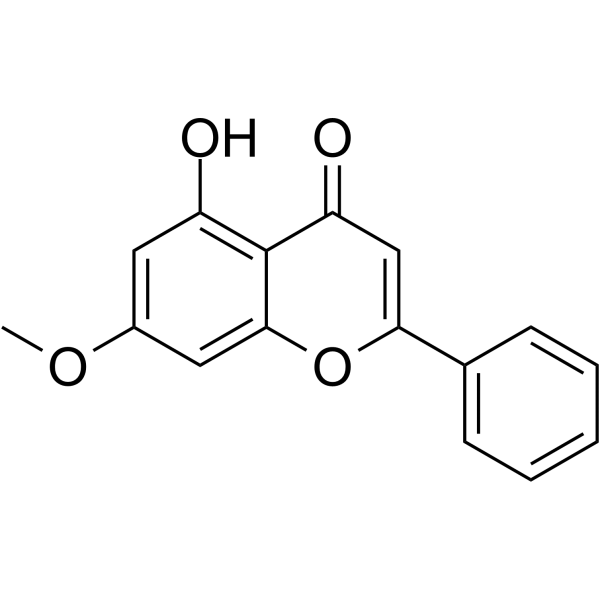 0 ImagesTectochrysin (Techtochrysin) is one of the major flavonoids of Alpinia oxyphylla Miquel. Tectochrysin inhibits activity of NF-κB.
-
DPLG3
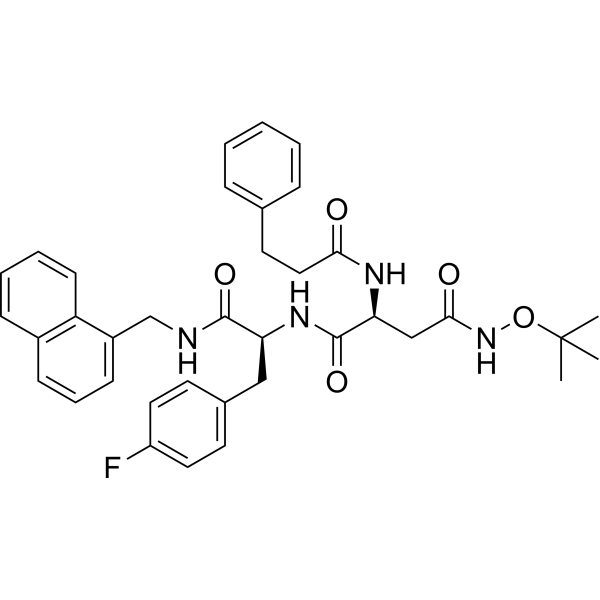 0 ImagesDPLG3 is a specific chymotryptic-like β5i subunits inhibitor, with an IC50 of 4.5 nM. DPLG3 inhibits mouse i-20S with IC50 of 9.4 nM. DPLG3 downregulates the protein levels of NF-κB p50 and p65. DPLG3 can be used for immune disease research.
-
Lucidone
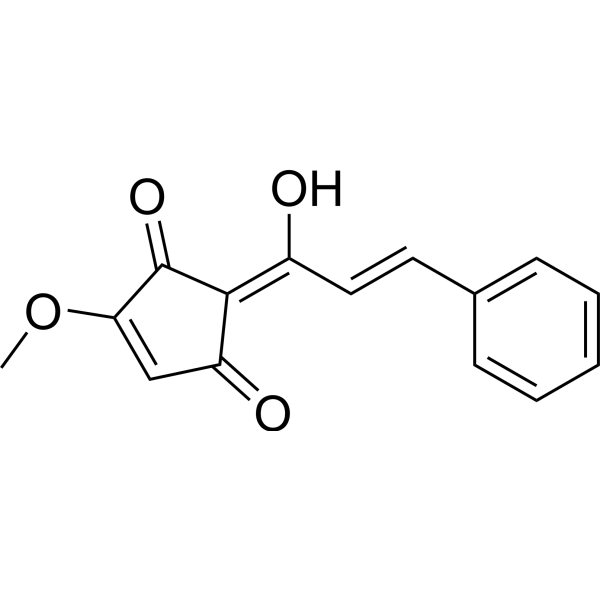 0 ImagesLucidone, an anti-inflammatory agent that can be isolated from the fruit of Lindera erythrocarpa Makino. Lucidone inhibits LPS-induced NO and PGE2 production in RAW 264.7 mouse macrophages. Lucidone also decreases TNF-α secretion, iNOS and COX-2 expression. Lucidone prevents NF-κB translocation and inhibits JNK and p38MAPK signals. Lucidone also has inhibitory activity against Dengue virus (DENV) (EC50=25 μM).
-
Dth
 0 ImagesCat. No.: HY-175397Synonyms: DFHBI-thalidomideDth (DFHBI-thalidomide) is an RNA aptamer-based PROTAC degrader. Dth can degrade a variety of endogenous proteins (such as mCherry, p50, p65 and E2F1) by replacing the 3′ module on the RNA scaffold with the RNA aptamer corresponding to the target protein. Dth upregulates IκB-α and Bax, and downregulates Bcl-2 and VEGF. Dth generates green fluorescence upon binding to the Broccoli RNA aptamer, enabling the tracing of RNA scaffolds. Dth can be used in cancer-related research.




