



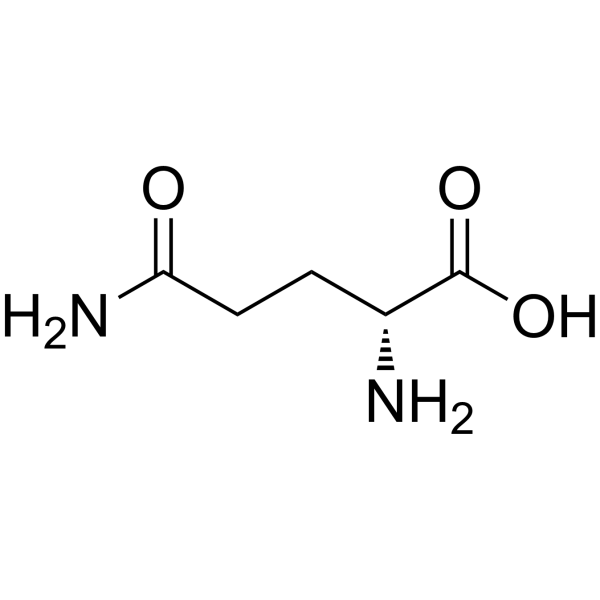
D-グルタミン
Based on 3 publication(s) in Google Scholar
D-Glutamine is a cell-permeable D type stereoisomer of Glutamine.
商品は「研究用試薬」です。人や動物の医療用・臨床診断用・食品用の製品ではありません。
研究用途以外に使用した場合、当社は一切の責任を負いかねます。
- 純度: 98.0%
- CAS 番号: 5959-95-5
- 分子式: C5H10N2O3
- 分子量:146.14
-
保管条件:Powder -20°C, 3 years , 4°C, 2 years ; In solvent -80°C, 2 years , -20°C, 1 year

To place orders, for customer services and technical support, please contact: MedChemExpress USA
Tel: 609-228-6898 E-mail: [email protected] [email protected]


-
 生物活性
生物活性
-
化学情報
-
溶剤 & 溶解度
- プロトコル
- 純度とドキュメンテーション
- 参考文献
-
 Help & FAQs
-


MCE Bioactive Compound Library
HY-L001V
-
Natural Product Library Plus
HY-L021P
-
Bioactive Compound Library
HY-L001
-
Miao Ethnicity Medicine Compound Library
HY-L190
-
Tibetan Medicine Compound Library
HY-L191
-
Non-Alcoholic Fatty Liver Disease (NAFLD) Compound Library
HY-L199
-
RO5 Drug-like Natural Product Library
HY-L200
-
High-Throughput Bioactive Compound Library
HY-L205
-
High-Throughput Natural Product Library
HY-L206
-
Mass Spectrometry Human Endogenous Metabolite Library
HY-L207
-
Ancient Chinese Classical Formulas Traditional Chinese Medicine Active Compound Library
HY-L209
-
Mass Spectrometry Human Metabolite Library
HY-L215
-
Mouse Metabolite Compound Library
HY-L217
-
Diarrhea-Related Traditional Chinese Medicine Active Compound Library
HY-L224
-
Amino Acid Metabolite Compound Library
HY-L227
-
Mongolian Medicine Compound Library
HY-L238
-
Chinese Baijiu Compound Library
HY-L241
-
Natural Product Diversity Scaffold Library
HY-L245
-
Tonifying Traditional Chinese Medicine Monomer Compound Library
HY-L246
-
Mass Spectrometry Natural Product Library
HY-L262
-
Natural Product and Natural Product-Like Compound Library
HY-L021M
-
Metabolism/Protease Compound Library
HY-L012
-
Natural Product Library
HY-L021
-
Autophagy Compound Library
HY-L029
-
Human Endogenous Metabolite Compound Library
HY-L030
-
Anti-Aging Compound Library
HY-L034
-
Ferroptosis Compound Library
HY-L051
-
Medicine Food Homology Compound Library
HY-L055
-
Traditional Chinese Medicine Active Compound Library
HY-L065
-
Microbial Metabolite Library
HY-L084
-
Mitochondria-Targeted Compound Library
HY-L089
-
Food-Sourced Compound Library
HY-L094
-
Human Metabolite Library
HY-L123
-
Mitochondrial Protection Compound Library
HY-L144
-
Animal-Sourced Natural Product Library
HY-L157
-
Cell Death Library
HY-L162
-
Mitophagy Compound Library
HY-L180
-
Bioactive Compound Library Max
HY-L181


MedChemExpress(MCE)の使用を引用している文献 D-Glutamine
MoreEndogenous Metabolite アイソフォーム固有の製品をすべて表示
More

生物活性
|
Human Endogenous Metabolite |
Glutamine is a key amino acid in the central nervous system (CNS), playing an important role in the glutamate/GABA-Glutamine cycle (GGC). In the GGC,Glutamine is transferred from astrocytes to neurons, where it will replenish the inhibitory and excitatory neurotransmitter pools[1].
D-Glutamine has been used to study its role in conferring protection against acetaldehyde-induced disruption of barrier function in Caco-2 cell monolayer. Role of L-Glutamine in the protection of intestinal epithelium from acetaldehyde-induced disruption of barrier function is evaluated in Caco-2 cell monolayer. L-Glutamine reduced the acetaldehyde-induced decrease in transepithelilal electrical resistance and increase in permeability to inulin and lipopolysaccharide in a time- and dose-dependent manner; D-Glutamine, L-aspargine, L-arginine, L-lysine, or L-alanine produced no significant protection. D-Glutamine also fails to influence the acetaldehyde-induced decrease in TER and increase in inulin flux. D-Glutamine or glutaminase inhibitor by themselves did not influence TER or inulin flux in control or acetaldehyde-treated cell monolayers. Lack of effect of D-Glutamine in protection from acetaldehyde indicates that the L-Glutamine-mediated protection is stereospecific[2].
MedChemExpress (MCE) has not independently confirmed the accuracy of these methods. They are for reference only.


化学情報
-
CAS 番号 5959-95-5
-
性状 Solid
-
分子量 146.14
-
分子式 C5H10N2O3
-
Color White to off-white
-
SMILES
N[C@H](CCC(N)=O)C(O)=O
-
別名
D-Glutamine
-
Structure Classification
-
Initial Source
-
輸送条件
Room temperature in continental US; may vary elsewhere.
-
保管条件
Powder -20°C 3 years 4°C 2 years In solvent -80°C 2 years -20°C 1 year


Publications (3)
-
Journal Impact Factor
-
Most Recent
-
Microbiome
Species-specific enhancement of enterohemorrhagic E. coli pathogenesis mediated by microbiome metabolites. [Abstract]2019 Mar 20;7(1):43. PMID: 30890187 -
J Assist Reprod Genet
LSD1-ESM1 regulates extravillous trophoblast function through metabolic reprogramming in recurrent spontaneous abortion. [Abstract]2026 May;43(5):1531-1547. PMID: 41984276 -


溶剤 & 溶解度
H2O : 20 mg/mL (136.86 mM; ultrasonic and adjust pH to 2 with HCl)
DMSO : 4 mg/mL (27.37 mM; ultrasonic and warming and adjust pH to 5 with HCl and heat to 60°C; Hygroscopic DMSO has a significant impact on the solubility of product, please use newly opened DMSO)
Please refer to the solubility information to select the appropriate solvent. Once prepared, please aliquot and store the solution to prevent product inactivation from repeated freeze-thaw cycles.
Storage method and period of stock solution: -80°C, 2 years; -20°C, 1 year. When stored at -80°C, please use it within 2 years. When stored at -20°C, please use it within 1 year.
* Note: If you choose water as the stock solution, please dilute it to the working solution, then filter and sterilize it with a 0.22 μm filter before use.
Please refer to the solubility information to select the appropriate solvent. Once prepared, please aliquot and store the solution to prevent product inactivation from repeated freeze-thaw cycles.
Storage method and period of stock solution: -80°C, 2 years; -20°C, 1 year. When stored at -80°C, please use it within 2 years. When stored at -20°C, please use it within 1 year.
* Note: If you choose water as the stock solution, please dilute it to the working solution, then filter and sterilize it with a 0.22 μm filter before use.
濃度 (開始) × 体積 (開始) = 濃度 (終了) × 体積 (終了)
For the following dissolution methods, please prepare the working solution directly:
It is recommended to prepare fresh solutions and use them promptly within a short period of time.
The percentages shown for the solvents indicate their volumetric ratio in the final prepared solution. If precipitation or phase separation occurs during preparation, heat and/or sonication can be used to aid dissolution.
Add each solvent one by one: PBS
Solubility: 12.5 mg/mL (85.53 mM); Clear solution; Need ultrasonic and warming and heat to 60°C

プロトコル
Effect of D-Glutamine and glutaminase inhibitor on acetaldehyde-induced permeability. Caco-2 cell monolayers are incubated for 4 h without or with acetaldehyde (600 μM) and L-Glutamine or D-Glutamine (2 mM) in the absence or presence of 6-diazo-5-oxo-L-norleucine (DON). Transepithelial electrical resistance (TER) and FITC-inulin flux are measured. Values are means±SE (n=6)[2].
MedChemExpress (MCE) has not independently confirmed the accuracy of these methods. They are for reference only.


純度とドキュメンテーション
-
データシート (272 KB)
-
SDS (393 KB)
- English - EN (393 KB)
- Français - FR (393 KB)
- Deutsch - DE (393 KB)
- Norwegian - NO (393 KB)
- Español - ES (393 KB)
- Swedish - SV (393 KB)
- Italian - IT (393 KB)
- Korean - KR (393 KB)
- Portuguese - PT (393 KB)
-
取扱説明書 (2659 KB)
参考文献
[1]. Leke R, et al. The Glutamine Transporters and Their Role in the Glutamate/GABA-Glutamine Cycle. Adv Neurobiol. 2016;13:223-257. [Content Brief]
[2]. Seth A, et al. L-Glutamine ameliorates acetaldehyde-induced increase in paracellular permeability in Caco-2 cellmonolayer. Am J Physiol Gastrointest Liver Physiol. 2004 Sep;287(3):G510-7. [Content Brief]


Complete Stock Solution Preparation Table
Please refer to the solubility information to select the appropriate solvent. Once prepared, please aliquot and store the solution to prevent product inactivation from repeated freeze-thaw cycles.
Storage method and period of stock solution: -80°C, 2 years; -20°C, 1 year. When stored at -80°C, please use it within 2 years. When stored at -20°C, please use it within 1 year.
| Optional Solvent | Concentration Solvent Mass | 1 mg | 5 mg | 10 mg | 25 mg |
|---|---|---|---|---|---|
| DMSO / H2O | 1 mM | 6.8428 mL | 34.2138 mL | 68.4275 mL | 171.0688 mL |
| 5 mM | 1.3686 mL | 6.8428 mL | 13.6855 mL | 34.2138 mL | |
| 10 mM | 0.6843 mL | 3.4214 mL | 6.8428 mL | 17.1069 mL | |
| 15 mM | 0.4562 mL | 2.2809 mL | 4.5618 mL | 11.4046 mL | |
| 20 mM | 0.3421 mL | 1.7107 mL | 3.4214 mL | 8.5534 mL | |
| 25 mM | 0.2737 mL | 1.3686 mL | 2.7371 mL | 6.8428 mL | |
| H2O | 30 mM | 0.2281 mL | 1.1405 mL | 2.2809 mL | 5.7023 mL |
| 40 mM | 0.1711 mL | 0.8553 mL | 1.7107 mL | 4.2767 mL | |
| 50 mM | 0.1369 mL | 0.6843 mL | 1.3686 mL | 3.4214 mL | |
| 60 mM | 0.1140 mL | 0.5702 mL | 1.1405 mL | 2.8511 mL | |
| 80 mM | 0.0855 mL | 0.4277 mL | 0.8553 mL | 2.1384 mL | |
| 100 mM | 0.0684 mL | 0.3421 mL | 0.6843 mL | 1.7107 mL |
* Note: If you choose water as the stock solution, please dilute it to the working solution, then filter and sterilize it with a 0.22 μm filter before use.


D-Glutamine 関連分類
HY-100587 関連分類
 Powered by Bioz