



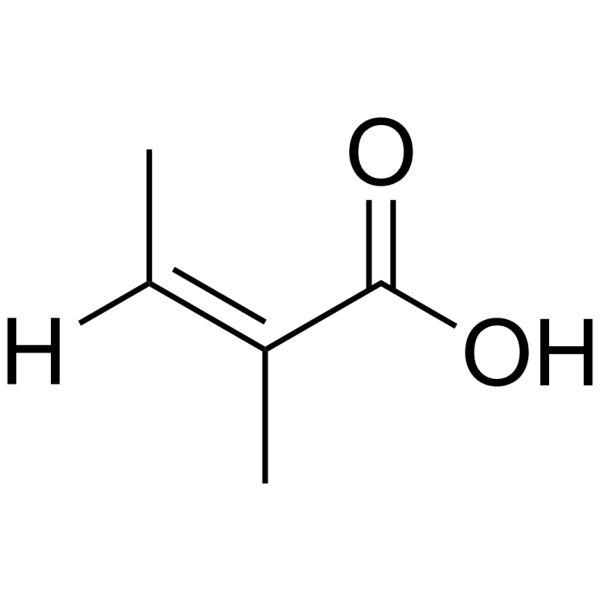
Angelic acid
Based on 1 publication(s) in Google Scholar
Angelic acid is a ferroptosis inducer, targeting NRF2 degradation. Angelic acid binds to NRF2 protein and promotes NRF2 degradation via ubiquitination-proteasome pathway, relieves the inhibitory effect of NRF2 on oxidative stress and lipid peroxidation. Then, Angelic acid induces ferroptosis in tumor cells. Angelic acid can enhance the accumulation of intracellular reactive oxygen species (ROS), upregulate ferroptosis-related markers CHAC1 and PTGS2, and synergize with ferroptosis inducers to enhance anti-tumor effects. Angelic acid also has the activity of scavenging UVA-induced ROS in vitro, inhibiting skin fibroblast senescence and extracellular matrix degradation. Angelic Acid helps wound healing with sedative activity.
For research use only. We do not sell to patients.
- Purity: 99.20%
- CAS No.: 565-63-9
- Formula: C5H8O2
- Molecular Weight:100.12
-
Storage:Powder -20°C, 3 years , 4°C, 2 years ; In solvent -80°C, 2 years , -20°C, 1 year

To place orders, for customer services and technical support, please contact: MedChemExpress USA
Tel: 609-228-6898 E-mail: [email protected] [email protected]


-
 Biological Activity
-
Chemical Information
-
Solvent & Solubility
- Purity & Documentation
- References
-
 Help & FAQs



Publications Citing Use of MedChemExpress (MCE) Angelic acid
More

Biological Activity
Angelic acid (200 μM; 24 h) synergistically inhibits the cell viability and cell proliferation of DLD1 and SW480 colorectal cancer cells with RSL3 (2 μM)[1].
Angelic acid (200 μM; 24 h) upregulates the mRNA expression of ferroptosis-related genes CHAC1 and PTGS2 in DLD1 cells, reduces the protein level of NRF2, and increases K48 ubiquitination modification[1].
Angelic acid (5-15 μM; 6 h pretreatment + UVA irradiation) significantly reduces the level of intracellular reactive oxygen species induced by UVA in the ROS detection experiment of normal human dermal fibroblasts (NHDFs), restores the GSH content, and upregulates the gene expression of antioxidant enzymes such as GPx1, SOD1/2, and CAT[2].
MedChemExpress (MCE) has not independently confirmed the accuracy of these methods. They are for reference only.
MedChemExpress (MCE) has not independently confirmed the accuracy of these methods. They are for reference only.
-
Animal Model:Male Balb/c mice with CT26 colorectal cancer subcutaneous xenograft model[1]
-
Dosage:8 mg/kg with or without Sulfasalazine 10 mg/kg
-
Administration:Intraperitoneal injection, every 2 days, for a total 20 days
-
Result:Combination treatment significantly retarded tumor growth compared to single-agent therapy (tumor volume inhibition rate: Combination group > Angelic acid group > Sulfasalazine group).
No significant changes in body weight were observed across groups, and H&E staining of major organs (heart, liver, spleen, lung, kidney) showed no pathological abnormalities, indicating no severe systemic toxicity.
Tumor tissues from the combination group exhibited enhanced lipid peroxidation and reduced NRF2 expression compared to controls.


Chemical Information
-
CAS No. 565-63-9
-
Appearance Solid
-
Molecular Weight 100.12
-
Formula C5H8O2
-
Color White to off-white
-
SMILES
C/C=C(C)\C(O)=O
-
Structure Classification
-
Initial Source
-
Shipping
Room temperature in continental US; may vary elsewhere.
-
Storage
Powder -20°C 3 years 4°C 2 years In solvent -80°C 2 years -20°C 1 year


Publications (1)
-
Journal Impact Factor
-
Most Recent


Solvent & Solubility
DMSO : 200 mg/mL (1997.60 mM; Need ultrasonic; Hygroscopic DMSO has a significant impact on the solubility of product, please use newly opened DMSO)
Please refer to the solubility information to select the appropriate solvent. Once prepared, please aliquot and store the solution to prevent product inactivation from repeated freeze-thaw cycles.
Storage method and period of stock solution: -80°C, 2 years; -20°C, 1 year. When stored at -80°C, please use it within 2 years. When stored at -20°C, please use it within 1 year.
Please refer to the solubility information to select the appropriate solvent. Once prepared, please aliquot and store the solution to prevent product inactivation from repeated freeze-thaw cycles.
Storage method and period of stock solution: -80°C, 2 years; -20°C, 1 year. When stored at -80°C, please use it within 2 years. When stored at -20°C, please use it within 1 year.
Concentration (start) × Volume (start) = Concentration (final) × Volume (final)
Select the appropriate dissolution method based on your experimental animal and administration route.
- For the following dissolution methods, please ensure to first prepare a clear stock solution using an In Vitro approach and then sequentially add co-solvents:
- To ensure reliable experimental results, the clarified stock solution can be appropriately stored based on storage conditions. As for the working solution for In Vivo experiments, it is recommended to prepare freshly and use it on the same day.
- The percentages shown for the solvents indicate their volumetric ratio in the final prepared solution. If precipitation or phase separation occurs during preparation, heat and/or sonication can be used to aid dissolution.
Add each solvent one by one: 10% DMSO 40% PEG300 5% Tween-80 45% Saline
Solubility: ≥ 5 mg/mL (49.94 mM); Clear solution
This protocol yields a clear solution of ≥ 5 mg/mL (saturation unknown).
Taking 1 mL working solution as an example, add 100 μL DMSO stock solution (50.0 mg/mL) to 400 μL PEG300, and mix evenly; then add 50 μL Tween-80 and mix evenly; then add 450 μL Saline to adjust the volume to 1 mL.
Preparation of Saline: Dissolve 0.9 g sodium chloride in ddH₂O and dilute to 100 mL to obtain a clear Saline solution.
Add each solvent one by one: 10% DMSO 90% (20% SBE-β-CD in Saline)
Solubility: ≥ 5 mg/mL (49.94 mM); Clear solution
This protocol yields a clear solution of ≥ 5 mg/mL (saturation unknown).
Taking 1 mL working solution as an example, add 100 μL DMSO stock solution (50.0 mg/mL) to 900 μL 20% SBE-β-CD in Saline, and mix evenly.
Preparation of 20% SBE-β-CD in Saline (4°C, storage for one week): 2 g SBE-β-CD powder is dissolved in 10 mL Saline, completely dissolve until clear.
Please enter the basic information of animal experiments:
-
-
-
-
Recommended: Prepare an additional quantity of animals to account for potential losses during experiments.
Please enter your animal formula composition:
-
%DMSO +
Recommended: Keep the proportion of DMSO in working solution below 2% if your animal is weak.
-
%+
-
+%Tween-80 + +
-
%Saline +
The co-solvents required include: DMSO, . All of co-solvents are available by MedChemExpress (MCE). , Tween 80. All of co-solvents are available by MedChemExpress (MCE).
Working solution concentration: 0.22 mg/mL
Method for preparing stock solution: mg drug dissolved in μL DMSO. Stock solution concentration: mg/mL.
1. Take μL DMSO stock solution;
2. Add μL .
μL , mix evenly;
3. Then add μL Tween 80, mix evenly;
4. Then add μL
Please ensure that the stock solution in the first step is dissolved to a clear state, and add co-solvents in sequence. You can use ultrasonic heating (ultrasonic cleaner, recommended frequency 20-40 kHz), vortexing, etc. to assist dissolution.


Purity & Documentation
-
Data Sheet (273 KB)
-
SDS (476 KB)
- English - EN (476 KB)
- Français - FR (476 KB)
- Deutsch - DE (476 KB)
- Norwegian - NO (476 KB)
- Español - ES (476 KB)
- Swedish - SV (476 KB)
- Italian - IT (476 KB)
- Korean - KR (476 KB)
- Portuguese - PT (476 KB)
-
Handling Instructions (2659 KB)
References


Complete Stock Solution Preparation Table
Please refer to the solubility information to select the appropriate solvent. Once prepared, please aliquot and store the solution to prevent product inactivation from repeated freeze-thaw cycles.
Storage method and period of stock solution: -80°C, 2 years; -20°C, 1 year. When stored at -80°C, please use it within 2 years. When stored at -20°C, please use it within 1 year.
| Optional Solvent | Concentration Solvent Mass | 1 mg | 5 mg | 10 mg | 25 mg |
|---|---|---|---|---|---|
| DMSO | 1 mM | 9.9880 mL | 49.9401 mL | 99.8801 mL | 249.7004 mL |
| 5 mM | 1.9976 mL | 9.9880 mL | 19.9760 mL | 49.9401 mL | |
| 10 mM | 0.9988 mL | 4.9940 mL | 9.9880 mL | 24.9700 mL | |
| 15 mM | 0.6659 mL | 3.3293 mL | 6.6587 mL | 16.6467 mL | |
| 20 mM | 0.4994 mL | 2.4970 mL | 4.9940 mL | 12.4850 mL | |
| 25 mM | 0.3995 mL | 1.9976 mL | 3.9952 mL | 9.9880 mL | |
| 30 mM | 0.3329 mL | 1.6647 mL | 3.3293 mL | 8.3233 mL | |
| 40 mM | 0.2497 mL | 1.2485 mL | 2.4970 mL | 6.2425 mL | |
| 50 mM | 0.1998 mL | 0.9988 mL | 1.9976 mL | 4.9940 mL | |
| 60 mM | 0.1665 mL | 0.8323 mL | 1.6647 mL | 4.1617 mL | |
| 80 mM | 0.1249 mL | 0.6243 mL | 1.2485 mL | 3.1213 mL | |
| 100 mM | 0.0999 mL | 0.4994 mL | 0.9988 mL | 2.4970 mL |


Angelic acid Related Classifications
HY-N6929 Related Classifications
 Powered by Bioz