



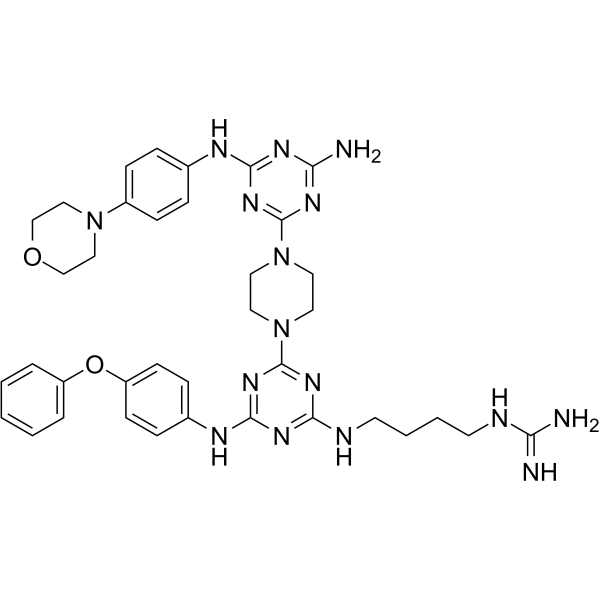
MC-1-F2

Based on 1 Customer Validation
MC-1-F2 is a FOXC2 inhibitor. MC-1-F2 shows a binding affinity (Kd) of 26 μM for full-length FOXC2. MC-1-F2 reduces epithelial-mesenchymal transition (EMT) markers in breast cancer cells, suppresses cancer stem cell (CSC) properties and reduces invasiveness in castration-resistant prostate cancer (CRPC) cells. MC-1-F2 can be used for the study of CRPC and breast cancer.
Nur für Forschungszwecke. Wir verkaufen nicht an Patienten.
- Reinheit : 99.69%
- CAS. Nr.: 2376894-10-7
- Formel: C37H46N16O2
- Molecular Weight:746.87
-
Speicherung:
4°C, stored under nitrogen
* In solvent : -80°C, 6 months; -20°C, 1 month (stored under nitrogen)

To place orders, for customer services and technical support, please contact: MedChemExpress USA
Tel: 609-228-6898 E-mail: [email protected] [email protected]


-
 Biologische Aktivität
-
Chemical Information
-
Lösungsmittel & Löslichkeit
- Protokoll
- Reinheit & Dokumentation
- Verweise
-
 Help & FAQs




Biologische Aktivität
Beschreibung
IC50 & Target
[1]|
FOXC2 26 μM (Kd) |
Cellular Effect
|
Cell Line

|
Type | Value | Description | References |
|---|---|---|---|---|
| DU-145 | EC50 |
1.75 nM
Compound: MC-1-F2
|
Synergistic antiproliferative activity against human DU-145 cells assessed as reduction in cell viability by measuring docetaxel EC50 by MTT assay
Synergistic antiproliferative activity against human DU-145 cells assessed as reduction in cell viability by measuring docetaxel EC50 by MTT assay
|
[PMID: 37290495] |
| DU-145 | EC50 |
48.14 μM
Compound: MC-1-F2
|
Antiproliferative activity against human DU-145 cells assessed as reduction in cell viability by MTT assay
Antiproliferative activity against human DU-145 cells assessed as reduction in cell viability by MTT assay
|
[PMID: 37290495] |
| PC-3 | EC50 |
1.97 nM
Compound: MC-1-F2
|
Synergistic antiproliferative activity against human PC-3 cells assessed as reduction in cell viability by measuring docetaxel EC50 by MTT assay
Synergistic antiproliferative activity against human PC-3 cells assessed as reduction in cell viability by measuring docetaxel EC50 by MTT assay
|
[PMID: 37290495] |
| PC-3 | EC50 |
53.21 μM
Compound: MC-1-F2
|
Antiproliferative activity against human PC-3 cells assessed as reduction in cell viability by MTT assay
Antiproliferative activity against human PC-3 cells assessed as reduction in cell viability by MTT assay
|
[PMID: 37290495] |
In Vitro
MC-1-F2 (20 μM, 48 h) reduces FOXC2 protein levels in CRPC cell lines DU145 and PC3, with no significant effect on FOXC2 gene expression[1].
MC-1-F2 (20 μM, 48 h) downregulates mesenchymal markers and CSC markers as well as upregulates epithelial markers in DU145 and PC3 cells[1].
MC-1-F2 (20 μM, 24 h) inhibits the invasive capabilities of DU145 and PC3 cells, with no effect on LNCaP cells (low FOXC2 expression)[1].
MC-1-F2 (0-50 μM) inhibits the viability of MDA-MB-231(IC50 = 20 μM) and BT549 cells with high FOXC2 expression, but has a weak inhibitory effect on MCF-7 cells with low FOXC2 expression[2].
MC-1-F2 (20 μM) significantly inhibits the soft-agar colony-forming ability of MDA-MB-231 cells[2].
MC-1-F2 (20 μM, 24-48 h) induces FOXC2 degradation via the 26S proteasome and reduces the nuclear localization of FOXC2 in MDA-MB-231 cells[2].
MC-1-F2 (20 μM, 24-48 h) downregulates the expression of PDGFR-β and MMP2, induces cadherin switching (upregulates E-cadherin and downregulates N-cadherin) and reduces the expression of mesenchymal markers Vimentin, Slug, and ZEB1 in MDA-MB-231 cells[2].
MC-1-F2 (20 μM, 48 h) decreases the expression of CSC markers c-Myc and KLF4 in MDA-MB-231 cells and reduces the nuclear localization of β-catenin[2].
MC-1-F2 (20 μM, 24 h) inhibits the migration and invasion abilities of MDA-MB-231 cells[2].
MedChemExpress (MCE) has not independently confirmed the accuracy of these methods. They are for reference only. Further protocols information, click here.
-
Cell Line:DU145 and PC3 cells
-
Concentration:20 μM
-
Incubation Time:48 h
-
Result:Reduced FOXC2 protein levels.
Downregulated mesenchymal markers (ZEB1, Vimentin, N-cadherin, Slug) and CSC markers (Nanog, C-myc, KLF4).
Upregulated epithelial markers (ZO-1, E-cadherin).
-
Cell Line:MDA-MB-231 cells
-
Concentration:20 μM
-
Incubation Time:24 h
-
Result:Inhibited the migration abilities of MDA-MB-231 cells.
-
Cell Line:DU145 and PC3 cells
-
Concentration:20 μM
-
Incubation Time:24 h
-
Result:Inhibited the invasion abilities of MDA-MB-231 cells.


Chemical Information
-
CAS. Nr. 2376894-10-7
-
Appearance Solid
-
Molecular Weight 746.87
-
Formel C37H46N16O2
-
Color White to off-white
-
SMILES
N=C(NCCCCNC1=NC(NC2=CC=C(C=C2)OC3=CC=CC=C3)=NC(N4CCN(CC4)C5=NC(NC6=CC=C(N7CCOCC7)C=C6)=NC(N)=N5)=N1)N
-
Versand
Room temperature in continental US; may vary elsewhere.
-
Speicherung
4°C, stored under nitrogen
* In solvent : -80°C, 6 months; -20°C, 1 month (stored under nitrogen)


Lösungsmittel & Löslichkeit
In Vitro:
DMSO : 100 mg/mL (133.89 mM; Need ultrasonic; Hygroscopic DMSO has a significant impact on the solubility of product, please use newly opened DMSO)
Please refer to the solubility information to select the appropriate solvent. Once prepared, please aliquot and store the solution to prevent product inactivation from repeated freeze-thaw cycles.
Storage method and period of stock solution: -80°C, 6 months; -20°C, 1 month (stored under nitrogen). When stored at -80°C, please use it within 6 months. When stored at -20°C, please use it within 1 month.
Please refer to the solubility information to select the appropriate solvent. Once prepared, please aliquot and store the solution to prevent product inactivation from repeated freeze-thaw cycles.
Storage method and period of stock solution: -80°C, 6 months; -20°C, 1 month (stored under nitrogen). When stored at -80°C, please use it within 6 months. When stored at -20°C, please use it within 1 month.
Konzentration (Stammlösung) × Volumen (Stammlösung) = Konzentration (Ziellösung) × Volumen (Ziellösung)
In Vivo:
Select the appropriate dissolution method based on your experimental animal and administration route.
- For the following dissolution methods, please ensure to first prepare a clear stock solution using an In Vitro approach and then sequentially add co-solvents:
- To ensure reliable experimental results, the clarified stock solution can be appropriately stored based on storage conditions. As for the working solution for In Vivo experiments, it is recommended to prepare freshly and use it on the same day.
- The percentages shown for the solvents indicate their volumetric ratio in the final prepared solution. If precipitation or phase separation occurs during preparation, heat and/or sonication can be used to aid dissolution.
Add each solvent one by one: 10% DMSO 40% PEG300 5% Tween-80 45% Saline
Solubility: ≥ 2.5 mg/mL (3.35 mM); Clear solution
This protocol yields a clear solution of ≥ 2.5 mg/mL (saturation unknown).
Taking 1 mL working solution as an example, add 100 μL DMSO stock solution (25.0 mg/mL) to 400 μL PEG300, and mix evenly; then add 50 μL Tween-80 and mix evenly; then add 450 μL Saline to adjust the volume to 1 mL.
Preparation of Saline: Dissolve 0.9 g sodium chloride in ddH₂O and dilute to 100 mL to obtain a clear Saline solution.
Add each solvent one by one: 10% DMSO 90% (20% SBE-β-CD in Saline)
Solubility: ≥ 2.5 mg/mL (3.35 mM); Clear solution
This protocol yields a clear solution of ≥ 2.5 mg/mL (saturation unknown).
Taking 1 mL working solution as an example, add 100 μL DMSO stock solution (25.0 mg/mL) to 900 μL 20% SBE-β-CD in Saline, and mix evenly.
Preparation of 20% SBE-β-CD in Saline (4°C, storage for one week): 2 g SBE-β-CD powder is dissolved in 10 mL Saline, completely dissolve until clear.
In Vivo Dissolution Calculator
Please enter the basic information of animal experiments:
-
-
-
-
Recommended: Prepare an additional quantity of animals to account for potential losses during experiments.
Please enter your animal formula composition:
-
%DMSO +
Recommended: Keep the proportion of DMSO in working solution below 2% if your animal is weak.
-
%+
-
+%Tween-80 + +
-
%Saline +
The co-solvents required include: DMSO, . All of co-solvents are available by MedChemExpress (MCE). , Tween 80. All of co-solvents are available by MedChemExpress (MCE).
Working solution concentration: 0.22 mg/mL
Method for preparing stock solution: mg drug dissolved in μL DMSO. Stock solution concentration: mg/mL. * In solvent : -80°C, 6 months; -20°C, 1 month (stored under nitrogen)
1. Take μL DMSO stock solution;
2. Add μL .
μL , mix evenly;
3. Then add μL Tween 80, mix evenly;
4. Then add μL
Please ensure that the stock solution in the first step is dissolved to a clear state, and add co-solvents in sequence. You can use ultrasonic heating (ultrasonic cleaner, recommended frequency 20-40 kHz), vortexing, etc. to assist dissolution.

Protokoll
-
Breast Cancer Modeling
Breast cancer is a heterogeneous cancer, and it has been distinguished into four subtypes: luminal A, luminal B, HER2-positive and basal-like. Molecular mutations, epigenetic alterations, hormone exposure and immune microenvironment are related to the progression of breast cancer.


Reinheit & Dokumentation
-
Data Sheet (278 KB)
-
SDS (252 KB)
- English - EN (252 KB)
- Français - FR (252 KB)
- Deutsch - DE (252 KB)
- Norwegian - NO (252 KB)
- Español - ES (252 KB)
- Swedish - SV (252 KB)
- Italian - IT (252 KB)
- Korean - KR (252 KB)
- Portuguese - PT (252 KB)
-
Handling Instructions (2659 KB)
Verweise
[1]. Castaneda M, et al. A FOXC2 inhibitor, MC-1-F2, as a therapeutic candidate for targeting EMT in castration-resistant prostate cancer. Bioorg Med Chem Lett. 2023 Jul 15;91:129369. [Content Brief]
[2]. Castaneda M, et al. A Forkhead Box Protein C2 Inhibitor: Targeting Epithelial-Mesenchymal Transition and Cancer Metastasis. Chembiochem. 2018 Jul 4;19(13):1359-1364. [Content Brief]


Complete Stock Solution Preparation Table
Please refer to the solubility information to select the appropriate solvent. Once prepared, please aliquot and store the solution to prevent product inactivation from repeated freeze-thaw cycles.
Storage method and period of stock solution: -80°C, 6 months; -20°C, 1 month (stored under nitrogen). When stored at -80°C, please use it within 6 months. When stored at -20°C, please use it within 1 month.
| Optional Solvent | Concentration Solvent Mass | 1 mg | 5 mg | 10 mg | 25 mg |
|---|---|---|---|---|---|
| DMSO | 1 mM | 1.3389 mL | 6.6946 mL | 13.3892 mL | 33.4730 mL |
| 5 mM | 0.2678 mL | 1.3389 mL | 2.6778 mL | 6.6946 mL | |
| 10 mM | 0.1339 mL | 0.6695 mL | 1.3389 mL | 3.3473 mL | |
| 15 mM | 0.0893 mL | 0.4463 mL | 0.8926 mL | 2.2315 mL | |
| 20 mM | 0.0669 mL | 0.3347 mL | 0.6695 mL | 1.6737 mL | |
| 25 mM | 0.0536 mL | 0.2678 mL | 0.5356 mL | 1.3389 mL | |
| 30 mM | 0.0446 mL | 0.2232 mL | 0.4463 mL | 1.1158 mL | |
| 40 mM | 0.0335 mL | 0.1674 mL | 0.3347 mL | 0.8368 mL | |
| 50 mM | 0.0268 mL | 0.1339 mL | 0.2678 mL | 0.6695 mL | |
| 60 mM | 0.0223 mL | 0.1116 mL | 0.2232 mL | 0.5579 mL | |
| 80 mM | 0.0167 mL | 0.0837 mL | 0.1674 mL | 0.4184 mL | |
| 100 mM | 0.0134 mL | 0.0669 mL | 0.1339 mL | 0.3347 mL |


MC-1-F2 Related Classifications
HY-149894 Related Classifications
 Powered by Bioz