



Phenethyl acetate

Based on 1 Customer Validation
Phenethyl acetate (Phenethyl alcohol, acetate) is an aryl alkyl alcohol simple acid ester found in evergreen trees and cloves. Phenethyl acetate can induce skin and eye irritation. Phenethyl acetate can be used for food and flavor use.
For research use only. We do not sell to patients.
- Purity : 99.27%
- CAS No.: 103-45-7
- Formula: C10H12O2
- Molecular Weight:164.20
-
Storage:
Store at room temperature 3 years.
In solvent -80°C, 2 years , -20°C, 1 year


To place orders, for customer services and technical support, please contact: MedChemExpress USA
Tel: 609-228-6898 E-mail: [email protected] [email protected]


-
 Biological Activity
-
Chemical Information
-
Solvent & Solubility
- Purity & Documentation
- References
-
 Help & FAQs





Biological Activity
Description
In Vitro
Phenethyl acetate is non-mutagenic in the Ames test using Salmonella typhimurium strains TA98, TA100, TA1535, TA1537, TA1538, with and without metabolic activation[1].
MedChemExpress (MCE) has not independently confirmed the accuracy of these methods. They are for reference only.
In Vivo
Phenethyl acetate (6.5-15 g/kg; topical; single dose) exhibits acute dermal toxicity in albino rabbits with an LD50 of 6.21 g/kg and causes transient mild skin irritation[1].
Phenethyl acetate (topical; single dose) causes transient slight dermal irritation in albino rabbits that resolves within 72 hours[1].
Phenethyl acetate (ocular; single dose) causes mild to moderate ocular irritation in albino rabbits, including corneal opacity, iris irritation, and conjunctivitis[1].
Phenethyl acetate (20-50 mg; inhalation; single 60-minute exposure) reduces mouse motility by 45.04% and results in a blood concentration of 5.35 ng/mL post-exposure[1].
Phenethyl acetate (1200-6000 mg/kg; i.p.; 24 doses over 20 weeks) administered intraperitoneally 24 times over 20 weeks has a no observed adverse effect level of 1200 mg/kg in female A/He mice and is not associated with increased lung tumor incidence at doses up to 6000 mg/kg[1].
Phenethyl acetate (73.8 mg/kg/day; p.o.; daily for 4 months) increases plasma cholinesterase activity in male rats with no observed changes in serum chemistry[1].
MedChemExpress (MCE) has not independently confirmed the accuracy of these methods. They are for reference only.
-
Animal Model:Rat[1]
-
Dosage:3.67 g/kg; 5 g/kg; 5.2 g/kg; 1 g/kg; 1.5 g/kg; 2.25 g/kg; 3.38 g/kg
-
Administration:p.o.; single dose
-
Result:Reported an oral LD50 of 3.67 g/kg across rats, mice, and guinea pigs.
Reported an oral LD50 greater than 5 g/kg in rats.
Reported an oral LD50 of 5.2 g/kg in rats.
Reported an oral LD50 of 2.4 g/kg in mice.
Caused 5/10 rat deaths at 5 g/kg, with piloerection and loss of righting reflex observed.
Caused 1/6 mouse deaths at 1.5 g/kg and 2.25 g/kg.
Caused all 6 mouse deaths at 3.38 g/kg.
-
Animal Model:Albino rabbit[1]
-
Dosage:10 g/kg; 15 g/kg; 6.5 g/kg
-
Administration:topical; single 24-hour occluded dose
-
Result:Reported a dermal LD50 of less than 10 g/kg in one study.
Reported a dermal LD50 of 6.21 g/kg in another study.
Caused all animal deaths within 3 days at 10 and 15 g/kg.
Caused 2/3 rabbit deaths within 30 hours and 1 death on day 5 at 6.5 g/kg.
Induced clinical signs including motor incoordination, dropped ears, dilated pupils, decreased respiratory rate, and general depression.
Caused slight erythema (no edema) immediately after patch removal, which resolved within 6 hours.
Showed no gross lesions at necropsy.
-
Animal Model:A/He (female)[1]
-
Dosage:1200 mg/kg; 6000 mg/kg
-
Administration:i.p.; 24 doses over 20 weeks
-
Result:Resulted in a survival rate of 13/20 in the 1200 mg/kg group.
Resulted in a survival rate of 17/20 in the 6000 mg/kg group.
Showed no adverse effects at 1200 mg/kg.
Caused lung tumors in 1/13 surviving animals in the 1200 mg/kg group.
Caused no lung tumors in 0/17 surviving animals in the 6000 mg/kg group.
-
Animal Model:Rat (male)[1]
-
Dosage:73.8 mg/kg/day
-
Administration:p.o.; daily for 4 months
-
Result:Caused a significant increase in plasma cholinesterase activity at 140 days compared to controls.
Showed no changes in serum chemistry parameters at 40 or 140 days.


Chemical Information
-
CAS No. 103-45-7
-
Appearance Liquid (Density: 1.0181 g/cm3)
-
Molecular Weight 164.20
-
Formula C10H12O2
-
Color Colorless to off-white
-
SMILES
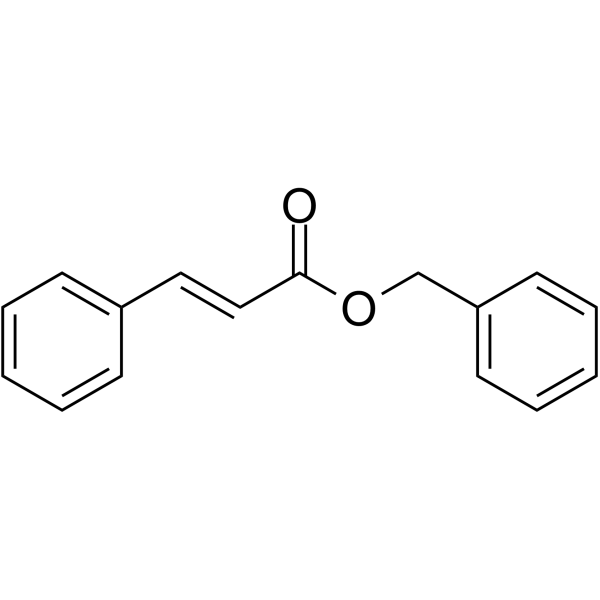
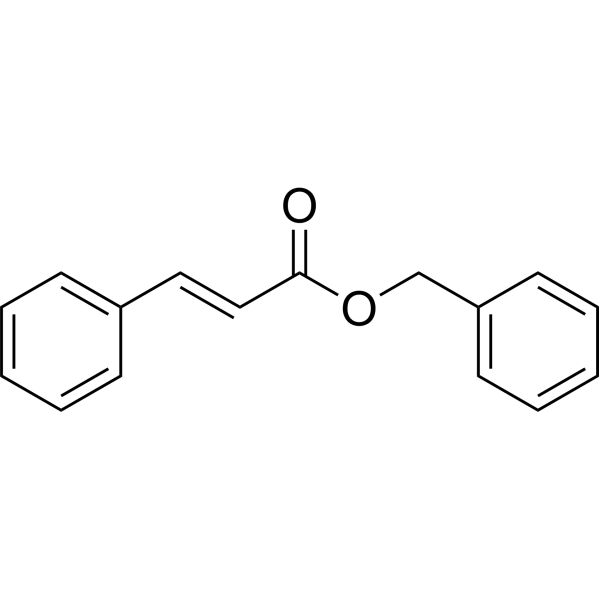
CC(=O)OCCC1=CC=CC=C1
-
Synonyms
Phenethyl alcohol, acetate
-
Initial Source
-
Shipping
Room temperature in continental US; may vary elsewhere.
-
Storage
Store at room temperature 3 years
In solvent -80°C 2 years -20°C 1 year


Solvent & Solubility
In Vitro:
DMSO : 100 mg/mL (609.01 mM; Need ultrasonic; Hygroscopic DMSO has a significant impact on the solubility of product, please use newly opened DMSO)
Please refer to the solubility information to select the appropriate solvent. Once prepared, please aliquot and store the solution to prevent product inactivation from repeated freeze-thaw cycles.
Storage method and period of stock solution: -80°C, 2 years; -20°C, 1 year. When stored at -80°C, please use it within 2 years. When stored at -20°C, please use it within 1 year.
Please refer to the solubility information to select the appropriate solvent. Once prepared, please aliquot and store the solution to prevent product inactivation from repeated freeze-thaw cycles.
Storage method and period of stock solution: -80°C, 2 years; -20°C, 1 year. When stored at -80°C, please use it within 2 years. When stored at -20°C, please use it within 1 year.
Concentration (start) × Volume (start) = Concentration (final) × Volume (final)
In Vivo:
Select the appropriate dissolution method based on your experimental animal and administration route.
- For the following dissolution methods, please ensure to first prepare a clear stock solution using an In Vitro approach and then sequentially add co-solvents:
- To ensure reliable experimental results, the clarified stock solution can be appropriately stored based on storage conditions. As for the working solution for In Vivo experiments, it is recommended to prepare freshly and use it on the same day.
- The percentages shown for the solvents indicate their volumetric ratio in the final prepared solution. If precipitation or phase separation occurs during preparation, heat and/or sonication can be used to aid dissolution.
Add each solvent one by one: 10% DMSO 40% PEG300 5% Tween-80 45% Saline
Solubility: ≥ 2.5 mg/mL (15.23 mM); Clear solution
This protocol yields a clear solution of ≥ 2.5 mg/mL (saturation unknown).
Taking 1 mL working solution as an example, add 100 μL DMSO stock solution (25.0 mg/mL) to 400 μL PEG300, and mix evenly; then add 50 μL Tween-80 and mix evenly; then add 450 μL Saline to adjust the volume to 1 mL.
Preparation of Saline: Dissolve 0.9 g sodium chloride in ddH₂O and dilute to 100 mL to obtain a clear Saline solution.
Add each solvent one by one: 10% DMSO 90% (20% SBE-β-CD in Saline)
Solubility: ≥ 2.5 mg/mL (15.23 mM); Clear solution
This protocol yields a clear solution of ≥ 2.5 mg/mL (saturation unknown).
Taking 1 mL working solution as an example, add 100 μL DMSO stock solution (25.0 mg/mL) to 900 μL 20% SBE-β-CD in Saline, and mix evenly.
Preparation of 20% SBE-β-CD in Saline (4°C, storage for one week): 2 g SBE-β-CD powder is dissolved in 10 mL Saline, completely dissolve until clear.
In Vivo Dissolution Calculator
Please enter the basic information of animal experiments:
-
-
-
-
Recommended: Prepare an additional quantity of animals to account for potential losses during experiments.
Please enter your animal formula composition:
-
%DMSO +
Recommended: Keep the proportion of DMSO in working solution below 2% if your animal is weak.
-
%+
-
+%Tween-80 + +
-
%Saline +
The co-solvents required include: DMSO, . All of co-solvents are available by MedChemExpress (MCE). , Tween 80. All of co-solvents are available by MedChemExpress (MCE).
Working solution concentration: 0.22 mg/mL
Method for preparing stock solution: mg drug dissolved in μL DMSO. Stock solution concentration: mg/mL.
1. Take μL DMSO stock solution;
2. Add μL .
μL , mix evenly;
3. Then add μL Tween 80, mix evenly;
4. Then add μL
Please ensure that the stock solution in the first step is dissolved to a clear state, and add co-solvents in sequence. You can use ultrasonic heating (ultrasonic cleaner, recommended frequency 20-40 kHz), vortexing, etc. to assist dissolution.


Purity & Documentation
-
Data Sheet (276 KB)
-
SDS (615 KB)
- English - EN (615 KB)
- Français - FR (615 KB)
- Deutsch - DE (615 KB)
- Norwegian - NO (615 KB)
- Español - ES (615 KB)
- Swedish - SV (615 KB)
- Italian - IT (615 KB)
- Korean - KR (615 KB)
- Portuguese - PT (615 KB)
-
Handling Instructions (2659 KB)
References
[1]. McGinty D, et al. Fragrance material review on phenethyl acetate. Food Chem Toxicol. 2012 Sep;50 Suppl 2:S491-7. [Content Brief]
[2]. Sekar BS, et al. Bioproduction of Natural Phenethyl Acetate, Phenylacetic Acid, Ethyl Phenylacetate, and Phenethyl Phenylacetate from Renewable Feedstock. ChemSusChem. 2022 May 6;15(9):e202102645. [Content Brief]


Complete Stock Solution Preparation Table
Please refer to the solubility information to select the appropriate solvent. Once prepared, please aliquot and store the solution to prevent product inactivation from repeated freeze-thaw cycles.
Storage method and period of stock solution: -80°C, 2 years; -20°C, 1 year. When stored at -80°C, please use it within 2 years. When stored at -20°C, please use it within 1 year.
| Optional Solvent | Concentration Solvent Mass | 1 mg | 5 mg | 10 mg | 25 mg |
|---|---|---|---|---|---|
| DMSO | 1 mM | 6.0901 mL | 30.4507 mL | 60.9013 mL | 152.2534 mL |
| 5 mM | 1.2180 mL | 6.0901 mL | 12.1803 mL | 30.4507 mL | |
| 10 mM | 0.6090 mL | 3.0451 mL | 6.0901 mL | 15.2253 mL | |
| 15 mM | 0.4060 mL | 2.0300 mL | 4.0601 mL | 10.1502 mL | |
| 20 mM | 0.3045 mL | 1.5225 mL | 3.0451 mL | 7.6127 mL | |
| 25 mM | 0.2436 mL | 1.2180 mL | 2.4361 mL | 6.0901 mL | |
| 30 mM | 0.2030 mL | 1.0150 mL | 2.0300 mL | 5.0751 mL | |
| 40 mM | 0.1523 mL | 0.7613 mL | 1.5225 mL | 3.8063 mL | |
| 50 mM | 0.1218 mL | 0.6090 mL | 1.2180 mL | 3.0451 mL | |
| 60 mM | 0.1015 mL | 0.5075 mL | 1.0150 mL | 2.5376 mL | |
| 80 mM | 0.0761 mL | 0.3806 mL | 0.7613 mL | 1.9032 mL | |
| 100 mM | 0.0609 mL | 0.3045 mL | 0.6090 mL | 1.5225 mL |


Phenethyl acetate Related Classifications
HY-W102356 Related Classifications
 Powered by Bioz