



Polyinosinic acid
Based on 2 publication(s) in Google Scholar
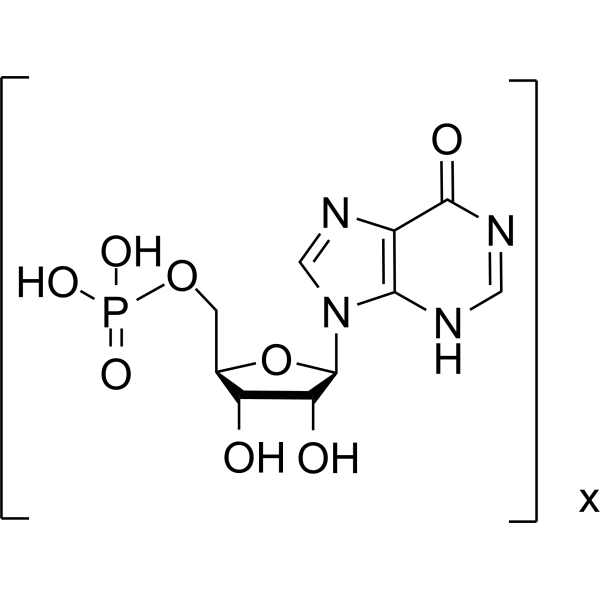
Polyinosinic acid is a single stranded homonucleic acid, which is a Toll-like Receptor 3 (TLR3) ligand. Polyinosinic acid enhances cellular immune response through TLR3 and TRIF. Polyinosinic acid has potential applications in immune regulation.
For research use only. We do not sell to patients.
- CAS No.: 30918-54-8
- Formula: (C10H13N4O8P)x
-
Storage:
Please store the product under the recommended conditions in the Certificate of Analysis.

To place orders, for customer services and technical support, please contact: MedChemExpress USA
Tel: 609-228-6898 E-mail: [email protected] [email protected]


-
 Biological Activity
-
Chemical Information
- Purity & Documentation
- References
-
 Help & FAQs


Publications Citing Use of MedChemExpress (MCE) Polyinosinic acid
More

Biological Activity
Description
In Vitro
Polyinosinic acid (50 µg/mL, 24 h) induces the expression of CD86, CD40 and MHC II in BALB/c B cells, the expression of CD86 and CD40 in BALB/c BMDC cells[1].
Polyinosinic acid (1-25 µg/mL, 48 h) enhances the uptake of [3H] thymidine by BALB/c B cells in a dose dependent manner[1].
Polyinosinic acid (50 µg/mL, 20 h) induces BALB/c BMDC cells, macrophages to secrete TNFα and IL-12, and BALB/c B cells, BMDC cells to secrete IFN. Polyinosinic acid increases expression of MHC II, CD86 in C57Bl/6, MyD88 knockout and TLR4 knockout mouse B cells[1].
Polyinosinic acid (50 µg/mL, 48 h) increases the uptake of thymidine by C57Bl/6, MyD88 knockout and TLR4 knockout mouse B cells[1].
Polyinosinic acid (25 µg/mL and 50 µg/mL, 24 h) induces BEAS-2B cells secrete IP-10 with dose-dependent manner[1].
Polyinosinic acid (50 µg/mL, 24-48 h) regulates the expression of CD86 and thymidine uptake in B cells of TRIF+/+ and TRIF-/- mice through TRIF[1].
Polyinosinic acid (10-50 µg/mL, 20 h) increases BMDC cells derived from TLR3+/+ to secrete IFN and IFNα without affecting BMDC cells derived from TLR3-/-[1].
MedChemExpress (MCE) has not independently confirmed the accuracy of these methods. They are for reference only.


Chemical Information
-
CAS No. 30918-54-8
-
Formula (C10H13N4O8P)x
-
SMILES
O=P(O)(O)OC[C@@H]1[C@@H](O)[C@@H](O)[C@H](N2C3=C(C(N=CN3)=O)N=C2)O1.[x]
-
Shipping
Room temperature in continental US; may vary elsewhere.
-
Storage
Please store the product under the recommended conditions in the Certificate of Analysis.


Publications (2)
-
Journal Impact Factor
-
Most Recent


Purity & Documentation
References

Calculators
Concentration (start) × Volume (start) = Concentration (final) × Volume (final)


Polyinosinic acid Related Classifications
HY-148980 Related Classifications
 Powered by Bioz