



Scaff10-8
Based on 1 publication(s) in Google Scholar
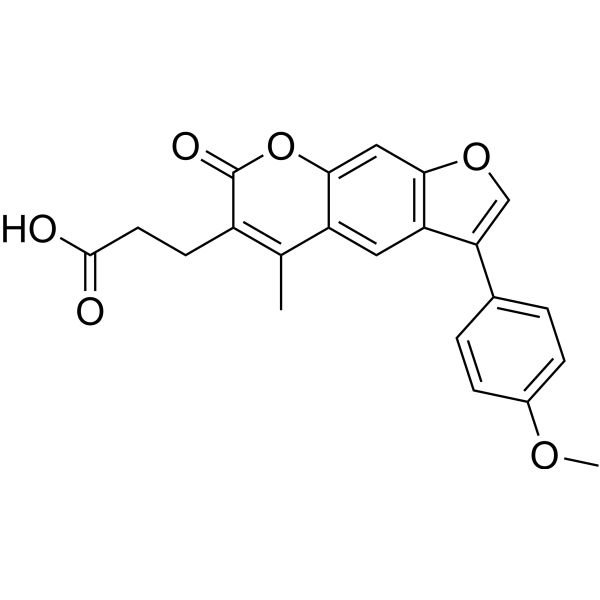
Scaff10-8 is a RhoA inhibitor. Scaff10-8 binds to RhoA, inhibits AKAP-Lbc-mediated RhoA activation. Scaff10-8 can be used for research on diabetes insipidus and bipolar disorder.
商品は「研究用試薬」です。人や動物の医療用・臨床診断用・食品用の製品ではありません。
研究用途以外に使用した場合、当社は一切の責任を負いかねます。
- 純度 : 99.11%
- CAS 番号: 777857-56-4
- 分子式: C22H18O6
- 分子量:378.37
-
保管条件:Powder -20°C, 3 years , 4°C, 2 years ; In solvent -80°C, 6 months , -20°C, 1 month

To place orders, for customer services and technical support, please contact: MedChemExpress USA
Tel: 609-228-6898 E-mail: [email protected] [email protected]


-
 生物活性
生物活性
-
化学情報
-
溶剤 & 溶解度
- プロトコル
- 純度とドキュメンテーション
- 参考文献
-
 Help & FAQs


MedChemExpress(MCE)の使用を引用している文献 Scaff10-8
More

生物活性
製品説明
体外実験
Scaff10-8 (1 h) potently inhibits the interaction between recombinant AKAP-Lbc/DHPH and RhoA in an HTRF assay with an IC50 of 34.1 μM[1].
Scaff10-8 inhibits the interaction between recombinant AKAP-Lbc DH domain and RhoA in an Alpha Screen assay with an IC50 of 42 μM[1].
Scaff10-8 (1 h) binds directly to recombinant 647-RhoA with a Kd of 20 μM, as measured by MST[1].
Scaff10-8 binds specifically to both GDP-bound and GTPγS-bound recombinant GST-RhoA, with Kd values of 20 μM and 38 μM, respectively[1].
Scaff10-8 (30-100 μM; 24-72 h) is not cytotoxic to primary IMCD, MCD4, HEK293, MCF7, or H9C2 cells[1].
Scaff10-8 (30 μM; 1 h) inhibits RhoA activity in primary IMCD cells[1].
Scaff10-8 (30 μM; 1 h) does not affect the activity of Cdc42 or Rac1 in primary IMCD cells[1].
Scaff10-8 (30 μM; 1 h) promotes the redistribution of AQP2 to the periphery of primary IMCD cells and depolymerizes F-actin[1].
Scaff10-8 (30 μM; 1-24 h) does not promote the insertion of AQP2 into the plasma membrane of primary IMCD cells[1].
Scaff10-8 (30-100 μM; 24 h) selectively inhibits AKAP-Lbc-mediated RhoA activation in HEK293 cells, with no effect on LARG or PDZ-RhoGEF-mediated RhoA activation, when treated at 30 or 100 μM[1].
MedChemExpress (MCE) has not independently confirmed the accuracy of these methods. They are for reference only.
-
Cell Line:primary rat inner medullary collecting duct (IMCD) cells, mouse collecting duct MCD4 cells, human embryonic kidney HEK293 cells, breast carcinoma MCF7 cells, cardiac myocyte H9C2 cells
-
Concentration:30 μM; 100 μM
-
Incubation Time:24 h; 48 h; 72 h
-
Result:Did not reduce cell viability in any of the tested cell lines across all concentrations and incubation times, as indicated by absorbance values comparable to untreated and DMSO control cells.
-
Cell Line:primary rat IMCD cells
-
Concentration:30 μM
-
Incubation Time:1 h
-
Result:Induced redistribution of AQP2 to the cell periphery, with a plasma membrane/perinuclear AQP2 ratio significantly higher than control cells.
Caused depolymerization of F-actin, with fiber structures replaced by dot-like fragments.


化学情報
-
CAS 番号 777857-56-4
-
性状 Solid
-
分子量 378.37
-
分子式 C22H18O6
-
Color Light yellow to yellow
-
SMILES
O=C(CCC1=C(C2=CC3=C(C=C2OC1=O)OC=C3C4=CC=C(C=C4)OC)C)O
-
輸送条件
Room temperature in continental US; may vary elsewhere.
-
保管条件
Powder -20°C 3 years 4°C 2 years In solvent -80°C 6 months -20°C 1 month


Publications (1)
-
Journal Impact Factor
-
Most Recent
-
Eur Heart J
Targeting P2Y14R alleviates platelet-induced NET formation and venous thrombosis through PKA/AKAP13/RhoA axis. [Abstract]2025 Oct 27:ehaf836. PMID: 41143464


溶剤 & 溶解度
体外:
DMSO : 100 mg/mL (264.29 mM; Need ultrasonic; Hygroscopic DMSO has a significant impact on the solubility of product, please use newly opened DMSO)
Please refer to the solubility information to select the appropriate solvent. Once prepared, please aliquot and store the solution to prevent product inactivation from repeated freeze-thaw cycles.
Storage method and period of stock solution: -80°C, 6 months; -20°C, 1 month. When stored at -80°C, please use it within 6 months. When stored at -20°C, please use it within 1 month.
Please refer to the solubility information to select the appropriate solvent. Once prepared, please aliquot and store the solution to prevent product inactivation from repeated freeze-thaw cycles.
Storage method and period of stock solution: -80°C, 6 months; -20°C, 1 month. When stored at -80°C, please use it within 6 months. When stored at -20°C, please use it within 1 month.
濃度 (開始) × 体積 (開始) = 濃度 (終了) × 体積 (終了)


純度とドキュメンテーション
-
データシート (276 KB)
-
SDS (252 KB)
- English - EN (252 KB)
- Français - FR (252 KB)
- Deutsch - DE (252 KB)
- Norwegian - NO (252 KB)
- Español - ES (252 KB)
- Swedish - SV (252 KB)
- Italian - IT (252 KB)
- Korean - KR (252 KB)
- Portuguese - PT (252 KB)
-
取扱説明書 (2659 KB)
参考文献


Complete Stock Solution Preparation Table
Please refer to the solubility information to select the appropriate solvent. Once prepared, please aliquot and store the solution to prevent product inactivation from repeated freeze-thaw cycles.
Storage method and period of stock solution: -80°C, 6 months; -20°C, 1 month. When stored at -80°C, please use it within 6 months. When stored at -20°C, please use it within 1 month.
| Optional Solvent | Concentration Solvent Mass | 1 mg | 5 mg | 10 mg | 25 mg |
|---|---|---|---|---|---|
| DMSO | 1 mM | 2.6429 mL | 13.2146 mL | 26.4292 mL | 66.0729 mL |
| 5 mM | 0.5286 mL | 2.6429 mL | 5.2858 mL | 13.2146 mL | |
| 10 mM | 0.2643 mL | 1.3215 mL | 2.6429 mL | 6.6073 mL | |
| 15 mM | 0.1762 mL | 0.8810 mL | 1.7619 mL | 4.4049 mL | |
| 20 mM | 0.1321 mL | 0.6607 mL | 1.3215 mL | 3.3036 mL | |
| 25 mM | 0.1057 mL | 0.5286 mL | 1.0572 mL | 2.6429 mL | |
| 30 mM | 0.0881 mL | 0.4405 mL | 0.8810 mL | 2.2024 mL | |
| 40 mM | 0.0661 mL | 0.3304 mL | 0.6607 mL | 1.6518 mL | |
| 50 mM | 0.0529 mL | 0.2643 mL | 0.5286 mL | 1.3215 mL | |
| 60 mM | 0.0440 mL | 0.2202 mL | 0.4405 mL | 1.1012 mL | |
| 80 mM | 0.0330 mL | 0.1652 mL | 0.3304 mL | 0.8259 mL | |
| 100 mM | 0.0264 mL | 0.1321 mL | 0.2643 mL | 0.6607 mL |


Scaff10-8 関連分類
HY-121667 関連分類
 Powered by Bioz