



S 38093

Based on 1 Customer Validation
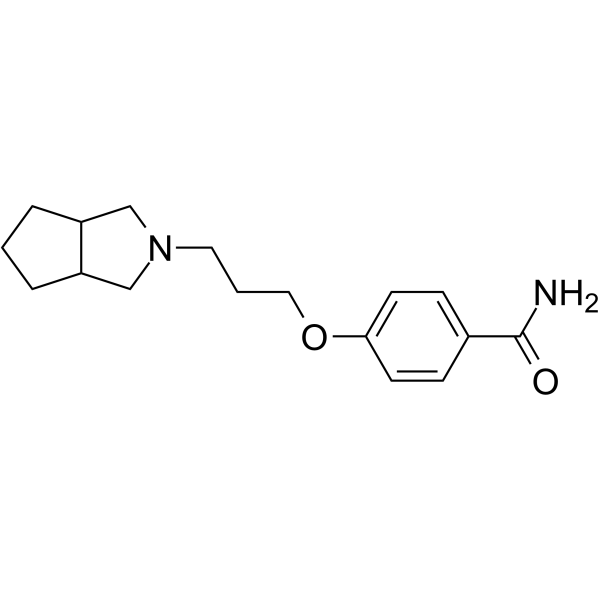
S 38093 is a brain-penetrant, orally active antagonist of H3 receptor, with Kis of 8.8, 1.44 and 1.2 μM for rat, mouse and human H3 receptors, respectively.
For research use only. We do not sell to patients.
- Purity: 99.86%
- CAS No.: 862896-30-8
- Formula: C17H24N2O2
- Molecular Weight:288.38
-
Storage:Powder -20°C, 3 years , 4°C, 2 years ; In solvent -80°C, 2 years , -20°C, 1 year

To place orders, for customer services and technical support, please contact: MedChemExpress USA
Tel: 609-228-6898 E-mail: [email protected] [email protected]


-
 Biological Activity
-
Chemical Information
-
Solvent & Solubility
- Protocol
- Purity & Documentation
- References
-
 Help & FAQs
-

GPCR/G Protein Compound Library
HY-L006
-
Immunology/Inflammation Compound Library
HY-L007
-
Neuronal Signaling Compound Library
HY-L013
-
CNS-Penetrant Compound Library
HY-L028
-
Endocrinology Compound Library
HY-L047
-
Neurotransmitter Receptor Compound Library
HY-L062
-
Anti-Parkinson's Disease Compound Library
HY-L085
-
Neurodegenerative Disease-related Compound Library
HY-L086
-
Anti-Obesity Compound Library
HY-L087
-
Coagulation and Anti-coagulation Compound Library
HY-L136
-
Heterocyclic Compound Library
HY-L138
-
Membrane Protein-targeted Compound Library
HY-L149
-
Membrane Receptor-targeted Compound Library
HY-L150
-
Bioactive Compound Library Max
HY-L181
-
MCE Bioactive Compound Library
HY-L001V
-
Bioactive Compound Library
HY-L001
-
High-Throughput Bioactive Compound Library
HY-L205
-
Lactylation Compound Library
HY-L249


All Histamine Receptor Isoforms
More

Biological Activity
|
H3 receptor |
In cellular models, S 38093 is able to antagonize mice H3 receptors (KB=0.65 μM) and to suppress cAMP decrease induced by an H3 agonist via human H3 receptors (KB=0.11 μM). In cells expressing a high H3 density, S 38093 behaves as a moderate inverse agonist at rat and human H3 receptors (EC50=9 and 1.7 μM, respectively)[2].
MedChemExpress (MCE) has not independently confirmed the accuracy of these methods. They are for reference only.
MedChemExpress (MCE) has not independently confirmed the accuracy of these methods. They are for reference only.


Chemical Information
-
CAS No. 862896-30-8
-
Appearance Solid
-
Molecular Weight 288.38
-
Formula C17H24N2O2
-
Color White to off-white
-
SMILES
O=C(N)C1=CC=C(OCCCN2CC3C(CCC3)C2)C=C1
-
Shipping
Room temperature in continental US; may vary elsewhere.
-
Storage
Powder -20°C 3 years 4°C 2 years In solvent -80°C 2 years -20°C 1 year


Solvent & Solubility
DMSO : 2 mg/mL (6.94 mM; Need ultrasonic; Hygroscopic DMSO has a significant impact on the solubility of product, please use newly opened DMSO)
Please refer to the solubility information to select the appropriate solvent. Once prepared, please aliquot and store the solution to prevent product inactivation from repeated freeze-thaw cycles.
Storage method and period of stock solution: -80°C, 2 years; -20°C, 1 year. When stored at -80°C, please use it within 2 years. When stored at -20°C, please use it within 1 year.
Please refer to the solubility information to select the appropriate solvent. Once prepared, please aliquot and store the solution to prevent product inactivation from repeated freeze-thaw cycles.
Storage method and period of stock solution: -80°C, 2 years; -20°C, 1 year. When stored at -80°C, please use it within 2 years. When stored at -20°C, please use it within 1 year.
Concentration (start) × Volume (start) = Concentration (final) × Volume (final)

Protocol
The context discrimination task consists of an 8-day contextual fear discrimination paradigm in which the mice have to learn to distinguish between a fearful shock context and a similar non-shock context. On day 1 the mice are only exposed to the training shock context, and on days 2-8 the mice are exposed to the shock and then non-shock context in that order each day. The mice are run through the context discrimination task starting at 10 am and ending at 2 pm and are then gavaged with vehicle or S 38093 at 4 pm each day. The drug and vehicle are always administered after behavioral testing to avoid possible acute effects of the drug on behavior. Learning is measured by the percent time the mice spent freezing and testing is terminated when percent freezing is consistently significantly different between the two contexts. The mice are tested after 29 days of drug treatment. Conditioning is conducted on one side of a Med-Associates shuttle box (ENV-010MC; 20.3 cm × 15.9 cm × 21.3 cm high) with a clear plexiglass wall, 3 aluminum walls and a stainless steel grid as a floor. Mouse behavior is recorded by digital video cameras mounted above the conditioning chamber. Freezeframe and Freezeview softwar are used for recording and analyzing freezing behavior, respectively. In training context A, mice are allowed to habituate in new cages outside the room and are then brought into the room in the new cages. The house fan and house light are turned on, the stainless steel grid is exposed, the plexiglass wall is up and a mild anise scent is used as an olfactory cue. The door to the sound dampening enclosure is shut for the duration of the trial. 180 s after the mice are placed in the training context, they are delivered a single footshock of 0.75 mA lasting 2 s. 15 s after the end of the footshock, the mice are placed back into their home cages. Non-alcoholic antiseptic wipes are used to clean the grids and catch trays in between trials. An hour later the mice are brought into the room in paper buckets and put into similar context B. The house fan and house light are turned off, the door of the enclosure is left ajar, plastic placemat sheets are put into the shuttle box to make a high-walled circular enclosure, the plexiglass wall is left down and a mild lemon scent is used as the olfactory cue. The stainless steel grid, a salient feature of both contexts, remained exposed. The mice stayed in the chambers for 180 s without receiving a footshock and are placed back into their home cages. 70% ethanol is used to clean the grids and catch trays between trials. The discrimination ratio allowed for evaluation of discrimination between the two contexts and is computed as follows: A = freezing in context A, B = freezing in context B, and the discrimination ratio = A/(A + B). Larger values indicate better discrimination.
MedChemExpress (MCE) has not independently confirmed the accuracy of these methods. They are for reference only.


Purity & Documentation
-
Data Sheet (273 KB)
-
SDS (396 KB)
- English - EN (396 KB)
- Français - FR (396 KB)
- Deutsch - DE (396 KB)
- Norwegian - NO (396 KB)
- Español - ES (396 KB)
- Swedish - SV (396 KB)
- Italian - IT (396 KB)
- Korean - KR (396 KB)
- Portuguese - PT (396 KB)
-
Handling Instructions (2659 KB)
References
[1]. Guilloux JP, et al. S 38093, a histamine H3 antagonist/inverse agonist, promotes hippocampal neurogenesis and improves context discrimination task in aged mice. Sci Rep. 2017 Feb 20;7:42946. [Content Brief]
[2]. Sors A, et al. Mechanistic characterization of S 38093, a novel inverse agonist at histamine H3 receptors. Eur J Pharmacol. 2017 May 15;803:11-23 [Content Brief]


Complete Stock Solution Preparation Table
Please refer to the solubility information to select the appropriate solvent. Once prepared, please aliquot and store the solution to prevent product inactivation from repeated freeze-thaw cycles.
Storage method and period of stock solution: -80°C, 2 years; -20°C, 1 year. When stored at -80°C, please use it within 2 years. When stored at -20°C, please use it within 1 year.
| Optional Solvent | Concentration Solvent Mass | 1 mg | 5 mg | 10 mg | 25 mg |
|---|---|---|---|---|---|
| DMSO | 1 mM | 3.4676 mL | 17.3382 mL | 34.6765 mL | 86.6912 mL |
| 5 mM | 0.6935 mL | 3.4676 mL | 6.9353 mL | 17.3382 mL |


S 38093 Related Classifications
HY-104003 Related Classifications
 Powered by Bioz