1. Search Result
Search Result
Results for "

5-HT2AR

" in MedChemExpress (MCE) Product Catalog:

10

Inhibitors & Agonists

1

Click Chemistry

Cat. No. Product Name Target Research Areas Chemical Structure
  • HY-169841

    5-HT Receptor Arrestin Neurological Disease
    IHCH-7086 is a blood-brain barrier-permeable, partial β-arrestin-biased agonist of 5-HT2AR with a Ki of 12.59 nM. IHCH-7086 blocks D-lysergic acid diethylamide-induced head-twitch response in mice and alleviates depression-like behaviors in mice subjected to acute restraint stress or injected with Corticosterone (HY-B1618). IHCH-7086 is applicable to research related to depression .
    IHCH-7086
  • HY-174466

    5-HT Receptor Arrestin Neurological Disease
    5-HT2AR ligand 1 (Compound 2 cis) is a 5-HT2AR ligand with nanomolar affinity for 5-HT2AR (Ki: 32 nM). 5-HT2AR ligand 1 is capable of inducing β-arrestin 2 recruitment. 5-HT2AR ligand 1 can be used in the research of neurological diseases .
    5-HT2AR ligand 1
  • HY-175285

    5-HT Receptor Neurological Disease
    5-HT2AR-IN-1 (Compound Ie) is an orally active 5-hydroxytryptamine 2A receptor (5-HT2AR) inhibitor with antidepressant efficacy. 5-HT2AR-IN-1 reduces 5-HT2AR expression and SERT protein levels. 5-HT2AR-IN-1 is promising for research of central nervous system (CNS), such as depression and addiction-related disorders .
    5-HT2AR-IN-1
  • HY-172995

    5-HT Receptor Neurological Disease
    RS130-180 is a selective β-arrestin-biased agonist targeting the serotonin 2A receptor (5-HT2aR). RS130-180 is promising for research of neuropsychiatric disorders such as depression .
    RS130-180
  • HY-151596

    Monoamine Oxidase 5-HT Receptor Neurological Disease
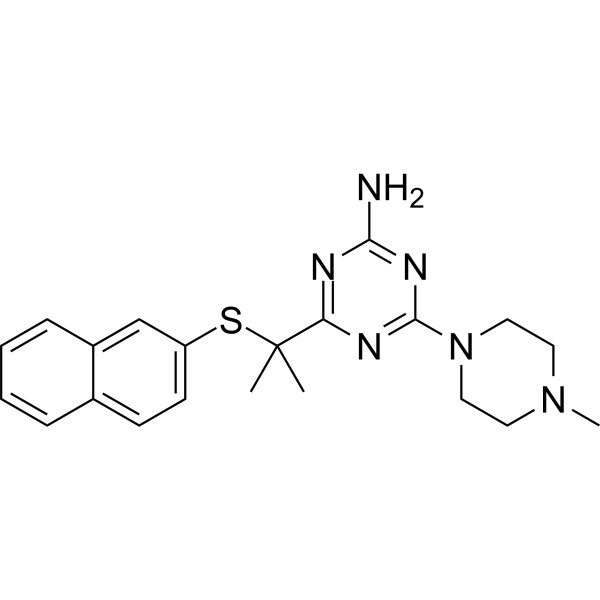
    MAO-A/5-HT2AR-IN-1 (compound I14) is a potent MAO-A and 5-HT2AR dual inhibitor, with IC50 values of 0.004 and 0.014 μM, respectively. MAO-A/5-HT2AR-IN-1 is a potential antidepressant agent .
    MAO-A/5-HT2AR-IN-1
  • HY-145862

    5-HT Receptor Neurological Disease
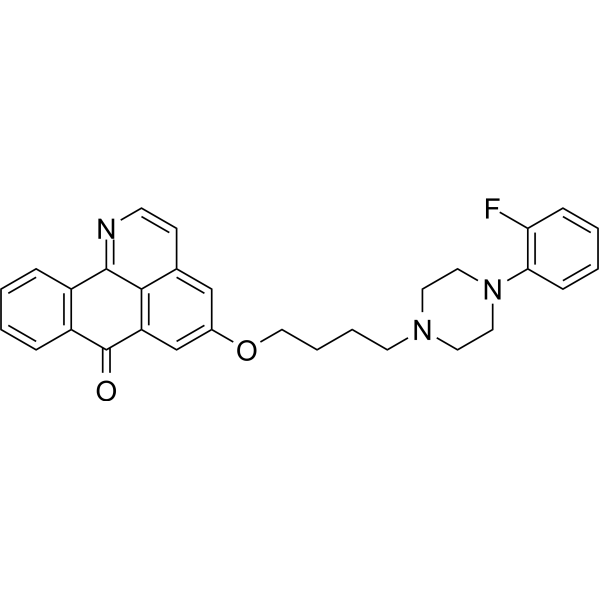
    5-HT6/5-HT2AR antagonist-1 is a potent dual 5-HT6/5-HT2AR antagonist with Ki values of 11 nM and 39 nM, respectively .
    5-HT6/5-HT2AR antagonist-1
  • HY-183357

    GABA Receptor 5-HT Receptor Reactive Oxygen Species (ROS) TNF Receptor Interleukin Related COX NF-κB IKK NO Synthase Neurological Disease Inflammation/Immunology
    GABAAR/5-HT2AR modulator-1 is an orally active and brain-penetrant GABAAR agonist and 5-HT2AR antagonist with Kd values of 0.89 and 0.78 μM. GABAAR/5-HT2AR modulator-1 blocks 5-HT-stimulated IP1 accumulation, inducing a chloride current, reduces LPS (HY-D1056)-induced increases of ROS, NO, TNF-α, IL-6, IL-1β, iNOS, and COX-2 levels. Antidepressant agent 11 dihydrochloride inhibits NF-κB pathway activation by reducing IκBα and p65 phosphorylation and blocking p65 nuclear translocation. GABAAR/5-HT2AR modulator-1 alleviates depression-like behaviors in LPS-challenged and chronic restraint stress-challenged mice, and protects hippocampal neurons against inflammation-mediated damage .
    GABAAR/5-HT2AR modulator-1
  • HY-W728110

    5-Methoxy pyrrolidinyltryptamine

    5-HT Receptor Neurological Disease
    5-MeO-pyr-T (5-Methoxy pyrrolidinyltryptamine) is a 5-HT1AR agonist, with Kis of 0.577 and 373 μM for 5-HT1AR and 5-HT2AR respectively. 5-MeO-pyr-T inhibits 5-HT uptake and elicits 5-HT release. 5-MeO-pyr-T induces hypolocomotion .
    5-MeO-pyr-T
  • HY-157425

    5-HT Receptor Neurological Disease
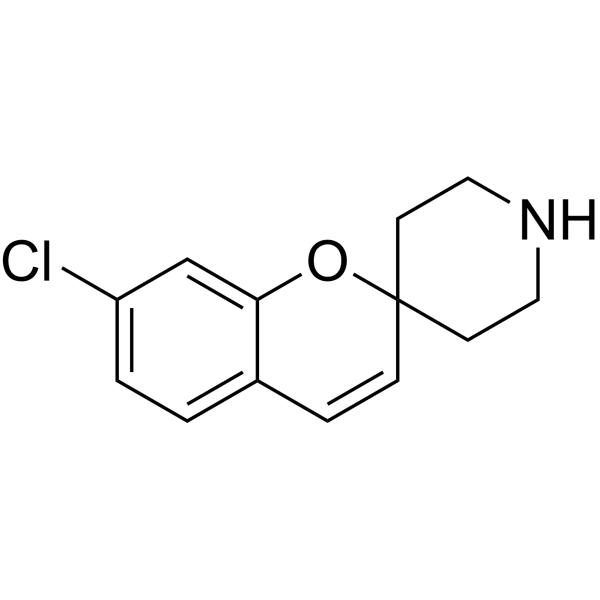
    5-HT2CR agonist 1 (compound 8), a 7-chloro analogue, is a selective 5-HT2CR partial agonist (Emax=71.09%) with an EC50 value of 121.5 nM and no observed activity toward 5-HT2AR or 5-HT2BR. 5-HT2CR agonist 1 exhibits no recruitment activity for β-arrestin and shows low inhibition of hERG at 10 μM .
    5-HT2CR agonist 1
  • HY-181977

    GlyT 5-HT Receptor Serotonin Transporter Neurological Disease
    RPI-GLYT2-82 is a reversible, blood-brain barrier-permeable allosteric inhibitor of GlyT2 with an IC50 value of 554 nM. RPI-GLYT2-82 also exhibits inhibitory activity against 5-HT2AR and SERT, with IC50 values of 1.9 μM and 4.7 μM, respectively. RPI-GLYT2-82 inhibits pain signals and alleviates allodynia, shows no target-related side effects at the maximum analgesic dose, and has no addictive potential. RPI-GLYT2-82 can be used for the research of neuropathic pain .
    RPI-GLYT2-82

Inquiry Online

Your information is safe with us. * Required Fields.

Salutation


Country or Region *

Applicant Name *


Organization Name *

Department *


Email Address *


Product Name *

Cat. No.


Requested quantity *

Phone Number *


Remarks

Inquiry Online

Inquiry Information

Product Name:
Cat. No.:
Quantity:
MCE Japan Authorized Agent:

