9 Results for "

BEAS2B

" in MedChemExpress (MCE) Product Catalog:
Products (9)

9 Results for "BEAS2B" in MCE Product Catalog:

Cat. No.: HY-Y1366
CAS No.: 116-09-6
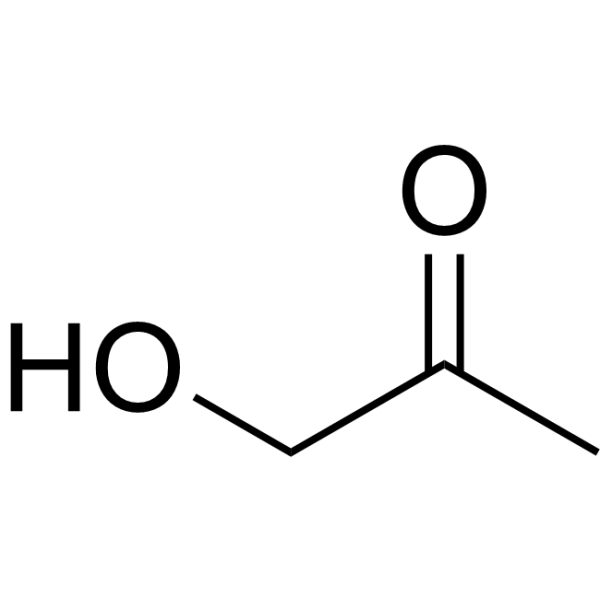
Hydroxyacetone is a toxic compound. Hydroxyacetone can be isolated from e-cigarette aerosols. Hydroxyacetone reduces the activity of cellular Mitochondrial reductase (with an IC50 of 5.53 mg/mL for mitochondrial reductase in BEAS-2B cells) and increases ROS levels. Hydroxyacetone induces mitochondrial stress and oxidative damage. Hydroxyacetone induces destabilization of F-actin. At high concentrations, Hydroxyacetone promotes cell rounding and Apoptotic body formation. Hydroxyacetone exerts toxic effects on cells including airway epithelial cells and possesses respiratory toxicity potential .\n


loading...
    loading...
Cat. No.: HY-150169
CAS No.: 2442519-59-5
Purity:  99.90%
Target:  

TGF-β Receptor

Research Areas:  

Cancer

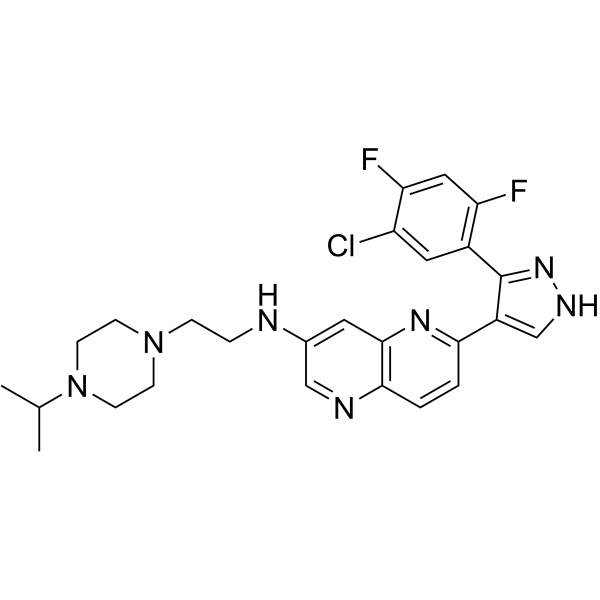
THRX-144644 is a Lung-restricted ALK5 inhibitor with an IC50 value of 0.14 nM. THRX-144644 avoids systemic toxicities associated with TGFβ pathway inhibition .
loading...
    loading...
Cat. No.: HY-156274
CAS No.: 2991427-09-7
Purity:  99.61%
Target:  

HDAC

Research Areas:  

Cancer

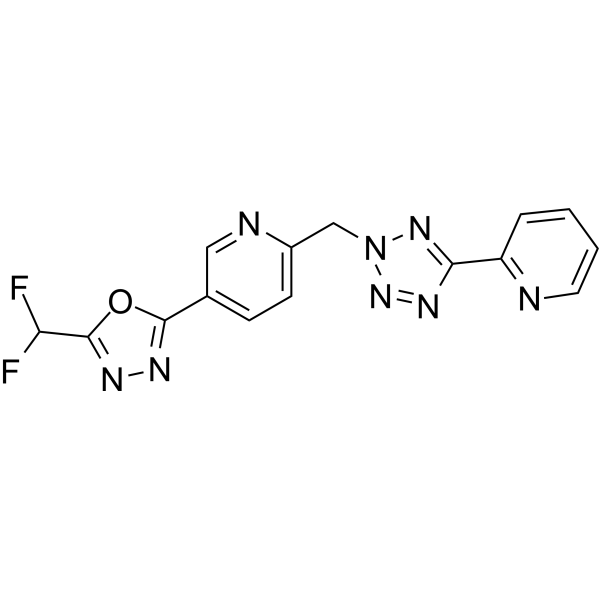
HDAC6-IN-23 (compound 9) is an orally active HDAC6 inhibitor .
loading...
    loading...
Cat. No.: HY-114732
CAS No.: 72332-33-3
Target:  

Adrenergic Receptor

Research Areas:  

Others

Procaterol is an oral selective β2 adrenergic receptor agonist. Procaterol inhibits eosinophil migration and the release of eosinophil chemotactic factor from BEAS-2B cells through a cyclic AMP-dependent mechanism. Procaterol has a large dose difference existing between the bronchodilator effect and the anabolic effect in rat, can be used for asthma research in athletes .
loading...
    loading...
Cat. No.: HY-162852
Target:  

G-quadruplex

Research Areas:  

Cancer

OAF89 is a small molecule that interacts with G-Quadruplexes (G4s) and dsDNA with an IC50 of 1.07 μM in normal lung epithelial cells BEAS-2B .
loading...
    loading...
Cat. No.: HY-P5829A
Target:  

Bacterial

Research Areas:  

Infection

CRAMP (140-173) (mouse) TFA is a ortholog of human LL-37 antimicrobial peptide. CRAMP (140-173) (mouse) TFA inhibits LPS (HY-D1056)-induced responses, and can not colocalized with TLR3 in BEAS-2B cells .
loading...
    loading...
Cat. No.: HY-118829
CAS No.: 24646-40-0
Purity:  99.90%
Target:  

Drug Derivative

Research Areas:  

Neurological Disease

3,4-Methylenedioxy PV9 hydrochloride is a drug derivative. 3,4-Methylenedioxy PV9 hydrochloride shows toxicity against BEAS-2B, human aortic endothelia, HASM, SK-N-SH, A172, HepG2, MKN45, and DLD1cells (LC50=12.8-67.5 μM) .
loading...
    loading...
Cat. No.: HY-114732S
Procaterol-d7 hydrochloride is the deuterium labeled Procaterol hydrochloride (HY-100704). Procaterol is an oral selective β2 adrenergic receptor agonist. Procaterol inhibits eosinophil migration and the release of eosinophil chemotactic factor from BEAS-2B cells through a cyclic AMP-dependent mechanism. Procaterol has a large dose difference existing between the bronchodilator effect and the anabolic effect in rat, can be used for asthma research in athletes .
loading...
    loading...
Cat. No.: HY-184389
Research Areas:  

Inflammation/Immunology

PROTAC HDAC6 degrader 10 is a highly efficient, safe and selective HDAC6 PROTAC degrader with a pIC50 of 8.75 and a pDC50 of 9.2 in BEAS-2B cells. PROTAC HDAC6 degrader 10 recruits cereblon to form a ternary complex with HDAC6, thereby achieving the degradation of HDAC6. PROTAC HDAC6 degrader 10 significantly induces hyperacetylation of α-tubulin without affecting the acetylation of H3, and achieves sustained HDAC6 knockdown in mouse lung tissues. PROTAC HDAC6 degrader 10 exhibits high bioavailability after subcutaneous administration in mice. PROTAC HDAC6 degrader 10 enables the study of HDAC6 pharmacology via chemical knockdown of HDAC6 in vitro and in vivo, and can be used for research on pulmonary diseases .
loading...
    loading...

