13 Results for "

Benzothiazole derivative

" in MedChemExpress (MCE) Product Catalog:
Products (13)

13 Results for "Benzothiazole derivative" in MCE Product Catalog:

Cat. No.: HY-105084A
CAS No.: 144665-09-8
Purity:  99.00%
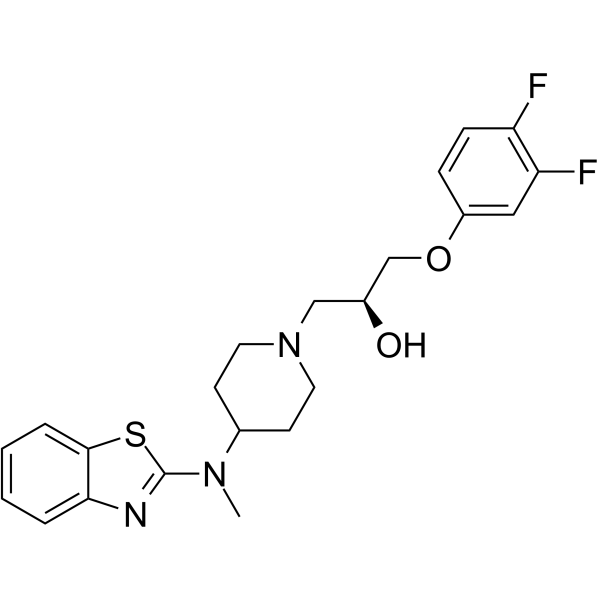
Lubeluzole dihydrochloride is the dihydrochloride salt of Lubeluzole (HY-105084). Lubeluzole dihydrochloride is the S-isomer of benzothiazole derivative. Lubeluzole dihydrochloride can inhibit glutamate release, glutamate-activated NO synthesis and block voltage-gated Sodium Channel and Calcium Channel. Lubeluzole dihydrochloride exhibits anti-ischemic and neuroprotective effects. Lubeluzole dihydrochloride also shows anti-bacterial and anti-diarrheal potential. Lubeluzole dihydrochloride can inhibit cardiac sodium channel and prolong cardiac action potential. Lubeluzole dihydrochloride can inhibit cancer cells proliferation and invasion and shows chemosensitizing effect. Lubeluzole dihydrochloride can be used for the researches of cancer, infection, neurological and cardiovascular disease such as stroke, infectious diarrhea and ovarian .
loading...
    loading...
Cat. No.: HY-18402
CAS No.: 615-22-5
Target:  

Drug Derivative

Research Areas:  

Cardiovascular Disease

2-(Methylthio)benzothiazole is a derivative of 2-Mercaptobenzothiazole (HY-W017113). 2-(Methylthio)benzothiazole reduces heart rate, causes pericardial edema and deformity, delays cardiac maturation, decreases stroke volume and cardiac output, and leads to vascular structural defects in zebrafish larvae .
loading...
    loading...
Cat. No.: HY-W067445
CAS No.: 122-85-0
Synonyms: 4-Acetamidobenzaldehyde
N-(4-Formylphenyl) acetamide (4-Acetamidobenzaldehyde) is an organic ligand bearing aldehyde and acetamide functional groups. N-(4-Formylphenyl) acetamide can be used to functionalize Fe3O4@SiO2 nanoparticles for selective fluorescence quenching detection of Hg 2+. N-(4-Formylphenyl) acetamide serves as a precursor for the synthesis of benzimidazole, benzothiazole and Schiff base derivatives, which exhibit antioxidant, AChE/BChE inhibitory and DNA-binding activities. N-(4-Formylphenyl) acetamide can be applied in studies related to Alzheimer's disease .
loading...
    loading...
Cat. No.: HY-105084
CAS No.: 144665-07-6
Lubeluzole is the S-isomer of benzothiazole derivative. Lubeluzole can inhibit glutamate release, glutamate-activated NO synthesis and block voltage-gated Sodium Channel and Calcium Channel. Lubeluzole exhibits anti-ischemic and neuroprotective effects. Lubeluzole also shows anti-bacterial and anti-diarrheal potential. Lubeluzole can inhibit cardiac sodium channel and prolong cardiac action potential. Lubeluzole can inhibit cancer cells proliferation and invasion and shows chemosensitizing effect. Lubeluzole can be used for the researches of cancer, infection, neurological and cardiovascular disease such as stroke, infectious diarrhea and ovarian .
loading...
    loading...
Cat. No.: HY-151581
CAS No.: 2977251-08-2
Target:  

Virus Protease

Research Areas:  

Infection

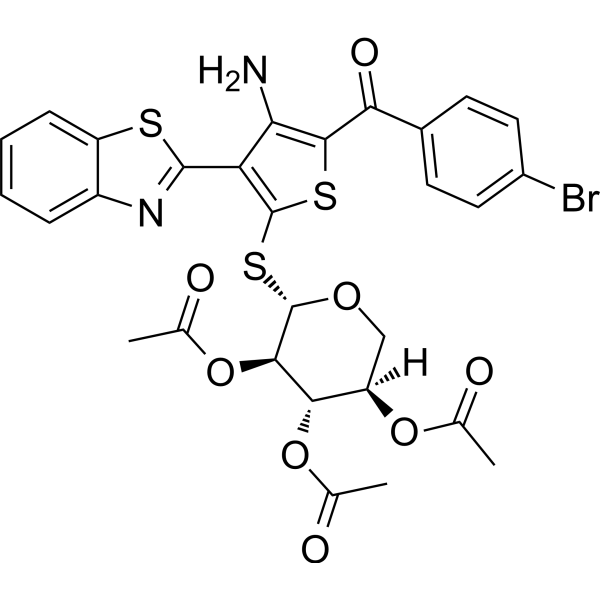
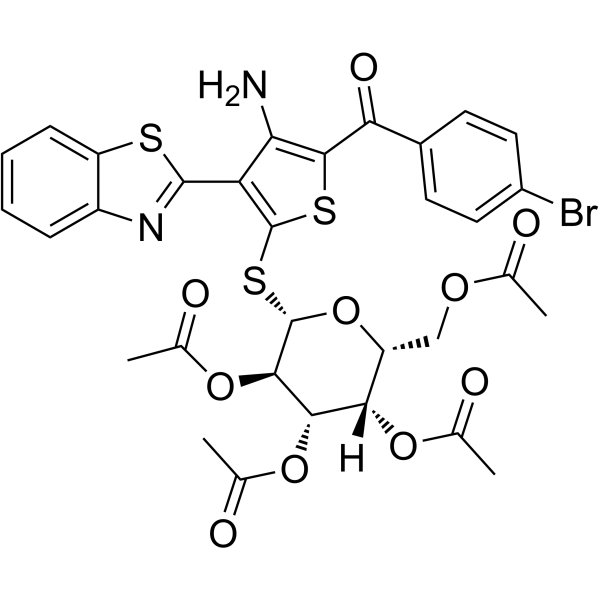
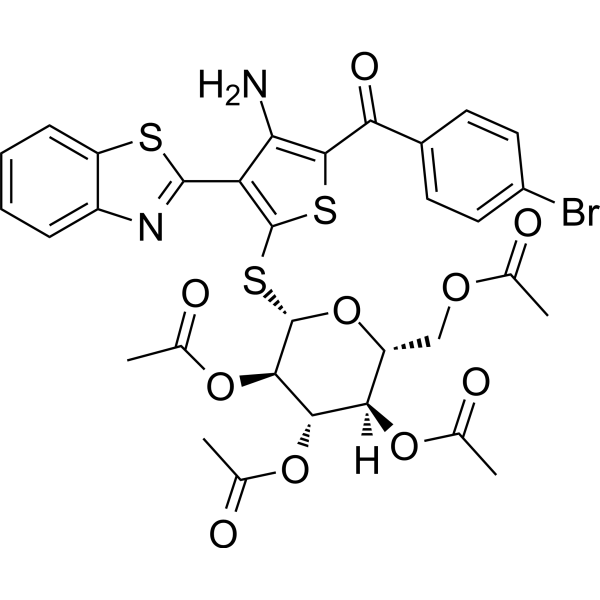
HCVcc-IN-1 is a benzothiazole-2-thiophene S-glycoside derivative with low toxic and antiviral activity .
loading...
    loading...
Cat. No.: HY-179415
CAS No.: 1088704-78-2
Research Areas:  

Infection

DHFR-IN-24, a benzothiazole derivative, is a dihydrofolate reductase (DHFR) inhibitor. DHFR-IN-24 has intrinsic antibacterial activity against both Gram-positive and Gram-negative strains. DHFR-IN-24 synergistically combines DHFR inhibition with photodynamic therapy (PDT) for enhanced antibacterial activity against multidrug-resistant pathogens .
loading...
    loading...
Cat. No.: HY-151588
CAS No.: 2977251-03-7
Target:  

Virus Protease

Research Areas:  

Cancer

Anticancer agent 90 is a benzothiazole-2-thiophene S-glycoside derivative with antitumor activity. Anticancer agent 90 has high inhibition against the two cell line from ovarian cancer (OVCAR-4), renal cancer (A498) .
loading...
    loading...
Cat. No.: HY-151592
CAS No.: 2977251-00-4
Target:  

Antibiotic

Research Areas:  

Cancer

Anticancer agent 91 is a benzothiazole-2-thiophene S-glycoside derivative with antitumor and antiviral activity. Anticancer agent 91 has high inhibition against the two cell line from CNS cancer (SF-539 and SNB-75) .
loading...
    loading...
Cat. No.: HY-151587
CAS No.: 2977251-05-9
Target:  

Others

Research Areas:  

Cancer

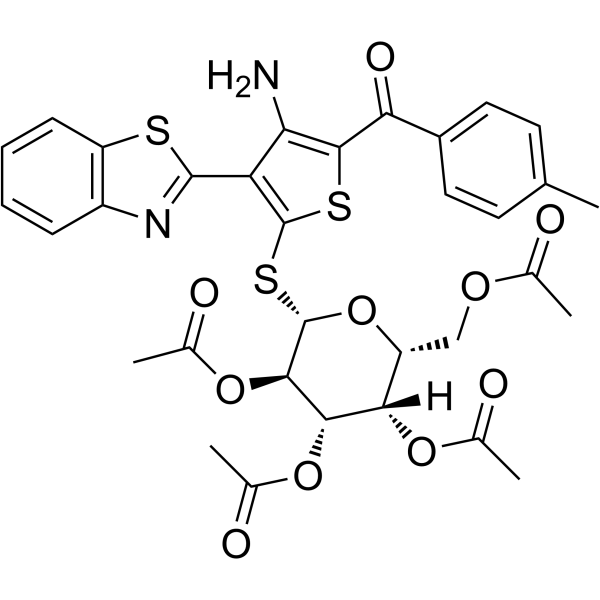
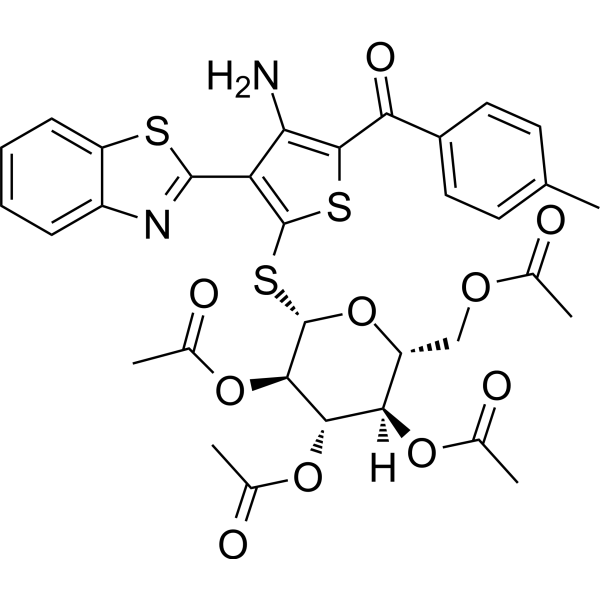
Anticancer agent 89 is a benzothiazole-2-thiophene S-glycoside derivative with antitumor activity, has high inhibition against the three cell line from ovarian cancer (OVCAR-4), renal cancer (A498), and melanoma (SK-MEL-5) .
loading...
    loading...
Cat. No.: HY-151589
CAS No.: 2977251-02-6
Target:  

Virus Protease

Research Areas:  

Infection Cancer

HCVcc-IN-2 is a benzothiazole-2-thiophene S-glycoside derivative with antitumor and antiviral activity. HCVcc-IN-2 has high inhibition against the three cell line from CNS cancer (SF-539 and SNB-75), colon cancer (HCT-116), and renal cancer (A498) .
loading...
    loading...
Cat. No.: HY-19054
CAS No.: 81059-04-3
Target:  

Parasite

Research Areas:  

Infection

CGP-20376, a 5-methoxyl-6-dithiocarbamic-S- (2-carboxy-ethyl) ester derivative of Benzothiazole (HY-W012634), is an orally active and potent antifilarial drug. CGP-20376 has anthelmintic activity .
loading...
    loading...
Cat. No.: HY-W017355
CAS No.: 25984-63-8
Synonyms: 4-Hydroxybenzothioamide
Target:  

Drug Derivative

Research Areas:  

Others

4-Hydroxythiobenzamide (4-Hydroxybenzothioamide) (Compound HT), a benzothiazole derivative of Nootkatone (HY-N2195), serves as an intermediate .
loading...
    loading...
Cat. No.: HY-D3117
CAS No.: 2146114-18-1
Target:  

Fluorescent Dye

Research Areas:  

Others

MBCB is a two-photon Fluorescent probe for dual-detection of mitochondrial SO₂ derivatives and viscosity. For SO₂ derivatives detection, the probe utilizes a Michael addition mechanism: nucleophilic addition of SO₂ derivatives to the C=C bond between the carbazole skeleton and 3-methylbenzothiazolium moiety destroys the strong intramolecular charge transfer (ICT) system between these groups, while enhancing the weak ICT system between the benzothiazole group and carbazole framework; this causes the red emission at 600 nm to decrease and the blue emission at 434 nm to increase, creating a ratiometric response based on the I₄₃₄ₙₘ/I₆₀₀ₙₘ intensity ratio. For viscosity detection, in low-viscosity environments, steric hindrance creates a twisted ICT (TICT) system with weak fluorescence, while in high-viscosity environments, intramolecular rotation is blocked, the TICT state is disrupted, and the strong ICT system is recovered, leading to a strong red emission at 567 nm with negligible change to the short-wavelength emission at 415 nm, creating a ratiometric response based on the I₅₆₇ₙₘ/I₄₁₅ₙₘ intensity ratio that has a logarithmic linear relationship with viscosity. The probe has excitation/emission wavelengths of Ex/Em = 351/434, 600 nm for SO₂ derivatives detection and Ex/Em = 351/567 nm for viscosity detection, with two-photon excitation at 740 nm for bioimaging; it also exhibits good mitochondrial targeting ability with a Pearson's colocalization coefficient of 0.93 when paired with Mito-Tracker Green. The probe shows high sensitivity and selectivity for SO₂ derivatives, has low cell cytotoxicity, and can be applied to detect exogenous/endogenous HSO₃⁻ in living cells and in vivo, as well as visualize mitochondrial viscosity changes induced by nystatin[1].
loading...
    loading...
  • 1

