1. Search Result
Search Result
Results for "

Brassicaceae

" in MedChemExpress (MCE) Product Catalog:

6

Inhibitors & Agonists

6

Natural
Products

Cat. No. Product Name Target Research Areas Chemical Structure
  • HY-N2388

    MMP PPAR Bacterial Cardiovascular Disease Neurological Disease Inflammation/Immunology Cancer
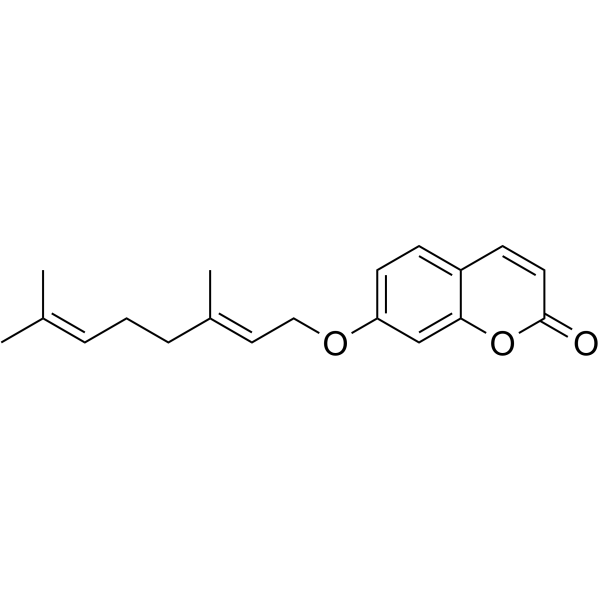
    Auraptene is an orally active geranyloxycoumarin that can be isolated from plants in the Brassicaceae family, antibacterial, anti-pathogen, antioxidant, anti-tumor, and neuroprotective effects. Auraptene plays an important role in the treatment of various chronic diseases such as hypertension and cystic fibrosis .
    Auraptene
  • HY-W265314

    NF-κB Interleukin Related Inflammation/Immunology
    Arvelexin is a biologically active compound. Arvelexin can be found in Brassica rapa L. (Brassicaceae). Arvelexin inhibits NF-κB activation and the expressions of IL-8. Arvelexin inhibits colonic inflammation .
    Arvelexin
  • HY-129584

    Others Inflammation/Immunology
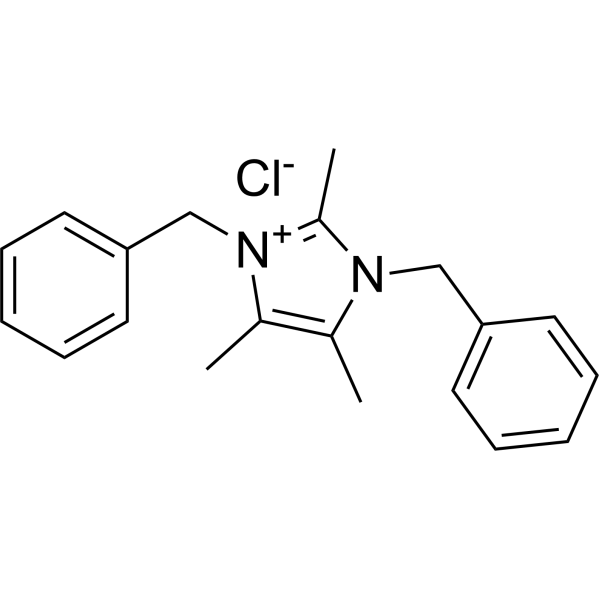
    Lepidiline B is a flavonolignan isolated from the roots of Brassicaceae Lepidium meyenii. Lepidiline B exhibits anti-inflammation activities in human cancer cell lines .
    Lepidiline B
  • HY-N2388R

    Reference Standards MMP PPAR Bacterial Cardiovascular Disease Neurological Disease Inflammation/Immunology Cancer
    Auraptene (Standard) is the analytical standard of Auraptene. This product is intended for research and analytical applications. Auraptene is an orally active geranyloxycoumarin that can be isolated from plants in the Brassicaceae family, antibacterial, anti-pathogen, antioxidant, anti-tumor, and neuroprotective effects. Auraptene plays an important role in the treatment of various chronic diseases such as hypertension and cystic fibrosis .
    Auraptene (Standard)
  • HY-W707148

    Endogenous Metabolite Infection
    4-Methyltridecane is a volatile substance specifically released by cabbage root flies (Delia radicum) after feeding. 4-Methyltridecane might be a key signal for the parasitoid bee Trybliographa rapae (Delia radicum’s specific parasitic predator) to locate the host. 4-Methyltridecane can serve as a specific marker for root damage in turnips (Brassica rapa subsp. Rapa) .
    4-Methyltridecane
  • HY-N2423B

    (E/Z)-Allyl-glucosinolate free base; (E/Z)-2-Propenyl-glucosinolate free base

    NF-κB p38 MAPK Apoptosis Cardiovascular Disease Infection Inflammation/Immunology Cancer
    (E/Z)-Sinigrin ((E/Z)-Allyl-glucosinolate; (E/Z)-2-Propenyl-glucosinolate) free base is an orally active aliphatic thioglucoside anti-leukemia compound. Allyl isothiocyanate, produced by the hydrolysis of (E/Z)-sinigrin free base by myrosinase, has an IC50 of 2.71 μM against HL60 leukemia cells. The hydrolysis products of (E/Z)-sinigrin free base can further activate apoptosis pathways, inhibit NF-κB and MAPK signaling pathways, and induce phase II metabolic enzyme activity, thus exhibiting anti-cancer, anti-inflammatory, antibacterial, antioxidant, and wound healing activities. (E/Z)-Sinigrin free base can be used in research on cancer, inflammation-related diseases (such as atherosclerosis), and infectious diseases. (E/Z)-Sinigrin free base can be naturally extracted from the seeds of Brassica nigra, Brassica juncea, and other Brassicaceae plants such as broccoli and Brussels sprouts. Methyl pechueloate is a guaiane-type sesquiterpene ester compound and a potential precursor of xerantholide. It is useful in the structural elucidation and biosynthetic pathway studies of sesquiterpenoids. Methyl pechueloate can be naturally extracted from the aerial parts of Pechuel-Loeschea leibnitziae (Kuntze) O. Hoffm .
    (E/Z)-Sinigrin free base

Inquiry Online

Your information is safe with us. * Required Fields.

Salutation


Country or Region *

Applicant Name *


Organization Name *

Department *


Email Address *


Product Name *

Cat. No.


Requested quantity *

Phone Number *


Remarks

Inquiry Online

Inquiry Information

Product Name:
Cat. No.:
Quantity:
MCE Japan Authorized Agent:

