13 Results for "

DNA break sites

" in MedChemExpress (MCE) Product Catalog:
Products (13)

13 Results for "DNA break sites" in MCE Product Catalog:

Cat. No.: HY-P3005
CAS No.: 9015-85-4
Target:  

DNA/RNA Synthesis

Research Areas:  

Others

T4 DNA ligase is the product of gene 30 of phage T4. T4 DNA ligase catalyzes the repair of single-stranded nicks in duplex DNA and joins duplex DNA restriction fragments having either blunt or cohesive ends. T4 DNA ligase catalyze the sealing of adjacent 5′-phosphate and 3′-­hydroxyl termini at single-stranded breaks in double-stranded DNA.T4 DNA ligase is an ATP-dependent ligase enzyme. T4 DNA ligase can be used in various biotechnological applications. T4 DNA ligase can join the ends of single-stranded DNA in the absence of any duplex DNA structure at the ligation site .
loading...
    loading...
Cat. No.: HY-W012817
CAS No.: 95-71-6
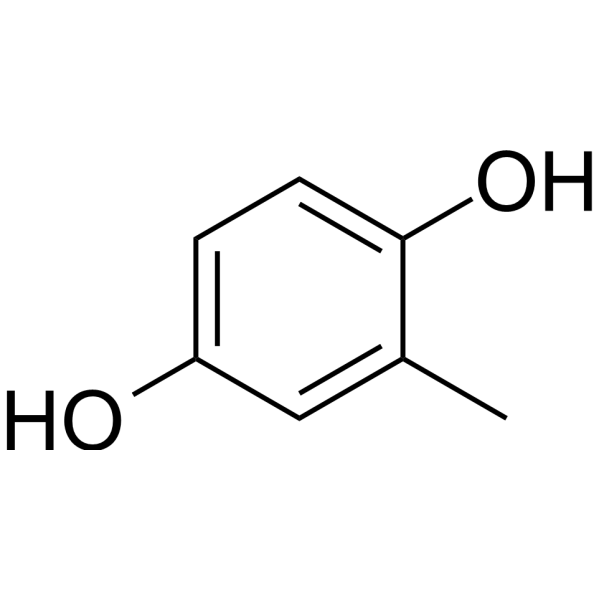
Methylhydroquinone is an orally active COX inhibitor with IC50s of 480.7 μM and 52.2 μM for ovine COX-1 and human recombinant COX-2, respectively. Methylhydroquinone has potential DNA damaging effects: 1) inhibiting COX-1 to reduce prostaglandin synthesis and exert anti-inflammatory activity; 2) inducing DNA single-strand breaks. Methylhydroquinone exerts its effects by competitively binding to the active sites of COX-1 (such as Tyr385, Met522) and non-covalent interactions .
loading...
    loading...
Cat. No.: HY-115531
CAS No.: 1648707-58-7
Purity:  98.84%
Target:  

DNA/RNA Synthesis

Research Areas:  

Cancer

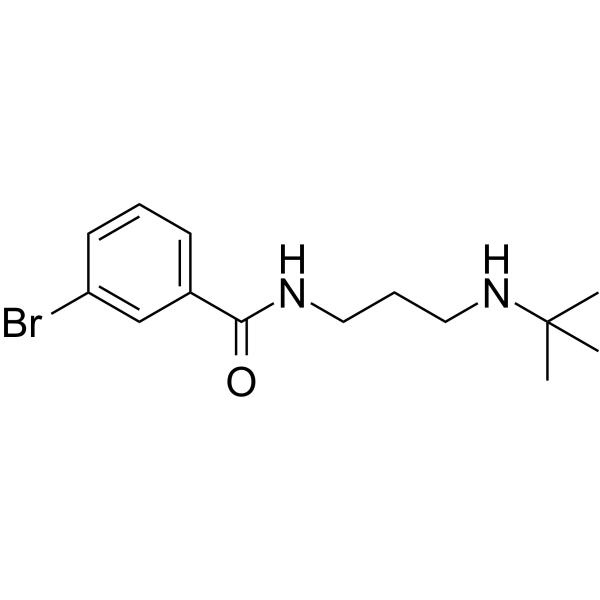
UNC-2170 is a functionally active, fragment-like ligand for 53BP1 (IC50=29 µM; Kd=22 µM). UNC-2170 shows at least 17-fold selectivity for 53BP1 as compared to nine other methyl-lysine (Kme) reader proteins. 53BP1 is a Kme binding protein that plays a central role in DNA Damage Repair (DDR) pathways and is recruited to sites of double-strand breaks (DSB) .
loading...
    loading...
Cat. No.: HY-164279
CAS No.: 1207615-74-4
Target:  

DNA/RNA Synthesis

Research Areas:  

Cancer

YTR107 is a radiation sensitizer. YTR107 binds to nucleophosmin1 (NPM1) and inhibits pentamer formation. YTR107 inhibits recruitment of nucleophosmin to sites of DNA damage, suppresses repair of DNA double strand breaks, and enhances radiosensitization .
loading...
    loading...
Cat. No.: HY-D2353
CAS No.: 756525-96-9
Target:  

DNA/RNA Synthesis

Research Areas:  

Cancer

Biotin-PEG3-benzophenone is biotin-labeled Benzophenone (HY-Y0546). Benzophenone is an endogenous metabolite and a photosensitizer that has been implicated in photosensitive damage to DNA. Benzophenone causes nucleobase oxidation, formation of cyclobutane-pyrimidine dimers, single-strand breaks, DNA-protein cross-links or abasic sites, different pathologies that may occur in nucleosides, oligonucleotides or DNA .
loading...
    loading...
Cat. No.: HY-135782
CAS No.: 15720-01-1
Research Areas:  

Cancer

iso-ADP ribose is the small-molecule ligand for protein nucleic acid modification, comprising parts of two consecutive ADP-ribosyl units within the PAR chain. iso-ADP ribose specifically binds WWE, FHA and OB-fold domains, enabling PAR-dependent functional responses like ubiquitylation and supporting DNA damage signaling and repair. iso-ADP ribose can be used for cancer research .
loading...
    loading...
Cat. No.: HY-135782A
Research Areas:  

Cancer

iso-ADP ribose TEA is the small-molecule ligand for protein nucleic acid modification, comprising parts of two consecutive ADP-ribosyl units within the PAR chain. iso-ADP ribose TEA specifically binds WWE, FHA and OB-fold domains, enabling PAR-dependent functional responses like ubiquitylation and supporting DNA damage signaling and repair. iso-ADP ribose TEA can be used for cancer research .
loading...
    loading...
Cat. No.: HY-174499
Target:  

mRNA

Research Areas:  

Others

Cas9 Nickase D10A mRNA expresses a version of the Streptococcus pyogenes SF370 Cas9 protein (CRISPR Associated Protein 9) that contains a D10A amino acid substitution. This mRNA also contains a C-terminal nuclear localization signal followed by a HA tag.Cas9 functions as part of the CRISPR (clustered regularly interspaced short palindromic repeats) genome editing system. In the CRISPR system, an RNA guide sequence targets the site of interest and the Cas9 protein is employed to perform the DNA cleavage. While wild-type Cas9 creates a double-stranded break at the target site, Cas9 nickase creates a single-stranded break. This favors homology-directed repair and decreases the occurrence of non-homologous end joining.
loading...
    loading...
Cat. No.: HY-175466
Research Areas:  

Cancer

BER-IN-1 is a base excision repair (BER) inhibtor, targeting DNA abasic sites. BER-IN-1 cleaves abasic sites via β- and β,δ-elimination mechanisms, disrupts the base excision repair (BER) pathway and leads to DNA double-strand breaks (DSBs). BER-IN-1 can enhance the effectiveness of the PARP inhibitor Olaparib (HY-10162) in homologous recombination (HR)-proficient cancer cells (MDA-MB-231, HeLa, and SKOV3). BER-IN-1 induces an S-phase arrest and apoptosis companied with Olaparib (HY-10162). BER-IN-1 can be used for the research of cancer, such as breast, cervical and ovarian cancer .
loading...
    loading...
Cat. No.: HY-118897
CAS No.: 2173992-60-2
Target:  

DNA/RNA Synthesis

Research Areas:  

Cancer

UNC-2170 maleate is the maleate salt form of UNC-2170 (HY-115531). UNC-2170 maleate is a selective inhibitor for the methyl-lysine binding protein 53BP1, with IC50 of 29 µM and Kd of 22 µM. UNC-2170 maleate shows at least 17-fold selectivity for 53BP1 as compared to nine other methyl-lysine (Kme) reader proteins. 53BP1 is a Kme binding protein that plays a central role in DNA Damage Repair (DDR) pathways and is recruited to sites of double-strand breaks (DSB) .
loading...
    loading...
Cat. No.: HY-W414321
CAS No.: 39002-30-7
Synonyms: D-Isoglucosamine hydrochloride
Target:  

Endogenous Metabolite

Research Areas:  

Others

Fructosamine (D-Isoglucosamine) hydrochloride is a metabolic intermediate and component of cell membranes and cartilage. Fructosamine hydrochloride induces site-specific breaks in DNA chains, especially in the presence of Cu 2+ .
loading...
    loading...
Cat. No.: HY-114923
CAS No.: 688036-19-3
Target:  

DNA-PK PI3K

Research Areas:  

Cancer

SU-11752 is an inhibitor for DNA-dependent protein kinase (DNA-PK) with an IC50 of 0.13 μM. SU-11752 inhibits PI3K p110γ kinase with IC50 of 1.1 μM. SU-11752 binds competitively for ATP-site in DNA-PK, results in inhibition of intracellular DNA double-strand break repair and increases the sensitivity of cells to radiotherapy .
loading...
    loading...
Cat. No.: HY-W012817R
CAS No.: 95-71-6
Methylhydroquinone (Standard) is the analytical standard of Methylhydroquinone. This product is intended for research and analytical applications. Methylhydroquinone is an orally active COX inhibitor with IC50s of 480.7 μM and 52.2 μM for ovine COX-1 and human recombinant COX-2, respectively. Methylhydroquinone has potential DNA damaging effects: 1) inhibiting COX-1 to reduce prostaglandin synthesis and exert anti-inflammatory activity; 2) inducing DNA single-strand breaks. Methylhydroquinone exerts its effects by competitively binding to the active sites of COX-1 (such as Tyr385, Met522) and non-covalent interactions[1][2].
loading...
    loading...
  • 1

