







25 Results for "

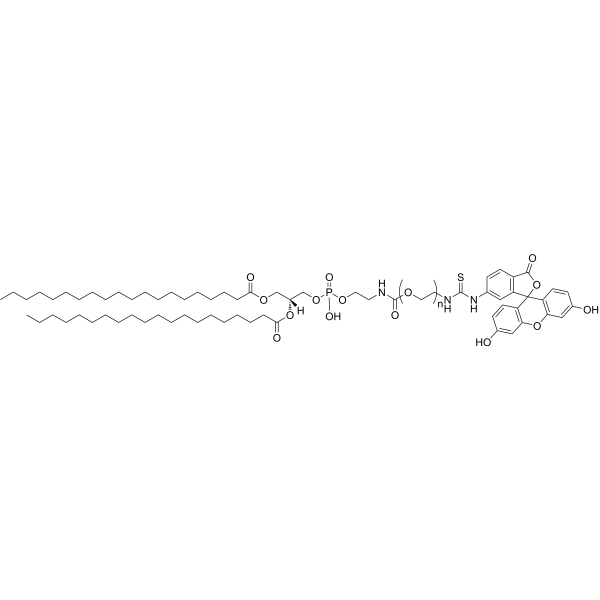
DSPE-PEG2000-FITC

" in MedChemExpress (MCE) Product Catalog:
Products (25)

25 Results for "DSPE-PEG2000-FITC" in MCE Product Catalog:

Cat. No.: HY-W440915
CAS No.: 1000788-53-3
DSPE-PEG2000-FITC is a PEG lipid conjugated with fluorescein. FITC is a green dye with a peak absorption at 494 nm and a maximum emission at 520 nm, which is used for staining biological samples or nanoparticles. DSPE-PEG2000-FITC spontaneously forms lipid bilayers or micelles in water and can be used to prepare liposomes for delivering substances such as mRNA vaccines .
loading...
    loading...
Cat. No.: HY-P5096
CAS No.: 1802087-77-9
Target:  

Amyloid-β

Research Areas:  

Neurological Disease

FITC-β-Ala-Amyloid β-Protein (1-42) is a FITC tagged Aβ1-42 peptide. Aβ1-42 plays a key role in the pathogenesis of Alzheimer’s disease .
loading...
    loading...
Cat. No.: HY-P10392AF
Target:  

Wnt β-catenin

Research Areas:  

Cancer

fStAx-35R TFA is the hydrocarbon-stapled peptide. fStAx-35R TFA inhibits Wnt/β-catenin signaling pathway by disrupting the β-catenin-TCF interaction. fStAx-35R TFA can be used in cancer research .
loading...
    loading...
Cat. No.: HY-P0128F
Target:  

Amyloid-β

Research Areas:  

Neurological Disease

FITC-β-Amyloid (25-35) is a FITC (HY-66019) labeled β-Amyloid (25-35) (HY-P0128)
loading...
    loading...
Cat. No.: HY-P4125A
Target:  

HIV Fluorescent Dye

Research Areas:  

Others

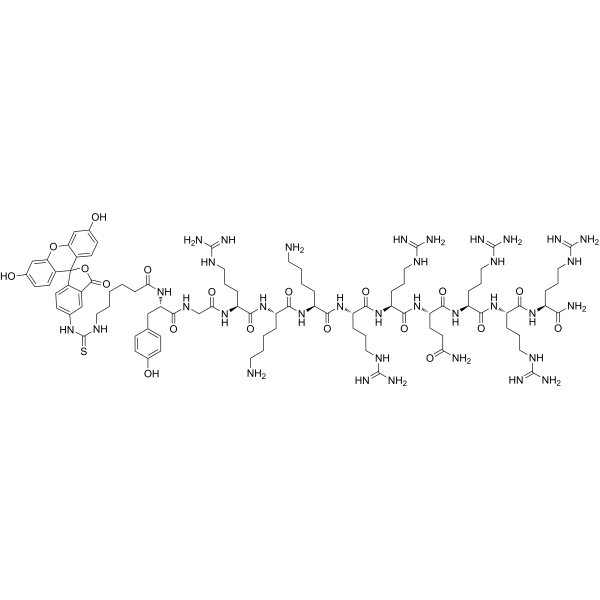
FITC-LC-TAT (47-57) acetate is a FITC-labeled TAT peptide (HY-P0281) (λex: 493 nm, λem: 522 nm). Derived from the trans-activator of transcription (TAT) of immunodeficiency virus (HIV-1), TAT enhances the yield of heterologous proteins .
loading...
    loading...
Cat. No.: HY-P11057
Target:  

Fluorescent Dye

Research Areas:  

Others

FGGH is a water-soluble peptide-based probe. FGGH performs the sequential detection of Cu 2+ and S 2- by fluorescence and colorimetry with high sensitivity (LOD: 1.42 and 22.2 nM for Cu 2+ and S 2-, respectively) (Ex=488 nm, Em=525 nm), and images both two ions in living cells and zebrafish models with low cytotoxicity. FGGH can be used for in vivo imaging and environmental pollution monitoring research .
loading...
    loading...
Cat. No.: HY-P2292
Target:  

Bacterial Fungal

Research Areas:  

Infection

Omiganan, FITC labeled is a peptide-FITC complex composed of Omiganan and a FITC. Omiganan is a bactericidal and fungicidal cationic peptide being developed as a topical gel for prevention of catheter-associated infections. FITC is a derivative of fluorescein for the labeling of amines .
loading...
    loading...
Cat. No.: HY-P10896
CAS No.: 1446005-10-2
Target:  

Bombesin Receptor

Research Areas:  

Cancer

NOTA-P2-RM26 is an antagonist of Bombesin (HY-P0195) analogs, and the gastrin-releasing peptide receptor (GRPR/BB2) is a molecular target for prostate cancer visualization. NOTA-P2-RM26 is labeled with 111In and 68Ga for prostate cancer imaging studies using PET and SPECT/CT .
loading...
    loading...
Cat. No.: HY-P1188
CAS No.: 1207610-07-8
Target:  

Integrin

Research Areas:  

Cancer

LDV-FITC, a fluorescent peptide, is a FITC-conjugated LDV peptide (HY-P2267). LDV-FITC binds to the α4β1 integrin with high affinity (Kd: 0.3 nM and 12 nM for binding to U937 cells in the presence and absence of Mn 2+ respectively). LDV-FITC can be used to detect α4β1 integrin affinity .
loading...
    loading...
Cat. No.: HY-P4125
Target:  

HIV Fluorescent Dye

Research Areas:  

Infection

FITC-LC-TAT (47-57) is a FITC-labeled TAT peptide (HY-P0281) (λex: 493 nm, λem: 522 nm). Derived from the trans-activator of transcription (TAT) of human immunodeficiency virus (HIV-1), TAT enhances the yield of heterologous proteins .
loading...
    loading...
Cat. No.: HY-P0128F1
Target:  

Amyloid-β

Research Areas:  

Neurological Disease

FITC-β-Ala-β-Amyloid (25-35) is a fluorescent product labeled by FITC that can be used in Alzheimer's disease research .
loading...
    loading...
Cat. No.: HY-169232
Target:  

PROTACs PD-1/PD-L1

Research Areas:  

Cancer

PCC16 chloride is a dual PROTAC degrader targeting DHHC3 and PD-L1, with a DC50 of 0.103 μM for PD-L1 degradation. PCC16 chloride induces DHHC3 degradation via the ubiquitin-proteasome pathway by recruiting the CRBN E3 ubiquitin ligase (E3 ubiquitin ligase). By targeting DHHC3-which is essential for PD-L1 palmitoylation and membrane stability-PCC16 chloride reduces PD-L1 levels, decreases PD-L1 membrane retention time, and impairs its immunosuppressive function. PCC16 chloride enhances anti-tumor immunity by disrupting PD-L1-mediated immunosuppression. PCC16 chloride can be used in the research of immune checkpoint blockade-resistant cancers .
loading...
    loading...
Cat. No.: HY-P1459
Target:  

Bacterial

Research Areas:  

Infection

Sphistin Synthetic Peptide (12-38, Fitc in N-Terminal-Fluorescently Labeled Peptide) is a truncated fragments of Sphistin Synthetic Peptide that shows potent antimicrobial activity.
loading...
    loading...
Cat. No.: HY-P2292A
Target:  

Bacterial Fungal

Research Areas:  

Infection

Omiganan, FITC labeled TFA is a peptide-FITC complex composed of Omiganan and a FITC. Omiganan is a bactericidal and fungicidal cationic peptide being developed as a topical gel for prevention of catheter-associated infections .
loading...
    loading...
Cat. No.: HY-P4135
Target:  

Fluorescent Dye

Research Areas:  

Others

FITC-LC-Antennapedia Peptide is a FITC labeled Antennapedia Peptide (HY-P0307). Antennapedia Peptide is a cellular-membrane permeable peptides (CPP). FITC-LC-Antennapedia Peptide has good penetration in 3T3 cell line, which was rapidly accumulated into nuclei .
loading...
    loading...
Cat. No.: HY-P1188A
Target:  

Integrin

Research Areas:  

Cancer

LDV-FITC TFA, a fluorescent peptide, is a FITC-conjugated LDV peptide (HY-P2267). LDV-FITC TFA binds to the α4β1 integrin with high affinity (Kd: 0.3 nM and 12 nM for binding to U937 cells in the presence and absence of Mn 2+ respectively). LDV-FITC TFA can be used to detect α4β1 integrin affinity .
loading...
    loading...
Cat. No.: HY-P0248F1
Research Areas:  

Others

Kemptide-FITC is a fluorescently labeled Kemptide (HY-P0248). Kemptide is a synthetic heptapeptide that acts as a specific substrate for cAMP-dependent protein kinase (PKA). Kemptide-FITC enables the quantification of PKA activity and can also indirectly determine cAMP concentrations through the activation of PKA in sperm insoluble fractions. Kemptide-FITC is applicable for kinase mobility shift assay (KiMSA), and its fluorescent signal shows a linear response with increasing peptide amount within a specific range on agarose gels .
loading...
    loading...
Cat. No.: HY-P11088F
VCAM1 binding peptide, FITC labeled acetate is a FITC-labeled VCAM1 binding peptide acetate (HY-P11088A). VCAM1 binding peptide acetate is a VCAM1 binder with internalization activity. VCAM1 binding peptide acetate serves as a component of biosensing systems for visualizing in vitro VCAM1 endocytic pathways. VCAM1 binding peptide acetate forms the research and development basis for MacroP and NAMP, PET radiotracers targeting VCAM1. VCAM1 binding peptide acetate is applicable to studies related to atherosclerosis .
loading...
    loading...
Cat. No.: HY-P11481
Research Areas:  

Others

FITC-Acp-RpYTPEP-NH2 is a potent fluorescent tracer. FITC-Acp-RpYTPEP-NH2 shows a binding affinity (Kd = 0.07 μM) for the Cbl-b SH2 domain. Fluorescence polarization assay based on FITC-Acp-RpYTPEP-NH2 can be for evaluating Cbl-b SH2 domain inhibitors .
loading...
    loading...
Cat. No.: HY-P11625
Target:  

RXFP Receptor

Research Areas:  

Cardiovascular Disease

R9-13 is a fatty acid-conjugated relaxin and an agonist of LGR7 (RXFP1). R9-13 induces sustained pubic symphysis elongation in estrogen-pretreated mice. R9-13 exhibits long-acting pharmacokinetic profiles in rodents, with in vivo activity lasting up to one week after administration. R9-13 can be used in studies related to acute heart failure .
loading...
    loading...

