


11 Results for "

FcγRIIb

" in MedChemExpress (MCE) Product Catalog:
Products (11)

11 Results for "FcγRIIb" in MCE Product Catalog:

1
1 Cited Publications
Cat. No.: HY-P9950
CAS No.: 242138-07-4
Synonyms: Olizumab; rhuMab-E25; IGE25; RG-3648

Target:  

Interleukin Related

Research Areas:  

Inflammation/Immunology Cancer

Omalizumab is a recombinant, humanized, monoclonal antibody against human immunoglobulin E (IgE) with a KD of 0.393 nM. Omalizumab binds to the human FcγRIIb receptors with a KD of 6.37 uM. Omalizumab has the potential for persistent allergic asthma research . The component ratio of this product is Active ingredient : Excipients = 1:1.3-1:1.5.
loading...
    loading...
Cat. No.: HY-P99761
CAS No.: 1690307-05-1
Synonyms: XmAb5871

Target:  

CD19 Apoptosis

Research Areas:  

Inflammation/Immunology

Obexelimab (XmAb5871) is a humanized anti-CD19 antibody. Obexelimab works by inhibiting B cell receptor (BCR) mediated calcium influx and promoting the phosphorylation of Fc γ receptor IIb (FcγRIIb), which reduces B cell activation and function, leading to B cell apoptosis. Obexelimab can be used in research for rheumatoid arthritis and systemic lupus erythematosus .
loading...
    loading...
Cat. No.: HY-P99529
CAS No.: 1804910-11-9
Synonyms: BAX1810; TAK-752; SM101

Target:  

Fc Receptor (FcR)

Research Areas:  

Inflammation/Immunology

Valziflocept (BAX1810) is a recombinant soluble human FcγRIIb receptor that targets Fc and FcγR. FcγRs bind to and neutralize pathogenic IgG, thereby acting as a "decoy" or "scavenger" receptor that reduces the severity of autoimmune diseases. Valziflocept is used in research on autoimmune diseases such as systemic lupus erythematosus (SLE) .
loading...
    loading...
Cat. No.: HY-P991086
Synonyms: PRV-3279

Target:  

Fc Receptor (FcR)

Research Areas:  

Inflammation/Immunology

MGD010 (PRV-3279) is a bispecific antibody targeting CD32B (FcγRIIb) and CD79B. MGD010 transmits negative signals by simultaneously co-linking CD32B (FcγRIIb) with CD79B, a component of the B-cell receptor (BCR), thereby inhibiting activated B cells. MGD010 can be used in research related to autoimmune diseases .
loading...
    loading...
Cat. No.: HY-P991225

Target:  

Fc Receptor (FcR) CD20

Research Areas:  

Inflammation/Immunology Cancer

BI-1206 is a recombinant and antagonistic human monoclonal antibody targeting FcγRIIB (CD32B). BI-1206 can block CD20 internalization induced by Rituximab (HY-P9913) itself or combined with others including Ibrutinib (HY-10997), Venetoclax (HY-15531), and CHOP. BI-1206 can enhance or recover the activity of Rituximab or other anti-CD20 monoclonal antibodies. BI-1206 has cytolytic activity against malignant B cells. BI-1206 can be studied for cancer research such as mantle cell lymphoma (MCL) .
loading...
    loading...
Cat. No.: HY-P991070

Target:  

TNF Receptor

Research Areas:  

Cancer

ADG-106 is a fully human agonistic monoclonal IgG4 antibody against CD137 (4-1BB). ADG-106 has the mechanism to activate CD137 via strong FcγRIIB-mediated crosslinking while antagonizing CD137 ligands. The isotype control for ADG-106 can refer to Human IgG4 (S228P) kappa, Isotype Control (HY-P99003) .
loading...
    loading...
Cat. No.: HY-P991525
CAS No.: 2923542-55-4

Target:  

Fc Receptor (FcR)

Research Areas:  

Cancer

2141-V11 is an Fc-engineered agonistic antibody against human CD40 with selectively enhanced binding affinity for human FcγRIIB. 2141-V11 drives CD40 multimerization and agonistic signal transduction, activates dendritic cells, promotes antigen cross-presentation and CD8 + T cell priming, induces tertiary lymphoid structure formation, increases leukocyte infiltration, and mediates local and abscopal anti-tumor effects, systemic immune activation and immune memory. 2141-V11 exhibits extremely low systemic toxicity upon intratumoral or intravesical administration, with no dose-limiting toxicity observed at the tested intratumoral doses, whereas high-dose systemic administration induces thrombocytopenia and elevated transaminases. 2141-V11 can be used in research related to breast cancer, melanoma, BCG-unresponsive non-muscle invasive bladder cancer, and recurrent malignant glioma .
loading...
    loading...
Cat. No.: HY-P991582

Research Areas:  

Cancer

BI-1607 is a humanized monoclonal antibody targeting FcγRIIB/CD32b. BI-1607 selectively blocks inhibitory FcγRIIB signaling, abrogates its inhibitory function, redirects tumor cell-bound antibodies to activating FcγRs, and its modified Fc region prevents the binding of its own Fc segment to FcγRs. BI-1607 reduces αPD-1 trogocytosis, enhances the effector functions of anti-tumor antibodies (including ADCP and ADCC, promotes intratumoral regulatory T cell (Treg) depletion, myeloid cell reprogramming, induction of interferon-γ (IFN-γ) and CXCL10, and increases the number of activated effector CD8 + T cells. BI-1607 can be used in research related to colorectal cancer, HER2-positive advanced solid tumors, HER2-positive locally advanced or metastatic breast cancer, and HER2-positive metastatic gastric cancer .
loading...
    loading...
Cat. No.: HY-P991394

Research Areas:  

Cancer

SEA-TGT is a human monoclonal antibody (mAb) targeting TIGIT. SEA-TGT enhances binding to the activating FcγRIIIA while reducing binding to the inhibitory FcγRIIb. SEA-TGT can be used in advanced solid tumors and Lymphoma research .
loading...
    loading...
Cat. No.: HY-158316
CAS No.: 2758569-43-4
Target:  

Fc Receptor (FcR)

Research Areas:  

Others

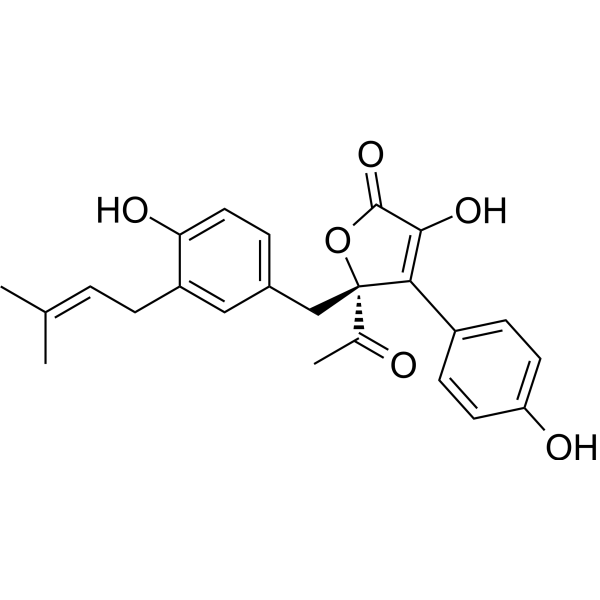
BTL-MK (Compound 19) an orally active antiallergic agent, that inhibits degranulation of mast cells with an IC50 of 6.7 μM, through binding to the inhibitory receptor FcγRIIB. BTL-MK improves the metaboilic stability in human liver microsomes. BTL-MK ameliorates the allergic response in Ovalbumin, low endotoxin (HY-W250978A)-induced food allergy mice model. BTL-MK exhibits a good pharmacokinetic character with metabolic stability .
loading...
    loading...
Cat. No.: HY-P991996

Target:  

Fc Receptor (FcR)

Research Areas:  

Inflammation/Immunology

SM201 is a monoclonal antibody that targets FcγRIIB. SM201 specifically binds to FcγRIIB, enhances ITIM phosphorylation of FcγRIIB in an immune complex-dependent manner, and acts synergistically with immune complexes to amplify inhibitory signals. SM201 does not induce apoptosis, activate NK cells, or deplete B cells. SM201 can be used for the research of autoimmune diseases .
loading...
    loading...
  • 1

