1. Search Result
Search Result
Results for "

HepAD38

" in MedChemExpress (MCE) Product Catalog:

15

Inhibitors & Agonists

1

Natural
Products

Cat. No. Product Name Target Research Areas Chemical Structure
  • HY-B1067

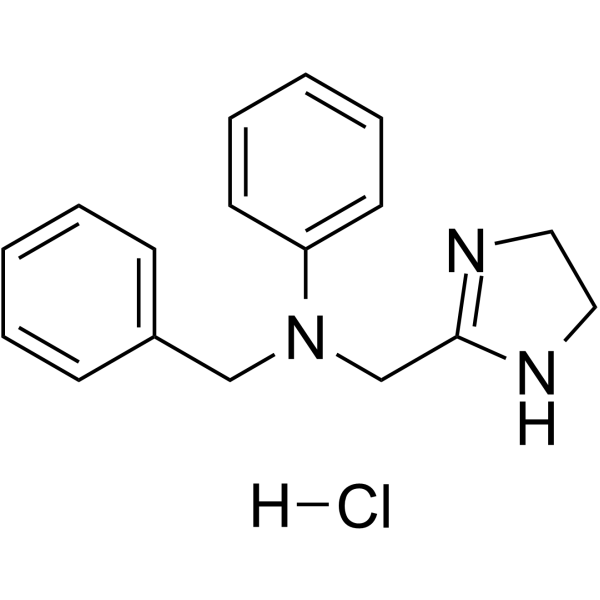
    Phenazoline hydrochloride

    Histamine Receptor HBV Neurological Disease Endocrinology
    Antazoline hydrochloride is a histamine H1 receptor antagonist with anticholinergic and antiviral properties. Antazoline hydrochloride can prevent histamine from acting on target cells through a reversible competition effect on histamine receptor sites of these cells. Antazoline hydrochloride can exert an antiallegic effect and prevent the occurrence of physiological reactions from the effect of blocking as well as inhibiting H1 receptor. Antazoline hydrochloride can effectively reduce HBV DNA in the extracellular supernatant in a dose-dependent manner, with EC50 of 2.910 μmol/L in HepAD38 cells. Antazoline hydrochloride also has a significant inhibitory effect on HBV DNA in the extracellular supernatant of Huh7 cells (EC50 = 2.349 μmol/L). Antazoline hydrochloride has anti-arrhythmic effect in acute myocardial infarctions. Antazoline hydrochloride can be studied in research for cardiovascular diseases, and HBV .
    Antazoline hydrochloride
  • HY-147255

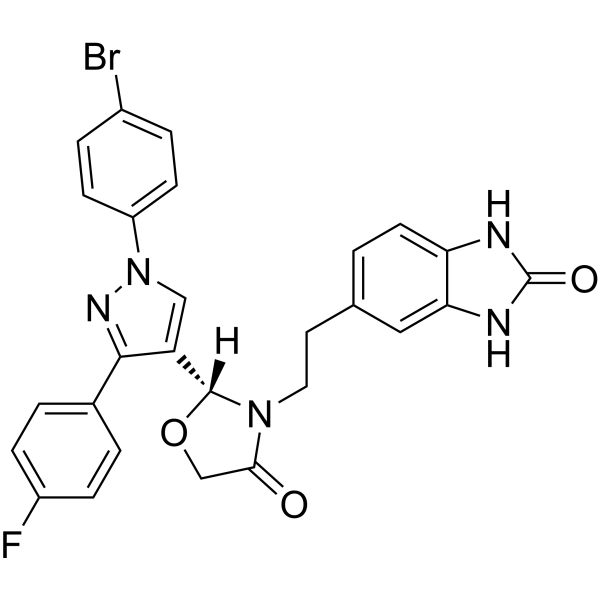
    ZM-H1505R

    HBV Infection
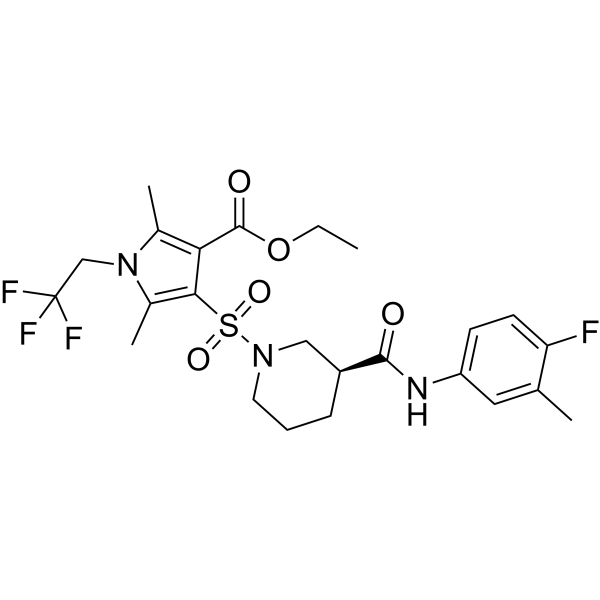
    Canocapavir (ZM-H1505R) is an orally active HBV core protein-targeting antiviral agent. Canocapavir binds to the hydrophobic pocket at the dimer-dimer interface of HBV core protein (HBc), stimulating intracellular accumulation of nonfunctional HBV capsids, disrupting viral replication. Canocapavir interferes with the interaction between HBc and HBV large surface protein, resulting in diminished
    production of empty virionsis. Canocapavir can be used for the research of hepatitis B virus (HBV) infection .
    Canocapavir
  • HY-B1067A

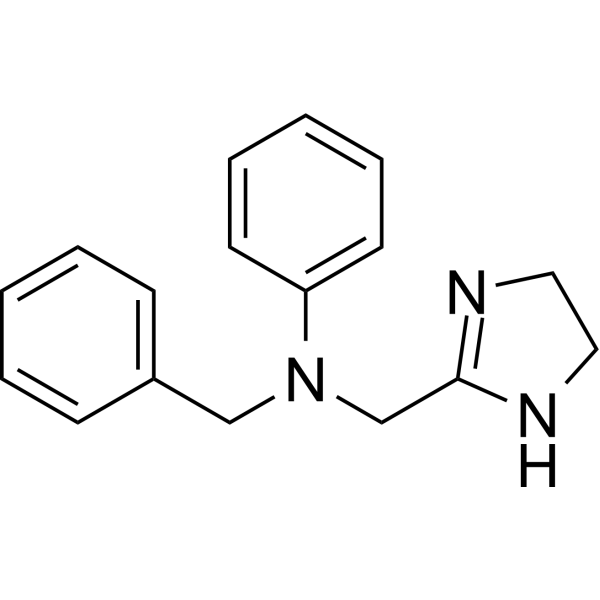
    Phenazoline

    Histamine Receptor Neurological Disease Endocrinology
    Antazoline (Phenazoline) is a histamine H1 receptor antagonist with anticholinergic and antiviral properties. Antazoline can prevent histamine from acting on target cells through a reversible competition effect on histamine receptor sites of these cells. Antazoline can exert an antiallegic effect and prevent the occurrence of physiological reactions from the effect of blocking as well as inhibiting H1 receptor. Antazoline can effectively reduce HBV DNA in the extracellular supernatant in a dose-dependent manner, with EC50 of 2.910 μmol/L in HepAD38 cells. Antazoline also has a significant inhibitory effect on HBV DNA in the extracellular supernatant of Huh7 cells (EC50 = 2.349 μmol/L). Antazoline has anti-arrhythmic effect in acute myocardial infarctions. Antazoline can be studied in research for cardiovascular diseases, and HBV .
    Antazoline
  • HY-N10404

    HBV Inflammation/Immunology
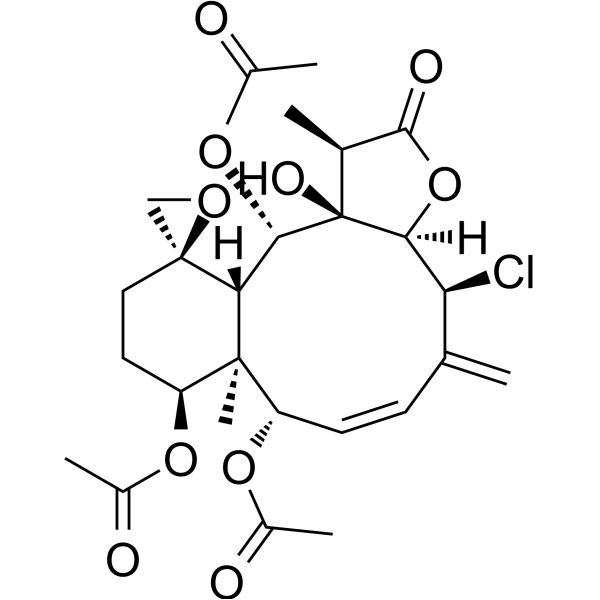
    Junceellolide C is a transcription inhibitor of cccDNA. Junceellolide C inhibits HBV DNA replication and significantly decreases the level of supernatant HBV RNA with EC50 values of 5.19, 3.52 μM respectively in HepAD38 cells. Junceellolide C is a potent anti-HBV agent .
    Junceellolide C
  • HY-149815

    HBV Infection Inflammation/Immunology
    HBV-IN-33 (C-49), a HBV inhibitor, notably suppresses HBV replication in HepAD38, HepG2-HBV1.3 and HepG2-NTCP cells .
    HBV-IN-33
  • HY-179265

    HBV Infection
    D-CAM-14 is a potent HBV capsid assembly modulator with potent anti-HBV activity (EC50 = 0.1 nM, EC90 = 9 nM in HepAD38 cells). D-CAM-14 suppresses HBeAg, and HBcAg in HBV-infected HepG2-NTCP cells, with EC50 values of 98 and 67 nM, respectively. D-CAM-14 has distinct impacts on capsid radii and the morphology of preassembled capsids. D-CAM-14 can be used for HBV infection disease research .
    D-CAM-14
  • HY-173120

    HBV Infection
    HBV-IN-51 (Compound 17e) is a potent HBV capsid assembly modulator. HBV-IN-51 exhibits remarkable anti-HBV activity with an EC50 of 0.033 μM in HepAD38 cells. HBV-IN-51 exhibits robust metabolic stability in plasma, and can be rapidly metabolized in human liver microsomes .
    HBV-IN-51
  • HY-162795

    HBV Infection
    HBV-IN-47 (compound 4a) is a capsid assembly regulator with inhibitory activity against hepatitis B virus (HBV). HBV-IN-47 exhibits strong anti-HBV activity in HepAD38 cells with low toxicity (EC50=0.24 μM). HBV-IN-47 can be used for the study of chronic hepatitis B (CHB) .
    HBV-IN-47
  • HY-B1067AR

    Phenazoline (Standard)

    Reference Standards Histamine Receptor Neurological Disease Endocrinology
    Antazoline (Phenazoline) (Standard) is the analytical standard of Antazoline. This product is intended for research and analytical applications. Antazoline is a histamine H1 receptor antagonist with anticholinergic and antiviral properties. Antazoline can prevent histamine from acting on target cells through a reversible competition effect on histamine receptor sites of these cells. Antazoline can exert an antiallegic effect and prevent the occurrence of physiological reactions from the effect of blocking as well as inhibiting H1 receptor. Antazoline can effectively reduce HBV DNA in the extracellular supernatant in a dose-dependent manner, with EC50 of 2.910 μmol/L in HepAD38 cells. Antazoline also has a significant inhibitory effect on HBV DNA in the extracellular supernatant of Huh7 cells (EC50 = 2.349 μmol/L). Antazoline has anti-arrhythmic effect in acute myocardial infarctions. Antazoline can be studied in research for cardiovascular diseases, and HBV .
    Antazoline (Standard)
  • HY-B1067R

    Phenazoline hydrochloride (Standard)

    Reference Standards Histamine Receptor HBV Neurological Disease Endocrinology
    Antazoline (hydrochloride) (Standard) is the analytical standard of Antazoline (hydrochloride). This product is intended for research and analytical applications. Antazoline hydrochloride is a histamine H1 receptor antagonist with anticholinergic and antiviral properties. Antazoline hydrochloride can prevent histamine from acting on target cells through a reversible competition effect on histamine receptor sites of these cells. Antazoline hydrochloride can exert an antiallegic effect and prevent the occurrence of physiological reactions from the effect of blocking as well as inhibiting H1 receptor. Antazoline hydrochloride can effectively reduce HBV DNA in the extracellular supernatant in a dose-dependent manner, with EC50 of 2.910 μmol/L in HepAD38 cells. Antazoline hydrochloride also has a significant inhibitory effect on HBV DNA in the extracellular supernatant of Huh7 cells (EC50 = 2.349 μmol/L). Antazoline hydrochloride has anti-arrhythmic effect in acute myocardial infarctions. Antazoline hydrochloride can be studied in research for cardiovascular diseases, and HBV .
    Antazoline hydrochloride (Standard)
  • HY-B1067BR

    Phenazoline phosphate (Standard)

    Reference Standards Histamine Receptor Neurological Disease Endocrinology
    Antazoline (phosphate) (Standard) is the analytical standard of Antazoline (phosphate). This product is intended for research and analytical applications. Antazoline phosphate is a histamine H1 receptor antagonist with anticholinergic and antiviral properties. Antazoline phosphate can prevent histamine from acting on target cells through a reversible competition effect on histamine receptor sites of these cells. Antazoline phosphate can exert an antiallegic effect and prevent the occurrence of physiological reactions from the effect of blocking as well as inhibiting H1 receptor. Antazoline phosphate can effectively reduce HBV DNA in the extracellular supernatant in a dose-dependent manner, with EC50 of 2.910 μmol/L in HepAD38 cells. Antazoline phosphate also has a significant inhibitory effect on HBV DNA in the extracellular supernatant of Huh7 cells (EC50 = 2.349 μmol/L). Antazoline phosphate has anti-arrhythmic effect in acute myocardial infarctions. Antazoline phosphate can be studied in research for cardiovascular diseases, and HBV .
    Antazoline phosphate (Standard)
  • HY-B1067B

    Phenazoline phosphate

    Histamine Receptor Neurological Disease Endocrinology
    Antazoline phosphate is an H1 receptor antagonist that affects the activity of the central nervous system, has a potent antiarrhythmic effect . Antazoline phosphate is a histamine H1 receptor antagonist with anticholinergic and antiviral properties. Antazoline phosphate can prevent histamine from acting on target cells through a reversible competition effect on histamine receptor sites of these cells. Antazoline phosphate can exert an antiallegic effect and prevent the occurrence of physiological reactions from the effect of blocking as well as inhibiting H1 receptor. Antazoline phosphate can effectively reduce HBV DNA in the extracellular supernatant in a dose-dependent manner, with EC50 of 2.910 μmol/L in HepAD38 cells. Antazoline phosphate also has a significant inhibitory effect on HBV DNA in the extracellular supernatant of Huh7 cells (EC50 = 2.349 μmol/L). Antazoline phosphate has anti-arrhythmic effect in acute myocardial infarctions. Antazoline phosphate can be studied in research for cardiovascular diseases, and HBV .
    Antazoline phosphate
  • HY-179393

    HBV Cancer
    HBV-IN-54 is a selective and orally active HBV inhibitor. HBV-IN-54 exhibits anti-HBV activity in both HepAD38 cells (EC50 = 0.020 μM, CC50 > 100 μM) and HLCZ01 cells (EC50 = 0.024 μM, CC50 > 100 μM). HBV-IN-54 inhibits viral replication in vivo. HBV-IN-54 displays favorable physicochemical properties and high plasma stability. HBV-IN-54 can be used for research on Hepatitis B (HBV) .
    HBV-IN-54
  • HY-174856

    PROTACs HBV Infection
    PROTAC HBeAg degrader-1 is a PROTAC targeting degradation agent for HBeAg. PROTAC HBeAg degrader-1 recruits the VHL E3 ligase but degrades HBV protein HBeAg through VHL-independent mechanism. PROTAC HBeAg degrader-1 decreases levels of secreted and intracellular HBeAg. PROTAC HBeAg degrader-1 can be used for the research of hepatitis B virus (HBV) . (Structure Note: Pink: HBeAg ligand (HY-174857); Blue: VHL Ligand (HY-125845); Black: linker; E3-linker (HY-135045))
    PROTAC HBeAg degrader-1
  • HY-180524

    HBV Infection
    CAB7-3 is an orally active HBV capsid assembly modulator (CAM). CAB7-3 exhibits an exceptional antiviral efficacy reducing HBV DNA with an EC50 = 70 nM, CC50 = 32.3 μM in HepDES19 cells. CAB7-3 exhibits significant anti-HBV activity in HBV-integrated HepDES19 (EC50 = 70 nM), HepAD38 (EC50 = 1 nM) and HBV-infected HLCZ01 cells (EC50 = 2 nM), respectively. CAB7-3 effectively reduces Hepatic HBV core protein levels and suppresses viral replication in vivo. CAB7-3 demonstrates a favorable drug-like and safety profile. CAB7-3 can be used for Hepatitis B Virus (HBV) research .
    CAB7-3

Inquiry Online

Your information is safe with us. * Required Fields.

Salutation


Country or Region *

Applicant Name *


Organization Name *

Department *


Email Address *


Product Name *

Cat. No.


Requested quantity *

Phone Number *


Remarks

Inquiry Online

Inquiry Information

Product Name:
Cat. No.:
Quantity:
MCE Japan Authorized Agent:

