6 Results for "

Jurkat effector cells

" in MedChemExpress (MCE) Product Catalog:
Products (6)

6 Results for "Jurkat effector cells" in MCE Product Catalog:

1
1 Cited Publications
Cat. No.: HY-P1684
CAS No.: 1319725-20-6
Synonyms: FOXP3 inhibitor P60
Peptide P60 is a FOXP3 inhibitor. Peptide P60 reduces the nuclear translocation of FOXP3 and impairs FOXP3-mediated inhibition of NF-κB and NFAT activity. Peptide P60 inhibits the immunosuppressive activity of regulatory T cells and restores the proliferation and activation of effector T cells. Peptide P60 induces lymphoproliferative autoimmune syndrome in neonatal ICR mice and reduces the number of CD4 +CD25 +Foxp3 + T cells in the spleen. Peptide P60 enhances the efficacy of AH1 (HY-P4193) peptide vaccine and recombinant adenovirus-based HCV NS3 vaccine in BALB/c mice, including protective effects against CT26 tumor implantation. Peptide P60 can be used in studies related to tumor immunity, viral infection and lymphoproliferative autoimmune syndrome .
loading...
    loading...
Cat. No.: HY-P5640
CAS No.: 179264-81-4
Target:  

Bacterial Parasite

Research Areas:  

Infection

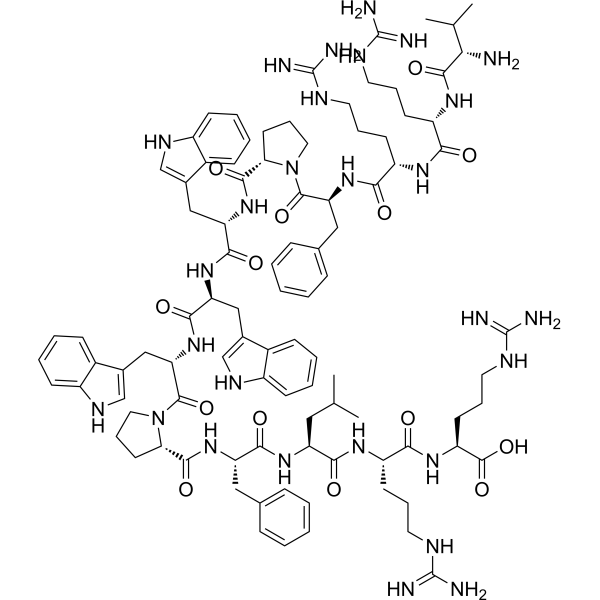
Tritrpticin is a porcine-derived antimicrobial peptide with properties such as membrane disruption and hemolysis. Tritrpticin disrupts the cell membranes of bacteria, fungi and Jurkat T cell leukemia cells and induces their death. Tritrpticin also enhances the efficacy of Metronidazole (HY-B0318) against *Trichomonas vaginalis*, reduces plasma endotoxin and inflammatory cytokine levels, restricts bacterial growth in blood and visceral tissues, decreases the mortality rate of septic shock in rats and enhances the therapeutic effect of ertapenem. Tritrpticin exhibits selective cytotoxicity against Jurkat T cell leukemia cells, while showing low toxicity to normal peripheral blood mononuclear cells and red blood cells, and can serve as a template for antimicrobial peptide design. Tritrpticin can be applied to research related to bacterial infections, fungal infections, trichomoniasis, septic shock and leukemia .
loading...
    loading...
Cat. No.: HY-172107
CAS No.: 2901054-39-3
Research Areas:  

Inflammation/Immunology Cancer

HPK1-IN-56 (Compound A29) is a HPK1 inhibitor (IC50: 2.70 nM). HPK1-IN-56 inhibits downstream p-SLP76 (IC50: 8.1 nM in Jurkat T cells). HPK1-IN-56 induces the production of IL-2 in human PBMCs. HPK1-IN-56 has anticancer effect, enhances T-cell killing ability and the antitumor efficacy of anti-PD-1 antibody .
loading...
    loading...
Cat. No.: HY-182799
Research Areas:  

Cancer

IBA-12 is a IKZF2 molecular glue/PROTAC degrader with a DC50 of 276.2 nM (Jurkat cells) and 461.8 nM (Mino cells), and an IC50 of 179.9 nM. IBA-12 binds to the canonical tryptophan triad pocket of CRBN to form a ternary complex with IKZF2. IBA-12 induces IKZF2 degradation mediated by the CRBN-dependent ubiquitin-proteasome system, with no effect on other CRBN substrates. IBA-12 induces the production of interleukin-2 (IL-2) through degrading IKZF2. IBA-12 is applicable to cancer immunology research .
loading...
    loading...
Cat. No.: HY-P992487
ZL-1211 is an anti-CLDN18.2 monoclonal antibody. ZL-1211 exhibits enhanced binding affinity to CD16A. ZL-1211 induces ADCC-mediated cell lysis and triggers the production of IFNγ, TNFα and IL6. ZL-1211 promotes antibody-dependent cellular cytotoxicity. ZL-1211 exerts anti-tumor activity in a mouse xenograft model of gastric cancer. ZL-1211 can be used for the research of gastric cancer .
loading...
    loading...
Cat. No.: HY-184441
CAS No.: 3116073-35-6
Research Areas:  

Cancer

CD28-IN-4 is a selective CD28 inhibitor with a human IC50 of 231 nM and a human Kd of 344 nM. CD28-IN-4 binds to CD28, disrupts its interaction with CD80, blocks CD28-mediated co-stimulatory signal transduction, and reduces cytokine secretion in a human primary tumor-PBMC and epithelial tissue co-culture model. CD28-IN-4 can be used for cancer-related research .
loading...
    loading...

