



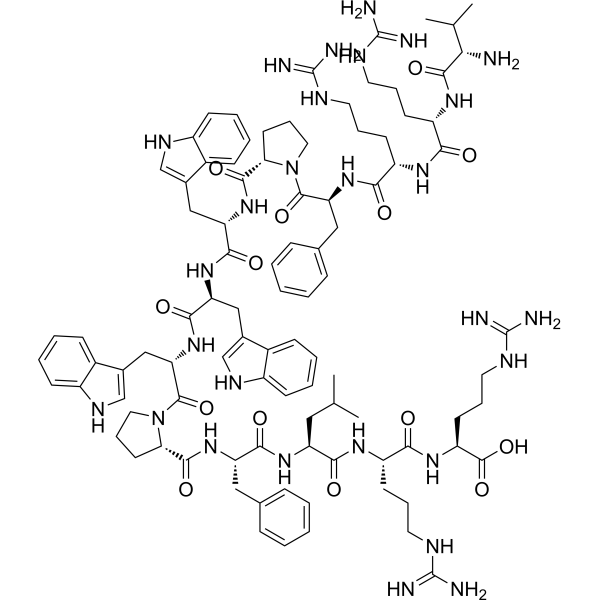
Tritrpticin
Tritrpticin is a porcine-derived antimicrobial peptide with properties such as membrane disruption and hemolysis. Tritrpticin disrupts the cell membranes of bacteria, fungi and Jurkat T cell leukemia cells and induces their death. Tritrpticin also enhances the efficacy of Metronidazole (HY-B0318) against *Trichomonas vaginalis*, reduces plasma endotoxin and inflammatory cytokine levels, restricts bacterial growth in blood and visceral tissues, decreases the mortality rate of septic shock in rats and enhances the therapeutic effect of ertapenem. Tritrpticin exhibits selective cytotoxicity against Jurkat T cell leukemia cells, while showing low toxicity to normal peripheral blood mononuclear cells and red blood cells, and can serve as a template for antimicrobial peptide design. Tritrpticin can be applied to research related to bacterial infections, fungal infections, trichomoniasis, septic shock and leukemia.
For research use only. We do not sell to patients.
- CAS No.: 179264-81-4
- Formula: C96H132N28O14
- Molecular Weight:1902.25
-
Storage:
Please store the product under the recommended conditions in the Certificate of Analysis.

To place orders, for customer services and technical support, please contact: MedChemExpress USA
Tel: 609-228-6898 E-mail: [email protected] [email protected]


-
 Biological Activity
-
Chemical Information
- Protocols
- Purity & Documentation
- References
-
 Help & FAQs


All Parasite Isoforms
More

Biological Activity
Description
In Vitro
Tritrpticin (8-64 μg/mL; 16 h) inhibits the growth of E. coli, S. typhimurium, P. aeruginosa, and C. albicans with an MIC of 32 μg/mL, B. subtilis and S. epidermidis with an MIC of 8 μg/mL, and S. aureus with an MIC of 16 μg/mL[1].
Tritrpticin (100 μg/mL; 1 h) induces 37% hemolysis of human red blood cells at a concentration of 100 μg/mL[1].
Tritrpticin (8 μg/mL; 2 min) induces 74% Calcein (HY-D0040) leakage from POPC/POPG (3:1) liposomes at a concentration of 8 μg/mL[1].
Tritrpticin (2.0-16 mg/L; 18 h) exhibits in vitro antibacterial activity against E. coli (MIC 2.0-8.0 mg/L) and E. faecalis (MIC 4-16 mg/L)[3].
Tritrpticin (10-40 μM; 24 h for Jurkat cells, PBMCs; 4 h for RBCs) potently induces cytotoxicity in Jurkat T-leukemia cells (IC50 = 18.3 μM) and exhibits lower toxicity towards normal PBMCs (IC50 = 40.6 μM) and minimal hemolytic activity against RBCs (IC50 ≥ 65 μM)[4].
MedChemExpress (MCE) has not independently confirmed the accuracy of these methods. They are for reference only.
-
Cell Line:Jurkat T-leukemia cells, primary peripheral blood mononuclear cells (PBMCs), red blood cells (RBCs)
-
Concentration:10-40 μM
-
Incubation Time:24 h (Jurkat cells, PBMCs); 4 h (RBCs)
-
Result:Exhibited cytotoxicity towards Jurkat cells with an IC50 of 18.3 μM.
Showed cytotoxicity towards PBMCs with an IC50 of 40.6 μM.
Induced hemolysis towards RBCs with an IC50 ≥ 65 μM.
In Vivo
Tritrpticin (1 mg/kg; i.v.; single dose) reduces 72-hour lethality to 35% and significantly lowers bacterial burdens in multiple tissues and plasma inflammatory mediator levels in cecal ligation and puncture-induced septic shock in Wistar rats[3].
MedChemExpress (MCE) has not independently confirmed the accuracy of these methods. They are for reference only.
-
Animal Model:Wistar (adult male, 200-300 g, LPS-induced septic shock)[3]
-
Dosage:1 mg/kg
-
Administration:i.p.; single dose
-
Result:Reduced plasma endotoxin to ≤0.015 EU/mL.
Reduced plasma IL-6 to 213.20 pg/mL.
Reduced plasma TNF-α to 0.26 ng/mL.
-
Animal Model:Wistar (adult male, 200-300 g, cecal ligation and puncture-induced septic shock)[3]
-
Dosage:1 mg/kg
-
Administration:i.v.; single dose
-
Result:Reduced 72-hour lethality to 35%.
Reduced bacterial count in blood to 8.8×10⁵ CFU/mL.
Reduced bacterial count in peritoneum to 8.2×10⁷ CFU/mL.
Reduced bacterial count in spleen to 7.0×10⁶ CFU/mL.
Reduced bacterial count in liver to 7.4×10⁶ CFU/mL.
Reduced bacterial count in mesenteric lymph nodes to 5.5×10⁷ CFU/mL.
Produced significant reductions in plasma endotoxin, IL-6, and TNF-α levels.
- Research Protocol for Infectious Diseases
- Cell Cytotoxicity Assay
- Mammalian live/dead viability and cytotoxicity staining
- PBMC Thawing for Immune Assays
- Aerobic Bacterial Batch Culture on Broth/Agar
- Research Protocol for Inflammation-related Diseases
- Research Protocol for Cancer Immunology
- Cell Viability Determination by MTT Colorimetric Assay


Chemical Information
-
CAS No. 179264-81-4
-
Molecular Weight 1902.25
-
Formula C96H132N28O14
-
Sequence
Val-Arg-Arg-Phe-Pro-Trp-Trp-Trp-Pro-Phe-Leu-Arg-Arg
-
Sequence Shortening
VRRFPWWWPFLRR
-
Shipping
Room temperature in continental US; may vary elsewhere.
-
Storage
Please store the product under the recommended conditions in the Certificate of Analysis.


Purity & Documentation
References
[1]. Yang ST, et al. Conformation-dependent antibiotic activity of tritrpticin, a cathelicidin-derived antimicrobial peptide. Biochem Biophys Res Commun. 2002;296(5):1044-1050. [Content Brief]
[2]. Infante VV, et al. Effect of the antimicrobial peptide tritrpticin on the in vitro viability and growth of Trichomonas vaginalis. Curr Microbiol. 2011;62(1):301-306. [Content Brief]
[3]. Ghiselli R, et al. The cathelicidin-derived tritrpticin enhances the efficacy of ertapenem in experimental rat models of septic shock. Shock. 2006;26(2):195-200. [Content Brief]
[4]. Arias M, et al. Selective anticancer activity of synthetic peptides derived from the host defence peptide tritrpticin. Biochim Biophys Acta Biomembr. 2020;1862(8):183228. [Content Brief]

Calculators
Concentration (start) × Volume (start) = Concentration (final) × Volume (final)


Tritrpticin Related Classifications
HY-P5640 Related Classifications
 Powered by Bioz