
15 Results for "

Leuconostoc

" in MedChemExpress (MCE) Product Catalog:
Products (15)

15 Results for "Leuconostoc" in MCE Product Catalog:

1
1 Cited Publications
Cat. No.: HY-N0913A
CAS No.: 3371-50-4
Research Areas:  

Others

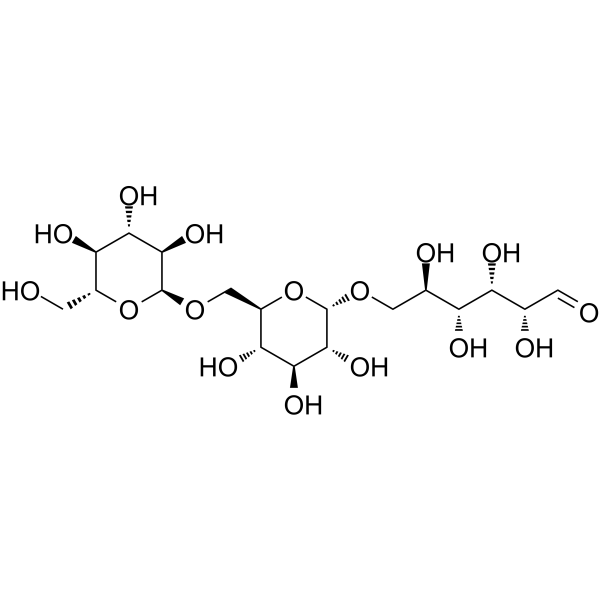
Isomaltotriose is a sugar from enzymic hydrolyzates of the dextran from Leuconostoc mesenteroides NRRL B-512 .
loading...
    loading...
Cat. No.: HY-W134328
CAS No.: 87915-38-6
Synonyms: Dextran blue (MW 2000000)
Blue dextran (Dextran blue) (MW 2000000) is a high-molecular-weight long-chain polymer of D-glucose. Blue dextran (MW 2000000) serves as an important model macromolecular drug and molecular weight estimation marker, and can be used as a standard for gel permeation chromatography. The release of Blue dextran (MW 2000000) from alginate microspheres is regulated by preparation conditions; its release rate in a pH 6.8 environment is significantly faster than that in pH 1.2, and it exhibits release characteristics close to zero-order kinetics under this condition .
loading...
    loading...
Cat. No.: HY-136593
CAS No.: 23508-35-2
Purity:  99.77%
Synonyms: (S)-3-(4-Hydroxyphenyl)lactic acid
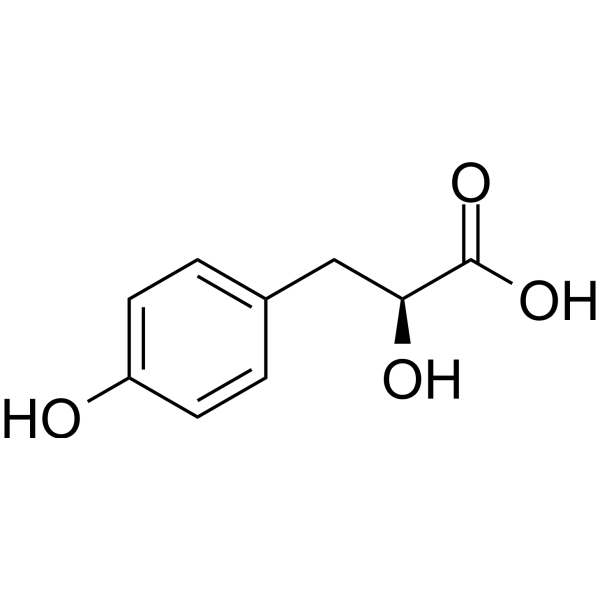
(S)-3-(4-Hydroxyphenyl)-2-hydroxypropionic acid (Compound 1) is a metabolite. (S)-3-(4-Hydroxyphenyl)-2-hydroxypropionic acid can be isolated from the culture medium of Leuconostoc mesenteroides. (S)-3-(4-Hydroxyphenyl)-2-hydroxypropionic acid has strong antioxidant activity .
loading...
    loading...
Cat. No.: HY-159067
CAS No.: 9064-91-9
Synonyms: DEAE-dextran, MW 500000 hydrochloride, from bacterial (Leuconostoc mesenteroides); Diethylaminoethyl-dextran, MW 500000 hydrochloride
DEAE-dextran, MW 500000 hydrochloride (DEAE-dextran, MW 500000 hydrochloride, from bacterial (Leuconostoc mesenteroides)) is a high-molecular-weight positively charged polymer that significantly enhances the uptake of viral RNA by tissue culture cells. When employed in the delivery system for "tumor immunity" RNA-splenocyte transfer, DEAE-dextran can markedly extend the lifespan of tumor-bearing animals, comparable to that of actively immunized animals. Furthermore, DEAE-dextran serves as a complexing agent for nucleic acids, forming composite particles with DNA/RNA for extensive applications in gene delivery. Additionally, DEAE-dextran can be utilized as a coating for liposomes .
loading...
    loading...
Cat. No.: HY-125863A
CAS No.: 9001-40-5
Synonyms: G6PD (Leuconostoc sp., recombinant)
Research Areas:  

Metabolic Disease

Glucose-6-phosphate dehydrogenase (Leuconostoc sp., recombinant) is an NADP-dependent enzyme in the pentose phosphate pathway, which is one of the ways glucose is metabolized. Glucose-6-phosphate dehydrogenase (Leuconostoc sp., recombinant) can be used to quantify ATP, glucose, and creatine kinase .
loading...
    loading...
Cat. No.: HY-103658
CAS No.: 15809-19-5
Synonyms: Miramistin
Research Areas:  

Infection

Myramistin (Miramistin) is a cationic surfactant and disinfectant preservative. Myramistin exhibits high bactericidal activity against Staphylococcus aureus and Escherichia coli, shows lower activity against yeasts and fungi, and is active against HIV, measles virus, mumps virus, as well as influenza viruses of the H3N2 and H5N1 subtypes. Myramistin adsorbs to the negatively charged microbial cell membrane, leading to increased membrane permeability and disruption of membrane integrity, which ultimately results in leakage of intracellular contents, enzyme inactivation, and the death of bacteria/fungi/enveloped viruses .
loading...
    loading...
Cat. No.: HY-P2723
CAS No.: 9032-14-8
Target:  

Endogenous Metabolite

Research Areas:  

Metabolic Disease

Dextran sucrase is an extracellular glucosyltransferase. It uses sucrose as a glucosyl donor to transfer D-glucopyranosyl groups to growing dextran chains, while releasing fructose, thereby catalyzing the synthesis of dextran with α-(1→6) glycosidic bonds as the main component. In the presence of acceptor sugars such as maltose, dextran sucrase also catalyzes the synthesis of oligosaccharides. Dextran sucrase can be used in studies related to dextran, glucooligosaccharides and glycosyl transfer .
loading...
    loading...
Cat. No.: HY-P11547
CAS No.: 159605-63-7
Target:  

Bacterial

Research Areas:  

Infection

Plantaricin F is an antibacterial peptide. Plantaricin F strongly inhibits several gram-negative bacteria including the foodbome pathogens Salmonella enteritidis and Pseudomonas aeruginosa. Plantaricin F inhibits several Lactobacillus, Pediococcus and Leuconostoc species .
loading...
    loading...
Cat. No.: HY-P11134
Synonyms: LeuA
Target:  

Bacterial

Research Areas:  

Infection

Leucocin A (LeuA), a 37-amino acid peptide, is a class II bacteriocin without Lanthionine (HY-135113). Leucocin A has potent anti-bacterial activity against gram-positive bacteria, such as Leuconostoc paramesenteroides and Lactobacillus sake with MICs of 69 and 39 nM, respectively. Leucocin A can be used for infectious diseases research .
loading...
    loading...
Cat. No.: HY-E70978
Target:  

Endogenous Metabolite

Research Areas:  

Metabolic Disease

6-Phosphogluconolactonase, Leuconostoc mesenteroides is an enzyme in the pentose phosphate pathway. 6-Phosphogluconolactonase, Leuconostoc mesenteroides converts 6-phosphogluconolactone to 6-phosphogluconate.
loading...
    loading...
Cat. No.: HY-E70913B
Research Areas:  

Metabolic Disease

Phosphotransacetylase, Leuconostoc mesenteroides (EC 2.3.1.8) converts coenzyme A to acetyl-CoA. Phosphotransacetylase, Leuconostoc mesenteroides (EC 2.3.1.8) belongs to the transtransferase family and participates in three metabolic pathways: taurine and linolenic acid metabolism, pyruvate metabolism, and propionic acid metabolism.
loading...
    loading...
Cat. No.: HY-P2897C
Research Areas:  

Metabolic Disease

D-Lactic Dehydrogenase, Leuconostoc mesenteroides (EC 1.1.1.28) is an oxidoreductase that acts on the CH-OH group in the donor molecule and uses cytochrome as the acceptor. D-Lactic Dehydrogenase, Leuconostoc mesenteroides (EC 1.1.1.28) is involved in pyruvate metabolism. It uses a cofactor, namely FAD.
loading...
    loading...
Cat. No.: HY-E71039
Research Areas:  

Others

Chemically modified Glucose-6-phosphate Dehydrogenase, Leuconostoc mesenteroides is a cytosolic enzyme. Chemically modified Glucose-6-phosphate Dehydrogenase, Leuconostoc mesenteroides is in the pentose phosphate pathway, a metabolic pathway that supplies reducing energy to cells (such as erythrocytes) by maintaining the level of the co-enzyme nicotinamide adenine dinucleotide phosphate (NADPH) .
loading...
    loading...
Cat. No.: HY-W248922
CAS No.: 2316-62-3
Target:  

PDI

Research Areas:  

Infection

2,6-Dibromo-4-(hydroxymethyl) phenol (Compound 5) acts as a selective inhibitor of Saccharomyces cerevisiae glucose-6-phosphate dehydrogenase, with an IC50 value of 50.2 μM, and shows no activity against Leuconostoc mesenteroides glucose-6-phosphate dehydrogenase .
loading...
    loading...
Cat. No.: HY-103658R
CAS No.: 15809-19-5
Synonyms: Miramistin (Standard)
Myramistin (Miramistin) (Standard) is the analytical standard of Myramistin (HY-103658). This product is intended for research and analytical applications. Myramistin is a cationic surfactant and disinfectant preservative. Myramistin exhibits high bactericidal activity against Staphylococcus aureus and Escherichia coli, shows lower activity against yeasts and fungi, and is active against HIV, measles virus, mumps virus, as well as influenza viruses of the H3N2 and H5N1 subtypes. Myramistin adsorbs to the negatively charged microbial cell membrane, leading to increased membrane permeability and disruption of membrane integrity, which ultimately results in leakage of intracellular contents, enzyme inactivation, and the death of bacteria/fungi/enveloped viruses .
loading...
    loading...
  • 1

