
1. Search Result
Search Result
Results for "

Peptide fiber

" in MedChemExpress (MCE) Product Catalog:

9

Inhibitors & Agonists

1

Biochemical Assay Reagents

11

Peptides

Cat. No. Product Name Target Research Areas Chemical Structure
  • HY-P0064

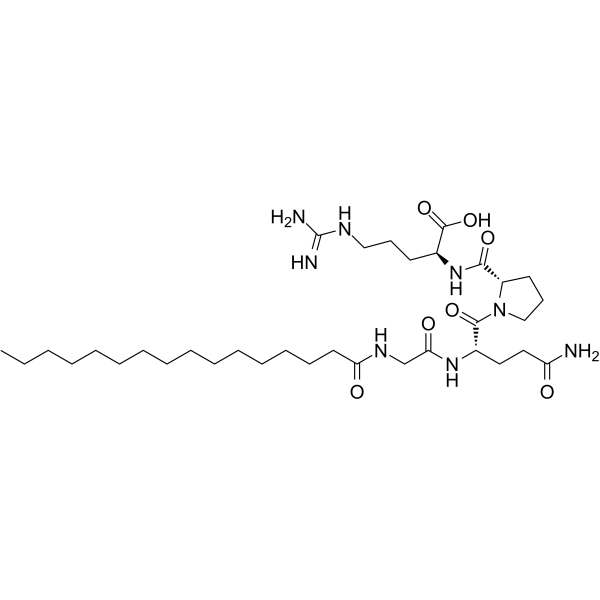
    Palmitoyl TetraPeptide-7

    Interleukin Related Inflammation/Immunology
    Palmitoyl Tetrapeptide-3 (Palmitoyl Tetrapeptide-7) is a synthetic peptide corresponding to amino acids 341-344 of the human immunoglobulin heavy chain, with the ability to stimulate phagocytosis. Palmitoyl tetrapeptide-3 reduces interleukin-6 (IL-6) secretion in keratinocytes and inhibits the UVB radiation-exposure inflammatory response of skin. Palmitoyl tetrapeptide-3 It also has anti-inflammatory and anti-aging effects, reducing skin wrinkles by promoting the production of elastic fibers in the papillary dermis .
    Palmitoyl Tetrapeptide-3
  • HY-W835525

    Biochemical Assay Reagents Others
    N-(Biotinoyl)-N''-(iodoacetyl)ethylenediamine is a biotinylated biochemical assay reagent that forms a layer of biotin derivative on the surface of ORMOCER, and triggers the assembly of peptide nanostructured fibers. N-(Biotinoyl)-N''-(iodoacetyl)ethylenediamine can be used for 3D assembly of peptides in molecular electronics, biosensors, and tissue engineering .
    N-(Biotinoyl)-N''-(iodoacetyl)ethylenediamine
  • HY-P10675

    Biochemical Assay Reagents Metabolic Disease
    Peptide K is a self-assembling peptide fiber that can be used to prepare fibrous nanocomposite hydrogels. The fibrous nanocomposite hydrogels have a dynamic network that adapts to cells and enhances cell-matrix and cell-cell interactions, thus significantly promoting the mechanotransduction, metabolic energy, and osteogenesis of encapsulated stem cells .
    Peptide K
  • HY-P10712

    Biochemical Assay Reagents Others
    Nap-GFFY, a naphthylacetic acid modifi ed tetrapeptide of GFFY, is a self-assembling fiber peptide .
    Nap-GFFY
  • HY-P10494

    Amyloid-β Neurological Disease
    FEFEFKFK is an octapeptide that self-assembles into fibrillar structures. FEFEFKFK is able to form gels at concentrations greater than about 7 mg/mL. The self-assembly and gelation properties of FEFEFKFK help to understand the mechanism of amyloid fibril formation in protein misfolding diseases such as Alzheimer's disease and Parkinson's disease .
    FEFEFKFK
  • HY-P10702

    Biochemical Assay Reagents Others
    SAF-p1 is a self-assembling fiber peptide that can form sticky-ended heterodimers by assembling with SAF-p2 (HY-P10703) through complementary amino acid sequences. These heterodimers further self-assemble into long-chain fiber structures. SAF-p1 is promising for the development of nanomaterials in the biomedical field .
    SAF-p1
  • HY-P10703

    Biochemical Assay Reagents Others
    SAF-p2 is a self-assembling fiber peptide that can form sticky-ended heterodimers by assembling with SAF-p2 (HY-P10702) through complementary amino acid sequences. These heterodimers further self-assemble into long-chain fiber structures. SAF-p2 is promising for the development of nanomaterials in the biomedical field .
    SAF-p2
  • HY-P10630

    Amyloid-β Neurological Disease
    Pep63 is a neuroprotective peptide (VFQVRARTVA). Pep63 has a neuroprotective effect on synaptic plasticity and memory. Pep63 can competitively bind with Aβ1-42 oligomers, and can block Aβ fiber formation. Pep63 can be used for Alzheimer’s disease (AD) research .
    Pep63
  • HY-P11615

    Bacterial Infection
    FuK is a WK2-analog antimicrobial peptide modified with fluorinated unnatural amino acids. FuK has an LD50 of 72.34 mg/kg in mice, shows no hemolytic activity, with high stability against trypsin, chymotrypsin, and saline environments. FuK exerts bactericidal effects by enhancing the permeability of bacterial outer membranes, inducing depolarization of cytoplasmic membranes, and disrupting membrane potential balance against bacterias such as Staphylococcus aureus, Escherichia coli, Klebsiella pneumoniae, and MRSA. FuK exhibits synergistic antimicrobial activity with polymyxin B (HY-149179), vancomycin (HY-B0671), and ciprofloxacin (HY-B0356), and also inhibits Ciprofloxacin-induced bacterial drug resistance. FuK has in vivo safety, effectively reduces bacterial load and inflammatory cell infiltration in a mouse MRSA model, and promotes collagen fiber formation in skin wounds .
    FuK

Inquiry Online

Your information is safe with us. * Required Fields.

Salutation


Country or Region *

Applicant Name *


Organization Name *

Department *


Email Address *


Product Name *

Cat. No.


Requested quantity *

Phone Number *


Remarks

Inquiry Online

Inquiry Information

Product Name:
Cat. No.:
Quantity:
MCE Japan Authorized Agent:

