



Laminin peptide CDPGYIGSR TFA

Based on 1 Customer Validation
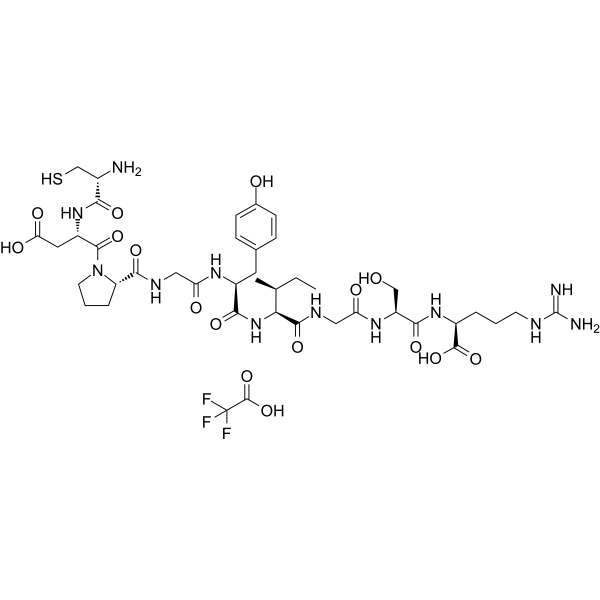
Laminin peptide CDPGYIGSR TFA (Laminin (925-933) TFA) is a peptide fragment derived from the laminin B1 chain that binds to laminin receptors, and acts as a ligand for the laminin receptor. Laminin peptide CDPGYIGSR TFA mediates cell spreading, induces the clustering of receptors with vinculin and α-actinin, regulates the actin cytoskeleton, promotes the formation of stress fibers, and enhances epithelial cell adhesion. Laminin peptide CDPGYIGSR TFA can be used in studies related to tumor metastasis and nerve injury.
For research use only. We do not sell to patients.
- Purity : 99.75%
- CAS No.: 2828432-44-4
- Formula: C42H63F3N12O16S
- Molecular Weight:1081.08
-
Storage:
Sealed storage, away from moisture.
Powder -80°C, 2 years , -20°C, 1 year* In solvent : -80°C, 6 months; -20°C, 1 month (sealed storage, away from moisture)

To place orders, for customer services and technical support, please contact: MedChemExpress USA
Tel: 609-228-6898 E-mail: [email protected] [email protected]


-
 Biological Activity
-
Chemical Information
-
Solvent & Solubility
- Protocols
- Purity & Documentation
- References
-
 Help & FAQs





Biological Activity
Description
In Vitro
Laminin peptide CDPGYIGSR TFA promotes the adhesion of human fibrosarcoma HT-1080 cells, with a maximum adhesion rate of 64% at a concentration of 60 μg; in contrast, its amide form (CDPGYIGSR-NH2) achieves a maximum adhesion rate of 100% at the same concentration; modification of the arginine residue in CDPGYIGSR with 1,2-cyclohexanedione completely abolishes its adhesive activity[2].
Laminin peptide CDPGYIGSR TFA confirms the presence of this peptide segment (with or without PEG spacer arms) on EA75 films[3].
Laminin peptide CDPGYIGSR TFA is chemically conjugated to PEG10 to form PEG10-CDPGYIGSR. When immobilized on EA75 films, this conjugate significantly enhances PC2 cell adhesion capacity but fails to induce obvious neurite outgrowth without extra laminin coating; after laminin modification, it markedly boosts PC12 cell adhesion, neurite generation and average neurite length[3].
Laminin peptide CDPGYIGSR (YIGSR) TFA binds non-covalently to t-chitosan/HAp tubes and covalently to t-chitosan/HAp-SH tubes[5].
MedChemExpress (MCE) has not independently confirmed the accuracy of these methods. They are for reference only. Further protocols information, click here.
In Vivo
MedChemExpress (MCE) has not independently confirmed the accuracy of these methods. They are for reference only.


Chemical Information
-
CAS No. 2828432-44-4
-
Appearance Solid
-
Molecular Weight 1081.08
-
Formula C42H63F3N12O16S
-
Color White to off-white
-
Synonyms
Laminin (925-933) TFA
-
Sequence
Cys-Asp-Pro-Gly-Tyr-Ile-Gly-Ser-Arg
-
Sequence Shortening
CDPGYIGSR
-
Shipping
Room temperature in continental US; may vary elsewhere.
-
Storage
Sealed storage, away from moisture
Powder -80°C 2 years -20°C 1 year * In solvent : -80°C, 6 months; -20°C, 1 month (sealed storage, away from moisture)


Solvent & Solubility
In Vitro:
H2O : 50 mg/mL (46.25 mM; Need ultrasonic)
Please refer to the solubility information to select the appropriate solvent. Once prepared, please aliquot and store the solution to prevent product inactivation from repeated freeze-thaw cycles.
Storage method and period of stock solution: -80°C, 6 months; -20°C, 1 month (sealed storage, away from moisture). When stored at -80°C, please use it within 6 months. When stored at -20°C, please use it within 1 month.
* Note: If you choose water as the stock solution, please dilute it to the working solution, then filter and sterilize it with a 0.22 μm filter before use.
Please refer to the solubility information to select the appropriate solvent. Once prepared, please aliquot and store the solution to prevent product inactivation from repeated freeze-thaw cycles.
Storage method and period of stock solution: -80°C, 6 months; -20°C, 1 month (sealed storage, away from moisture). When stored at -80°C, please use it within 6 months. When stored at -20°C, please use it within 1 month.
* Note: If you choose water as the stock solution, please dilute it to the working solution, then filter and sterilize it with a 0.22 μm filter before use.
Concentration (start) × Volume (start) = Concentration (final) × Volume (final)
In Vivo:
For the following dissolution methods, please prepare the working solution directly:
It is recommended to prepare fresh solutions and use them promptly within a short period of time.
The percentages shown for the solvents indicate their volumetric ratio in the final prepared solution. If precipitation or phase separation occurs during preparation, heat and/or sonication can be used to aid dissolution.
Add each solvent one by one: PBS
Solubility: 50 mg/mL (46.25 mM); Clear solution; Need ultrasonic

Protocols
-
Orthotopic Cell-Line Xenograft
Orthotopic cell-line xenograft models involve implantation of human cancer cell lines into the anatomically corresponding organ of immunodeficient mice to reproduce tumor growth within a native microenvironment, enabling more clinically relevant tumor behavior compared with subcutaneous models. These models are widely used because orthotopic placement better recapitulates tumor progression, including invasion and metastatic spread, which are often underrepresented in heterotopic implantation systems. Compared with conventional xenografts, orthotopic implantation is described as more technically complex but provides improved simulation of tumor-microenvironment interactions and metastatic behavior, making it particularly valuable for translational oncology research. Surgical orthotopic implantation approaches have been emphasized as enabling faithful reproduction of clinical cancer features, including metastasis and disease progression patterns that align with the tumor’s organ of origi
-
Phalloidin F-actin cytoskeleton staining
Phalloidin F-actin staining detects polymerized filamentous actin in fixed and permeabilized specimens by using fluorescent phalloidin or phalloidin-derived phallotoxins that bind actin filaments and generate a fluorescence microscopy readout corresponding to F-actin organization, including stress fibers, cortical actin, filament bundles, and tissue-specific actin networks. Phalloidin stabilizes F-actin by reducing actin subunit dissociation from filament ends, and fluorescent phallotoxins were established as tools for visualizing actin-containing structures in eukaryotic cells.


Purity & Documentation
-
Data Sheet (285 KB)
-
SDS (254 KB)
- English - EN (254 KB)
- Français - FR (254 KB)
- Deutsch - DE (254 KB)
- Norwegian - NO (254 KB)
- Español - ES (254 KB)
- Swedish - SV (254 KB)
- Italian - IT (254 KB)
- Korean - KR (254 KB)
- Portuguese - PT (254 KB)
-
Handling Instructions (2659 KB)
References
[1]. Massia SP, et al. Covalently immobilized laminin peptide Tyr-Ile-Gly-Ser-Arg (YIGSR) supports cell spreading and co-localization of the 67-kilodalton laminin receptor with alpha-actinin and vinculin. The Journal of biological chemistry. 1993 Apr 15;268(11):8053-9. [Content Brief]
[2]. Graf J, et al. A pentapeptide from the laminin B1 chain mediates cell adhesion and binds the 67,000 laminin receptor. Biochemistry. 1987 Nov 03;26(22):6896-900. [Content Brief]
[3]. Bhagwat N, et al. Biofunctionalization of PEDOT films with laminin-derived peptides. Acta biomaterialia. 2016 Sep 01;41:235-46. [Content Brief]
[4]. Castellano F, et al. An Overview of l-Amino Acid Oxidase Functions from Bacteria to Mammals: Focus on the Immunoregulatory Phenylalanine Oxidase IL4I1. Molecules (Basel, Switzerland). 2017 Dec 05;22(12):2151. [Content Brief]
[5]. Itoh S, et al. Effects of a laminin peptide (YIGSR) immobilized on crab-tendon chitosan tubes on nerve regeneration. Journal of biomedical materials research. Part B, Applied biomaterials. 2005 May;73(2):375-82. [Content Brief]


Complete Stock Solution Preparation Table
Please refer to the solubility information to select the appropriate solvent. Once prepared, please aliquot and store the solution to prevent product inactivation from repeated freeze-thaw cycles.
Storage method and period of stock solution: -80°C, 6 months; -20°C, 1 month (sealed storage, away from moisture). When stored at -80°C, please use it within 6 months. When stored at -20°C, please use it within 1 month.
| Optional Solvent | Concentration Solvent Mass | 1 mg | 5 mg | 10 mg | 25 mg |
|---|---|---|---|---|---|
| H2O | 1 mM | 0.9250 mL | 4.6250 mL | 9.2500 mL | 23.1250 mL |
| 5 mM | 0.1850 mL | 0.9250 mL | 1.8500 mL | 4.6250 mL | |
| 10 mM | 0.0925 mL | 0.4625 mL | 0.9250 mL | 2.3125 mL | |
| 15 mM | 0.0617 mL | 0.3083 mL | 0.6167 mL | 1.5417 mL | |
| 20 mM | 0.0463 mL | 0.2313 mL | 0.4625 mL | 1.1563 mL | |
| 25 mM | 0.0370 mL | 0.1850 mL | 0.3700 mL | 0.9250 mL | |
| 30 mM | 0.0308 mL | 0.1542 mL | 0.3083 mL | 0.7708 mL | |
| 40 mM | 0.0231 mL | 0.1156 mL | 0.2313 mL | 0.5781 mL |
* Note: If you choose water as the stock solution, please dilute it to the working solution, then filter and sterilize it with a 0.22 μm filter before use.


Laminin peptide CDPGYIGSR TFA Related Classifications
HY-P0131A Related Classifications
 Powered by Bioz