1. Search Result
Search Result
Results for "

Peptoids

" in MedChemExpress (MCE) Product Catalog:

12

Inhibitors & Agonists

1

Screening Libraries

1

Biochemical Assay Reagents

7

Peptides

2

Click Chemistry

Cat. No. Product Name Target Research Areas Chemical Structure
  • HY-W007655

    Biochemical Assay Reagents Amino Acid Derivatives Others
    Fmoc-D-Lys (Boc)-OH is an Fmoc- and Boc-protected D-lysine derivative. Fmoc-D-Lys (Boc)-OH ensures the precise incorporation of D-lysine into peptide chains, maintaining the specific conformation and biological activity of peptides. Fmoc-D-Lys (Boc)-OH can be used in research on the synthesis of peptides containing unnatural amino acids .
    Fmoc-D-Lys(Boc)-OH
  • HY-107987

    CXCR Endocrinology
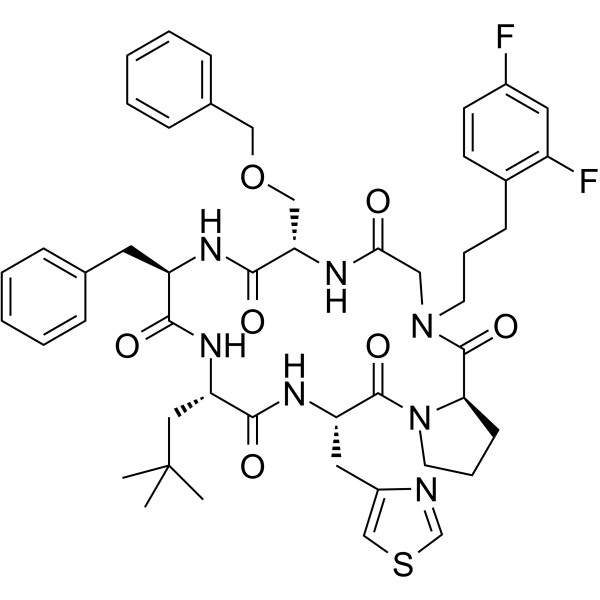
    CXCR7 modulator 1 (compound 25) is a potent and orally bioavailable peptoid hybrid CXCR7 modulator, with a Ki of 9 nM .
    CXCR7 modulator 1
  • HY-P3430

    Biochemical Assay Reagents Cancer
    JM3A is a highly specific peptoid reagent that targets newly appears cell surface vimentin (CSV) on tumor-transformed early lung cancer cells. JM3A can detect and stain CSV by coupling with fluorophores .
    JM3A
  • HY-151738

    ADC Linker Others
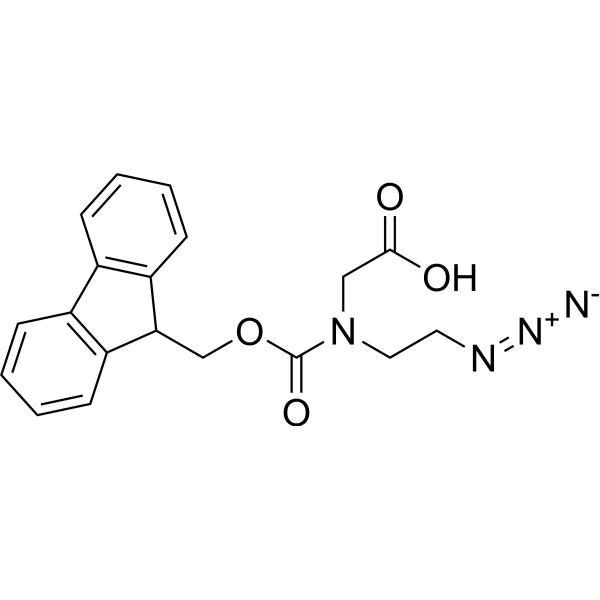
    Fmoc-Aeg(N3)-OH is a click chemistry reagent containing an Azide. Alkylating the Nitrogen of an amide bond results in peptoid structures, which leads to conformational restrains, like N-methylation and allows backbone derivatisation. Altering cytotoxicity, bacterial cell selectivity and receptor pharmacology through formation of peptoid derivatives have been published for Cilengitide, Piscidin 1, and MC3, MC4 and MC5 receptor agonist. This building block enables design of macrocycles through intermolecular crosslinking or backbone stabilization through intermolecular ring-closure. This compound is a potential building block for the construction of (customized) peptide nucleic acids (PNAs) and for peptoid synthesis . Fmoc-Aeg(N3)-OH is a click chemistry reagent, it contains an Azide group and can undergo copper-catalyzed azide-alkyne cycloaddition reaction (CuAAc) with molecules containing Alkyne groups. It can also undergo strain-promoted alkyne-azide cycloaddition (SPAAC) reactions with molecules containing DBCO or BCN groups.
    Fmoc-Aeg(N3)-OH
  • HY-P11007

    β-catenin Wnt Androgen Receptor Cancer
    β-catenin inhibitory peptoid (compound 13) inhibits the β-catenin:TCF interaction with an IC50 of 5.44 µM. β-catenin inhibitory peptoid inhibits both Wnt (IC50 of 0.105 µM) and androgen receptor (AR)-signaling (IC50 of 1.02 µM) in prostate cancer cell lines. β-catenin inhibitory peptoid markedly diminishes cell proliferation of prostate cancer cell lines .
    β-catenin inhibitory peptoid
  • HY-151778

    ADC Linker Others
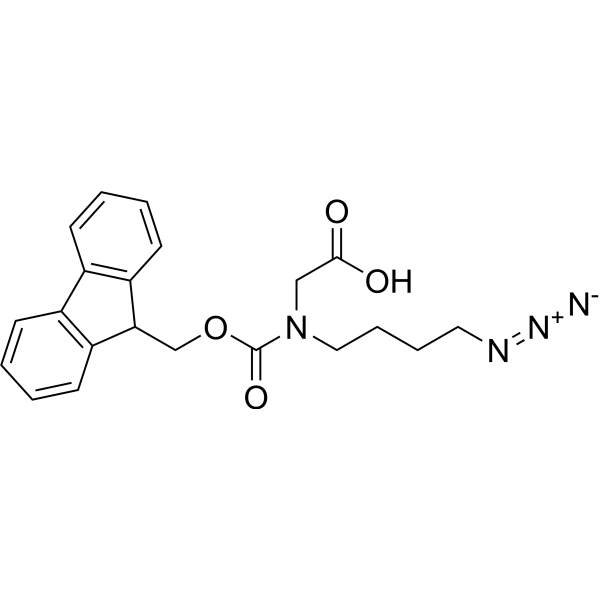
    Fmoc-Abg(N3)-OH is a click chemistry reagent containing an azide group. Fmoc-Abg(N3)-OH has the potential to synthesize peptide nucleic acids (PNA) and peptoids. It contains an azide group and can undergo copper-catalyzed azide-alkyne cycloaddition (CuAAc) with molecules containing alkyne groups. It can also undergo ring strain-promoted alkyne-azide cycloaddition (SPAAC) with molecules containing DBCO or BCN groups.
    Fmoc-Abg(N3)-OH
  • HY-P4873

    Amylin Receptor Neurological Disease
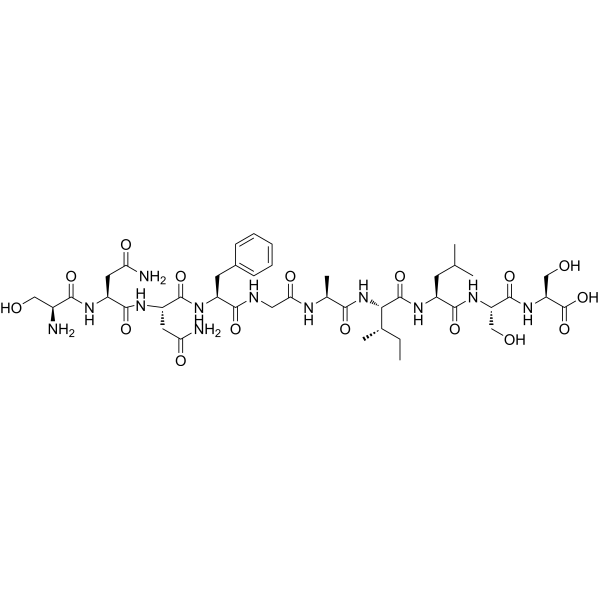
    Amylin (20-29) (human) is the fragment of human islet amyloid polypeptide (hIAPP) or Amylin. Amylin is a 37-residue hormone. Amylin (20-29) (human) is responsible for the amyloidogenic propensities of the full length protein. Amylin (20-29) (human) can be transformed into its corresponding peptoid and retropeptoid sequences, to obtain beta-sheet breaker peptides as amyloid inhibitors .
    Amylin (20-29) (human)
  • HY-118971

    Bacterial Infection
    CHIR-29498 is an antibacterial peptoid. CHIR-29498 is active against both Gram-positive and Gram-negative bacteria. CHIR-29498 can be used for the study of fatal Staphylococcus aureus .
    CHIR-29498
  • HY-P11659

    Antibiotic Bacterial Infection
    B26 peptoid is a ptoid antibiotic. B26 peptoid exhibits excellent broad-spectrum activity and high selectivity toward a panel of Gram-positive and Gram-negative bacterial strains. B26 peptoid disrupts bacterial membranes and has bactericidal activity. B26 peptoid shows low propensity for bacterial drug resistance. B26 peptoid can be used for the research of bacterial infection .
    B26 peptoid
  • HY-P11657

    Bacterial Infection
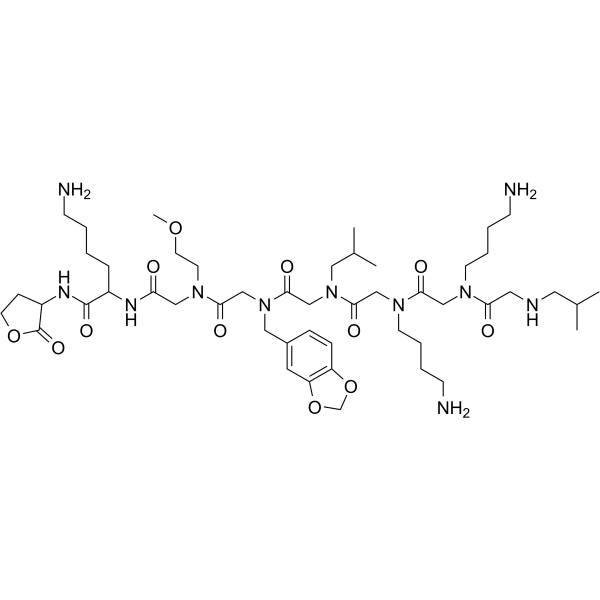
    GN-2 peptoid is a 9-mer cationic amphipathic peptoid and bactericidal agent with an overall net charge of +4, broad-spectrum antimicrobial activity, and low hemolytic and cytotoxic activity against mammalian cells. GN-2 peptoid exerts bactericidal action against Escherichia coli in a concentration-dependent manner. GN-2 peptoid exhibits antimicrobial activity against Gram-positive Staphylococcus aureus and Gram-negative Escherichia coli, Pseudomonas aeruginosa strains. GN-2 peptoid shows low toxicity against human red blood cells and HeLa cells. GN-2 peptoid maintains antimicrobial activity in the presence of 50% human blood plasma. GN-2 peptoid can be used for the research of bacterial infections .
    GN-2 peptoid
  • HY-P11661

    Epigenetic Reader Domain Inflammation/Immunology
    DC-peptoid-1 is a specific binder and crosslinker targeting the phosphorylated Brd4 PDID domain, with a dissociation constant (Kd) of approximately 50-100 μM for human-derived targets. DC-peptoid-1 only binds to phosphorylated PDID and fails to recognize the non-phosphorylated form or other domains (such as Brd4 598-785). DC-peptoid-1 effectively crosslinks with the target protein both in solution and cell lysates. It can successfully capture phosphorylated PDID from complex systems via immobilization, without binding to bacterial-derived non-phosphorylated proteins or other non-specific phosphoproteins. DC-peptoid-1 has the potential to serve as a phosphoprotein-specific antibody substitute for applications such as immunoaffinity purification .
    DC-peptoid-1
  • HY-107987R

    Reference Standards CXCR Endocrinology
    CXCR7 modulator 1 (Standard) is the analytical standard of CXCR7 modulator 1 (HY-107987). This product is intended for research and analytical applications. CXCR7 modulator 1 (compound 25) is a potent and orally bioavailable peptoid hybrid CXCR7 modulator, with a Ki of 9 nM .
    CXCR7 modulator 1 (Standard)

Inquiry Online

Your information is safe with us. * Required Fields.

Salutation


Country or Region *

Applicant Name *


Organization Name *

Department *


Email Address *


Product Name *

Cat. No.


Requested quantity *

Phone Number *


Remarks

Inquiry Online

Inquiry Information

Product Name:
Cat. No.:
Quantity:
MCE Japan Authorized Agent:

