12 Results for "

Radioactivity

" in MedChemExpress (MCE) Product Catalog:
Products (12)

12 Results for "Radioactivity" in MCE Product Catalog:

3
3 Cited Publications
Cat. No.: HY-137331
CAS No.: 2374782-04-2
Purity:  98.57%
Target:  

FAP

Research Areas:  

Cancer

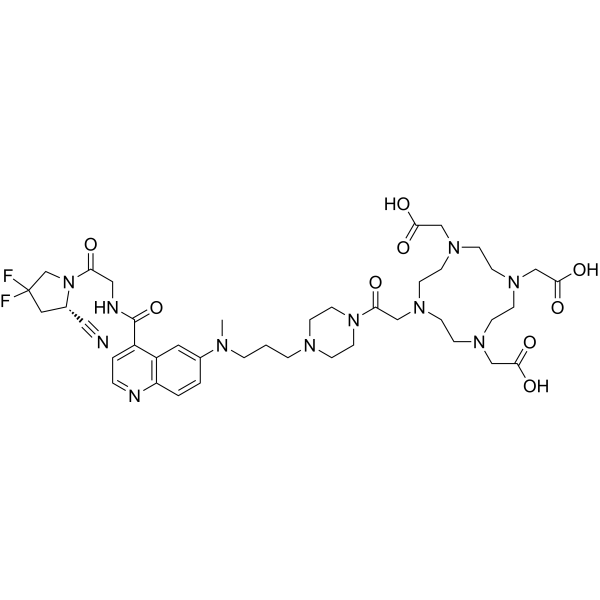
FAPI-46 is a quinoline-based fibroblast activation protein (FAP)-targeted tracer. Use radioactivity FAPI-46 labeled with 68Ga or 177Lu can be used for tumor imaging in a variety of cancers and has higher tumor uptake rates and longer tumor accumulation .
loading...
    loading...
Cat. No.: HY-P10761
CAS No.: 2941391-49-5
DPI-4452 is a CAIX-targeting cyclic peptide with a DOTA cage, and can be chelated with radionuclide for CAIX-expressing tumor PET-CT imaging and study. DPI-4452 specifically and selectively binds CAIX without interaction with an in vitro off-target receptor panel of 55 targets (IC50 for recombinant hCAIX: 130 nM). Radiolabeled DPI-4452 inhibits tumor growth in HT-29 and SK-RC-52 xenograft mouse models . DPI-4452 can be used for the synthesis/research of Radionuclide-Drug Conjugates (RDCs).
loading...
    loading...
Cat. No.: HY-P10239
CAS No.: 302794-43-0
Tyr3-Octreotate is a ligand for somatostatin receptor subtype 2 (sst2), with an IC50 value of 1.3 nM against sst2 when labeled with [ 111In-DTPA], and an IC50 value of 1.6 nM against sst2 when labeled with [ 90Y-DOTA]. Radiolabeled Tyr3-Octreotate generates cell-associated radioactivity, and acts as both a tumor growth inhibitor and a tumor cytotoxic agent. When radiolabeled with 177Lu or 90Y, Tyr3-Octreotate serves as a peptide receptor radionuclide therapy (PRRT) analog. Tyr3-Octreotate can be used in studies related to pancreatic tumors .
loading...
    loading...
Cat. No.: HY-145461
CAS No.: 1421593-78-3
Synonyms: 5-Hydroxy lenalidomide
Target:  

Drug Metabolite

Research Areas:  

Others

Hydroxy lenalidomide (5-Hydroxy lenalidomide) is a metabolite of lenalidomide that is present as a minor component in plasma and excreta, accounting for less than 5% of the total radioactivity, following oral administration of lenalidomide in healthy male subjects.
loading...
    loading...
Cat. No.: HY-E70260
CAS No.: 1367862-09-6
Target:  

Acyltransferase

Research Areas:  

Others

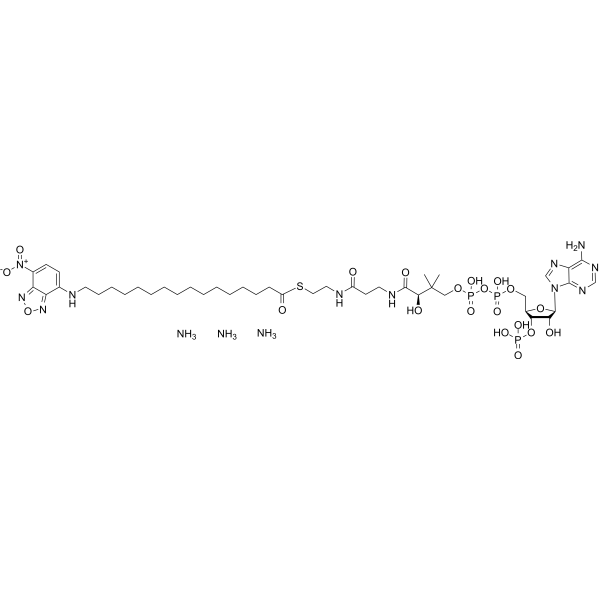
16-NBD-16:0 Coenzyme A triammonium can be used as a substrate to measure the in vitro activity of other Acyltransferase .
loading...
    loading...
Cat. No.: HY-14560
CAS No.: 71620-89-8
Target:  

Adrenergic Receptor

Research Areas:  

Neurological Disease

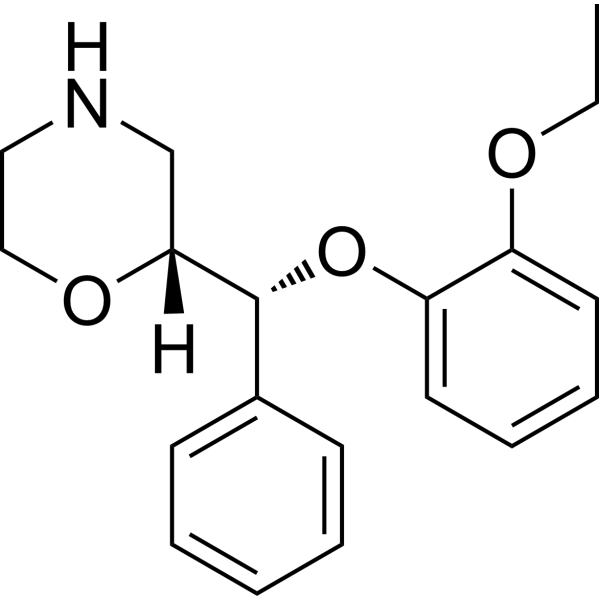
Reboxetine is an orally active, potent and selective noradrenaline uptake blocker. Reboxetine can be used for antidepressant research .
loading...
    loading...
Cat. No.: HY-163683
CAS No.: 2375590-67-1
Research Areas:  

Cancer

EB-PSMA-617 is a modified form of PSMA-617 that has enhanced pharmacokinetic properties by conjugating it to Evans Blue (EB) to extend its circulation half-life to improve prostate tumor uptake and radiotherapy efficacy. In preclinical studies using PC3-PIP-loaded mice, EB-PSMA-617 demonstrated prolonged blood half-life, increased accumulation in PSMA-positive tumors, and successful tumor elimination with lower radioactivity .
loading...
    loading...
Cat. No.: HY-137263
CAS No.: 35775-65-6
Target:  

Antibiotic

Research Areas:  

Infection

Propionylmaridomycin is a macrolide antibiotic with antibacterial activity. Propionylmaridomycin is rapidly absorbed from the gastrointestinal tract and rapidly distributed to tissues. Propionylmaridomycin radioactivity levels in the liver, kidneys, and lungs were significantly higher than in plasma, while distribution to the brain was less. Propionylmaridomycin is excreted primarily through the feces, and the high fecal recovery rate is due to unabsorbed compounds and biliary excretion of compounds and their metabolites. Propionylmaridomycin exhibits the highest antibacterial activity in the lungs. Propionylmaridomycin is completely converted to several metabolites in rats, of which 4''-depropionyl-9-propionylmaridomycin was identified as the major metabolite .
loading...
    loading...
Cat. No.: HY-121659
CAS No.: 564482-79-7
Target:  

PSMA

Research Areas:  

Cancer

DCFBC is a prostate-specific membrane antigen (PSMA) inhibitor that can be used for small animal positron emission tomography (PET) imaging. DCFBC labeled with F 18 ([18F]DCFBC) can images in severe combined immunodeficient mice. [18F]DCFBC uptake is higher in PIP tumors, but almost absent in FLU tumors. [18F]DCFBC uptake is also high in the kidney and bladder, but the radioactivity washout time is shorter than that in PIP tumors. Indicating that [18F]DCFBC can specifically localize to PSMA+ expressing tumors and is applicable to the study of prostate cancer .
loading...
    loading...
Cat. No.: HY-W205529
CAS No.: 87235-61-8
Target:  

Fluorescent Dye

Research Areas:  

Neurological Disease

RO 16-6491 Free base is a selective, reversible inhibitor of monoamine oxidase type B (MAO-B), exhibiting high affinity and specificity for binding sites in human frontal cortex mitochondria and platelet membranes. RO 16-6491 demonstrates a fast dissociation of bound radioactivity at 20 degrees C, indicating its dynamic binding properties. RO 16-6491 also acts as a substrate for MAO-B, suggesting that its oxidation may produce a stable intermediate responsible for its potent inhibitory effects. RO 16-6491 serves as an excellent radioligand probe for investigating the regional tissue distribution of MAO-B in various physiological and pathological states.
loading...
    loading...
Cat. No.: HY-129878
CAS No.: 26295-56-7
Synonyms: AD-41
Target:  

Endogenous Metabolite

Research Areas:  

Cancer

N-Trifluoroacetyladriamycin (AD-41) is a chemotherapeutic compound with antitumor activity. N-Trifluoroacetyladriamycin exhibits the highest fluorescence and radioactivity levels in the small intestine and liver, indicating its significant accumulation in these tissues. N-Trifluoroacetyladriamycin also shows significant accumulation in the kidney, spleen, large intestine, lung, and heart. N-Trifluoroacetyladriamycin is a metabolite of Valrubicin, which is used to inhibit bladder cancer. The presence of N-Trifluoroacetyladriamycin and its derivatives may be related to the biotransformation of the compound and its antitumor mechanism .
loading...
    loading...
Cat. No.: HY-W1058183
CAS No.: 70380-30-2
Research Areas:  

Cancer

1-Benzyl-4-(bromomethyl)-1H-1,2,3-triazole is a bromomethyl derivative that inhibits DNA synthesis in tumor cells and promotes the release of radioactivity from labeled nucleic acids. 1-Benzyl-4-(bromomethyl)-1H-1,2,3-triazole inhibits the growth of cancer cells in vitro with an ED50 of 2 μg/mL. It can be used in cervical cancer-related research .
loading...
    loading...
  • 1

