18 Results for "

acyl transfer

" in MedChemExpress (MCE) Product Catalog:
Products (18)

18 Results for "acyl transfer" in MCE Product Catalog:

1
1 Cited Publications
Cat. No.: HY-Y1089
CAS No.: 1122-58-3
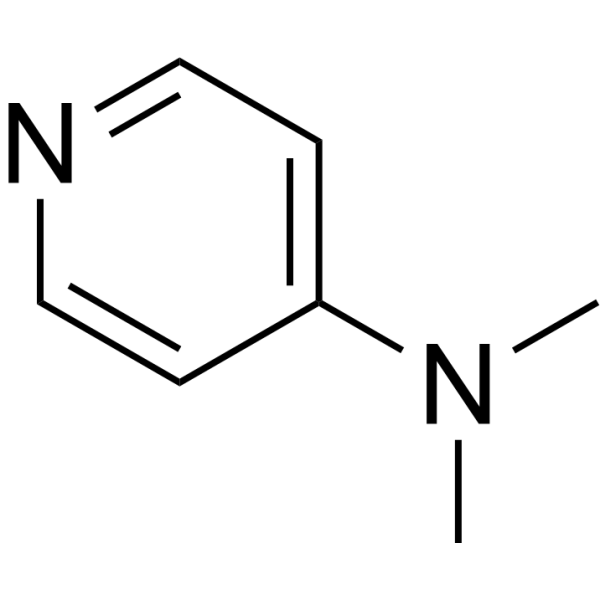
4-Dimethylaminopyridine is an acyl transfer catalyst. 4-Dimethylaminopyridine is used for labeling and analysis of glycoproteins on the surface of living cells. 4-Dimethylaminopyridine reduces dyskinesia attacks .
loading...
    loading...
Cat. No.: HY-N11424
CAS No.: 17459-92-6
Bilirubin diglucuronide is a bilirubin glycoside conjugate with a 1-O-acyl β-D-glucuronide structure. Bilirubin diglucuronide is the major conjugated bilirubin (HY-N0323) and predominant pigment excreted in the bile of adult humans, rats, dogs and cats. Bilirubin diglucuronide is mainly synthesized via UDP-glucuronosyltransferase-mediated transfer of glucuronic acid from UDP-glucuronic acid to bilirubin monoglucuronide, or via enzymatic disproportionation of two moles of bilirubin monoglucuronide (predominantly producing the IXα configuration). In addition, Bilirubin diglucuronide can also be synthesized from bilirubin or its monoglucuronide in a UDP-glucuronic acid-dependent manner. Pretreatment with phenobarbital significantly enhances the formation process of Bilirubin diglucuronide .
loading...
    loading...
Cat. No.: HY-Y0549
CAS No.: 117-34-0
Synonyms: Diphenylmethane-α-carboxylic Acid
Diphenylacetic acid (Diphenylmethane-α-carboxylic Acid) is a biochemical reagent that can be used as a biological material or organic compound for life science related research. Diphenylacetic acid can be used as a reagent in the kinetic resolution of racemic 2-hydroxy-y-butyrolactones by asymmetric esterification in the presence of pivalic anhydride and chiral acyl-transfer catalyst. Diphenylacetic acid can act as a catalyst to synthesize 2-allyl-3-oxazolin-5-one derivatives via Rh-catalyzed coupling reaction of azlactones and alkynes followed by aza-Cope rearrangement .
loading...
    loading...
Cat. No.: HY-W039724
CAS No.: 492-22-8
Research Areas:  

Others

Thioxanthone is a powerful photocatalyst for organic reactions. Thioxanthone mediates energy transfer, single-electron transfer, and hydrogen atom transfer processes. As a photoredox catalyst, Thioxanthone is used in nickel-catalyzed self-coupling reactions of aryl halides, arylation reactions of H-phosphine oxides/H-phosphites, decarbonylation reactions of cyclopropenones, and reactions generating acyl radicals from aromatic aldehydes .
loading...
    loading...
Cat. No.: HY-CE00775
CAS No.: 10478-66-7
Synonyms: o-Hydroxybenzoyl-coenzyme A
Research Areas:  

Metabolic Disease

2-Hydroxybenzoyl-CoA (o-Hydroxybenzoyl-coenzyme A) is a coenzyme A thioester of o-hydroxybenzoic acid and substrate for esterolysis. 2-Hydroxybenzoyl-CoA serves as a substrate for studies of acyl-CoA formation, acyl transfer, and peptide bond formation reactions and enzymes .
loading...
    loading...
Cat. No.: HY-E70453
CAS No.: 80146-85-6
Synonyms: Prostate Transglutaminase; TG4; TGase 4
Research Areas:  

Metabolic Disease

Human prostate transglutaminase (TG4; TGase 4) is an enzyme that mediates the transfer of acyl groups from glutamine residues in proteins or peptides to primary amines and belongs to the prostate transglutaminase protein family. Human prostate transglutaminase forms an ε-(γ-glutamyl)lysine bond between proteins by transferring the acyl group of a peptide-bound glutamine residue to the primary amino group of a peptide-bound lysine residue .
loading...
    loading...
Cat. No.: HY-E70264
CAS No.: 799812-86-5
Target:  

Endogenous Metabolite

Research Areas:  

Metabolic Disease

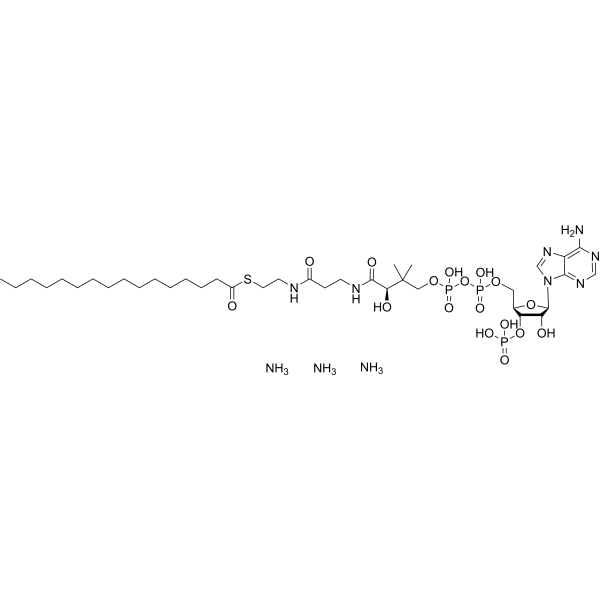
16:0 Coenzyme A triammonium is palmitoyl-CoA, which can serve as a reaction substrate to transfer the palmitoyl group to the free thiol group of the target protein through palmitoylation catalyzed by protein acyl transferases (PATs) .
loading...
    loading...
Cat. No.: HY-134129
CAS No.: 6756-74-7
Synonyms: Benzoyl CoA
Target:  

Endogenous Metabolite

Research Areas:  

Others Metabolic Disease

Benzoyl coenzyme A (Benzoyl CoA) is A derivative of Coenzyme A (CoA) in which the mercaptan group of CoA binds to the benzoyl group. Benzoyl coenzyme A is involved in the catalytic reaction as a substrate for the acyl transfer reaction. Benzoyl coenzyme A is a versatile metabolic intermediate that can be used to reveal substrate specificity of enzymes, metabolic regulation, and drug metabolism .
loading...
    loading...
Cat. No.: HY-Y1089R
CAS No.: 1122-58-3
4-Dimethylaminopyridine (Standard) is the analytical standard of 4-Dimethylaminopyridine. This product is intended for research and analytical applications. 4-Dimethylaminopyridine is an acyl transfer catalyst. 4-Dimethylaminopyridine is used for labeling and analysis of glycoproteins on the surface of living cells. 4-Dimethylaminopyridine reduces dyskinesia attacks .
loading...
    loading...
Cat. No.: HY-176751
CAS No.: 1082605-61-5
Target:  

Glutaminase

Research Areas:  

Cancer

TG-2-IN-5 (Compound CP4d) is a reversible TG2 inhibitor with a Ki of 1.0 μM for human TG2. TG-2-IN-5 can be used to study diseases associated with upregulation of TG2-mediated acyl transfer, such as fibrosis and cancer .
loading...
    loading...
Cat. No.: HY-E70276
CAS No.: 103404-53-1
Target:  

Endogenous Metabolite

Research Areas:  

Metabolic Disease

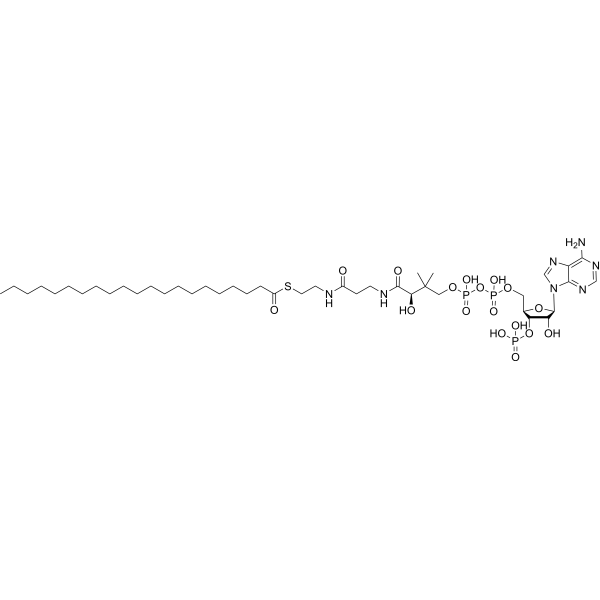
Heneicosanoyl-CoA is a substrate of Very long-chain acyl-CoA dehydrogenase (VLCAD) in the anaerobic electron transfer flavoprotein (ETF) assay .
loading...
    loading...
Cat. No.: HY-134129B
Synonyms: Benzoyl CoA sodium
Target:  

Endogenous Metabolite

Research Areas:  

Others Metabolic Disease

Benzoyl coenzyme A (sodium) is the sodium salt form of Benzoyl coenzyme A (HY-134129). Benzoyl coenzyme A (sodium) is A derivative of Coenzyme A (CoA) in which the mercaptan group of CoA binds to the benzoyl group. Benzoyl coenzyme A (sodium) is involved in the catalytic reaction as a substrate for the acyl transfer reaction. Benzoyl coenzyme A (sodium) is a versatile metabolic intermediate that can be used to reveal substrate specificity of enzymes, metabolic regulation, and drug metabolism .
loading...
    loading...
Cat. No.: HY-139404
CAS No.: 1263052-40-9
Synonyms: Anthrylvinyl ceramide; AV Ceramide; AV Ceramide (d18:1/10:0)
Target:  

Fluorescent Dye

Research Areas:  

Others

C10 AV Ceramide (d18:1/10:0) is a fluorescent probe. Anthrylvinyl (AV) acts as the fluorescent label positioned on the amide linked acyl chain on the Ceramide molecule to measure the CERT-mediated transfer. The anthrylvinyl moiety of C10 AV Ceramide (d18:1/10:0) localizes to the hydrophobic region of the bilayer .
loading...
    loading...
Cat. No.: HY-CE00775A
Synonyms: o-Hydroxybenzoyl-coenzyme A lithium
Research Areas:  

Others

2-Hydroxybenzoyl-CoA (o-Hydroxybenzoyl-coenzyme A) lithium is a coenzyme A thioester of o-hydroxybenzoic acid and substrate for esterolysis. 2-Hydroxybenzoyl-CoA lithium serves as a substrate for studies of acyl-CoA formation, acyl transfer, and peptide bond formation reactions and enzymes .
loading...
    loading...
Cat. No.: HY-E71561
Research Areas:  

Others

2-Hydroxyglutarate synthase (EC 2.3.3.11) belongs to the family of transferases, specifically those acyltransferases that convert acyl groups into alkyl groups on transfer.
loading...
    loading...
Cat. No.: HY-E71689
Research Areas:  

Others

3-Ethylmalate synthase (EC 2.3.3.7) belongs to the family of transferases, specifically those acyltransferases that convert acyl groups into alkyl groups on transfer.
loading...
    loading...
Cat. No.: HY-187024
CAS No.: 60133-17-7
Target:  

Drug Intermediate

Research Areas:  

Metabolic Disease

D-GlupNA is a substrate of bovine kidney γ-glutamyl transpeptidase (γ-GluTP), which acts as a γ-glutamyl donor for acyl transfer and hydrolysis reactions. D-GlupNA can be hydrolyzed into glutamic acid and p-nitroaniline. D-GlupNA is applicable for metabolism-related research .
loading...
    loading...
Cat. No.: HY-N9868
CAS No.: 423170-79-0
(-)-Phaselic acid is a protein protectant that can be isolated from red clover (Trifolium pratense) leaves. (-)-Phaselic acid is synthesized through an acyl transfer reaction between caffeoyl-CoA and malic acid catalyzed by the HCT2 enzyme. As a substrate for endogenous polyphenol oxidase (PPO), its oxidation to o-quinone can inhibit protein degradation during forage storage. (-)-Phaselic acid can be used to improve the protein preservation performance of forage crops such as alfalfa, reducing nutritional losses during storage and environmental nitrogen pollution .
loading...
    loading...
  • 1

