1. Search Result
Search Result
Pathways Recommended: Membrane Transporter/Ion Channel
Results for "

brain cortex membranes

" in MedChemExpress (MCE) Product Catalog:

5

Inhibitors & Agonists

1

Peptides

1

Natural
Products

Cat. No. Product Name Target Research Areas Chemical Structure
  • HY-B2167R

    DHA (Standard); Cervonic acid (Standard)

    Reference Standards Endogenous Metabolite Neurological Disease Cancer
    Docosahexaenoic acid (Standard) is the analytical standard of Docosahexaenoic acid. This product is intended for research and analytical applications. Docosahexaenoic Acid (DHA) is an omega-3 fatty acid abundantly present brain and retina. It can be obtained directly from fish oil and maternal milk. In Vitro: Docosahexaenoic acid (DHA) is essential for the growth and functional development of the brain in infants. DHA is also required for maintenance of normal brain function in adults. The inclusion of plentiful DHA in the diet improves learning ability and memory . DHA is an essential requirement in every step of brain development like neural cell proliferation, migration, differentiation, synaptogenesis. The multiple double bonds and unique structure allow DHA to impart special membrane characteristics for effective cell signaling. Many development disorders like dyslexia, autism spectrum disorder, attention deficit hyperactivity disorder, schizophrenia etc. are causally related to decreased level of DHA . DHA is a potent RXR ligand inducing robust RXR activation already at low micro molar concentrations. The EC50 for RXRα activation by DHA is about 5-10 μM fatty acid . In Vivo: Docosahexaenoic acid administration over 10 weeks significantly reduces the number of reference memory errors, without affecting the number of working memory errors, and significantly increases the docosahexaenoic acid content and the docosahexaenoic acid/arachidonic acid ratio in both the hippocampus and the cerebral cortex . DHA treatment exerts neuroprotective actions on an experimental mouse model of PD. There is a decrease tendency in brain lipid oxidation of MPTP mice but it does not significantly .
    Docosahexaenoic acid (Standard)
  • HY-100834
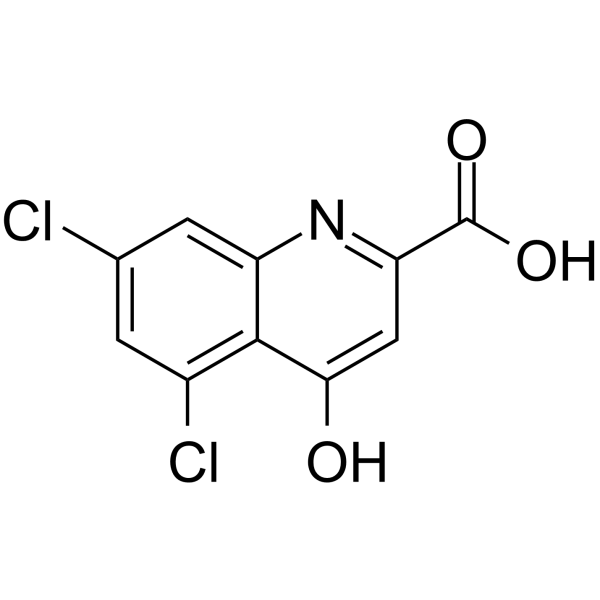
    5,7-Dichlorokynurenic acid
    1 Publications Verification

    5,7-DCKA

    iGluR Neurological Disease
    5,7-Dichlorokynurenic acid (5,7-DCKA) is a selective and competitive antagonist of the glycine site on NMDA receptor with a KB of 65 nM. 5,7-Dichlorokynurenic acid reduces NMDA-induced neuron injury. 5,7-Dichlorokynurenic acid increases social interaction time, increases open arm exploration time, disinhibits suppressed conflict responding in rodent models. 5,7-Dichlorokynurenic acid exhibits anxiolytic-like activity in rodent models and supports exploration of glycine’s role in NMDA receptor-mediated synaptic transmission .
    5,7-Dichlorokynurenic acid
  • HY-P3883

    Neurokinin Receptor Neurological Disease
    [DAla4] Substance P (4-11) is an analog of Substance P (HY-P0201) that inhibits the binding of 125I-Bolton Hunter-conjugated Eledoisin (HY-P0006) (IC50 of 0.5 μM) and 125I-Bolton Hunter-conjugated Substance P (IC50 of 0.15 μM) to rat brain cortex membranes .
    [DAla4] Substance P (4-11)
  • HY-100834A

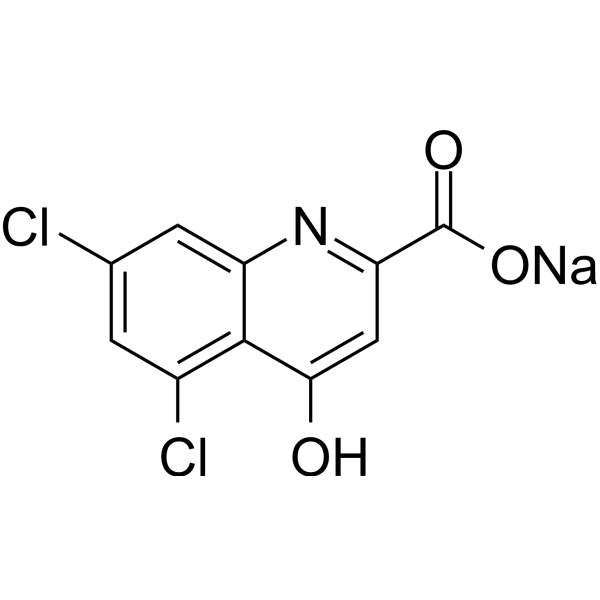
    5,7-DCKA sodium

    iGluR Neurological Disease
    5,7-Dichlorokynurenic acid (5,7-DCKA) sodium is a selective and competitive antagonist of the glycine site on NMDA receptor with a KB of 65 nM. 5,7-Dichlorokynurenic acid sodium reduces NMDA-induced neuron injury. 5,7-Dichlorokynurenic acid sodium increases social interaction time, increases open arm exploration time, disinhibits suppressed conflict responding in rodent models. 5,7-Dichlorokynurenic acid sodium exhibits anxiolytic-like activity in rodent models and supports exploration of glycine’s role in NMDA receptor-mediated synaptic transmission .
    5,7-Dichlorokynurenic acid sodium
  • HY-183910

    GABA Receptor Glycine Receptor (GlyR) Neurological Disease
    Pitrazepin is a GABAA receptor antagonist and glycine receptor antagonist. Pitrazepin blocks synaptic GABA action, induces neuronal bursting and reduces inhibitory postsynaptic potentials. Pitrazepin can be used in research on depression and psychosis .
    Pitrazepin

Inquiry Online

Your information is safe with us. * Required Fields.

Salutation


Country or Region *

Applicant Name *


Organization Name *

Department *


Email Address *


Product Name *

Cat. No.


Requested quantity *

Phone Number *


Remarks

Inquiry Online

Inquiry Information

Product Name:
Cat. No.:
Quantity:
MCE Japan Authorized Agent: