



1. Search Result
Search Result
Results for "

cadaverine

" in MedChemExpress (MCE) Product Catalog:

24

Inhibitors & Agonists

15

Fluorescent Dyes

4

Natural
Products

Cat. No. Product Name Target Research Areas Chemical Structure
  • HY-D1027
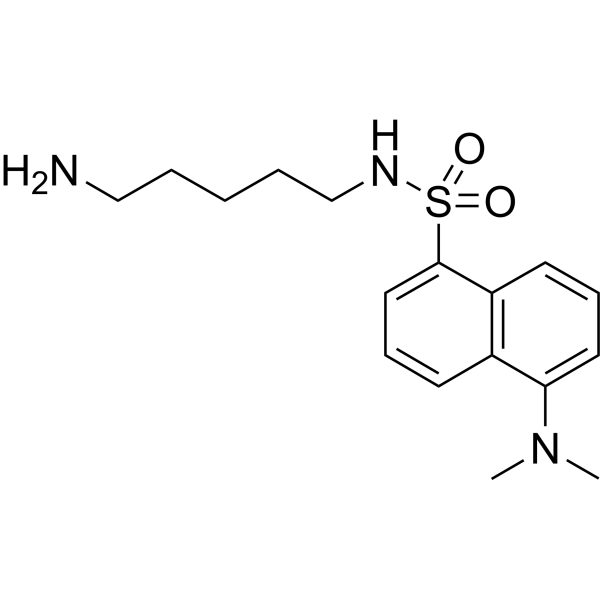
    Dansylcadaverine
    10+ Cited Publications

    Monodansyl cadaverine

    Autophagy Others
    Dansylcadaverine (Monodansyl cadaverine) is an autofluorescent compound used for the labeling of autophagic vacuoles. Dansylcadaverine, a high affinity substrate of transglutaminases, can block the receptor-mediated endocytosis of many ligands .
    Dansylcadaverine
  • HY-101403

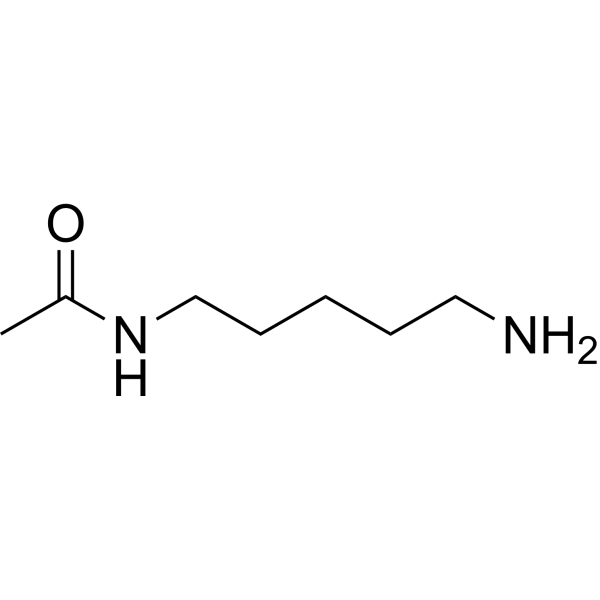
    Monoacetylcadaverine

    Endogenous Metabolite Cancer
    N-(5-Aminopentyl)acetamide is the acetylated form of the polyamine cadaverine.
    N-(5-Aminopentyl)acetamide
  • HY-W016750

    Biochemical Assay Reagents Others
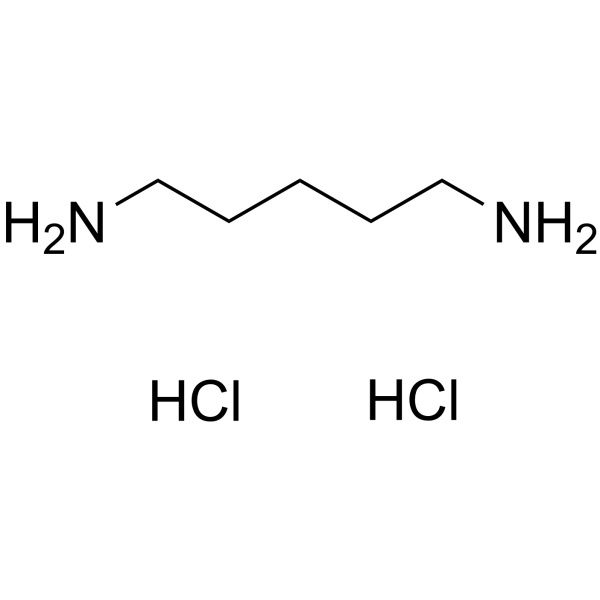
    Pentane-1,5-diamine dihydrochloride is a putrescine. Pentane-1,5-diamine dihydrochloride can be incorporated into lobeline, but it is not a conventional intermediate in the lysine-to-lobeline synthesis process .
    Pentane-1,5-diamine dihydrochloride
  • HY-D1594
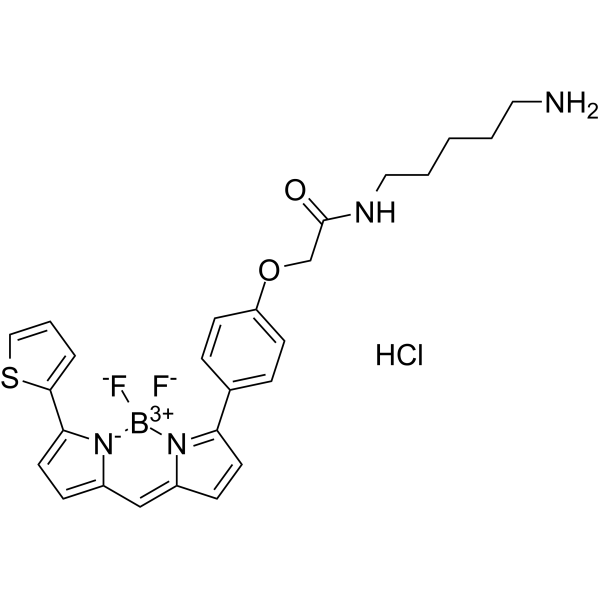
    BODIPY TR Cadaverine
    3 Publications Verification

    Fluorescent Dye Others
    BODIPY TR Cadaverine, a cadaverine derivative, is a red fluorescent dye. BODIPY TR Cadaverine can be used in a a highly sensitive and robust fluorescent displacement assay, which binds to native LPS strongly, specifically recognizing lipid A, and is competitively displaced by compounds displaying an affinity for lipid A .
    BODIPY TR Cadaverine
  • HY-DY1076

    Fluorescent Dye Others
    BODIPY TR Cadaverine (solution) , a cadaverine derivative, is a red fluorescent dye. BODIPY TR Cadaverine can be used in a a highly sensitive and robust fluorescent displacement assay, which binds to native LPS strongly, specifically recognizing lipid A, and is competitively displaced by compounds displaying an affinity for lipid A .
    Solvent and concentration: DMSO: 2 mM
    BODIPY TR Cadaverine (solution)
  • HY-P2758

    DAO

    Biochemical Assay Reagents Metabolic Disease Inflammation/Immunology Cancer
    Diamine oxidase (DAO) is an orally active enzyme. Diamine oxidase catalyzes oxidative deamination of various polyamines. Diamine oxidase degrades histamine and polyamines to maintain the metabolic balance of amines in the body. Diamine oxidase is a key regulatory enzyme in rapidly proliferating tissues such as bone marrow and intestinal mucosa. Diamine oxidase can be used in research related to intestinal diseases, small bowel transplant rejection, histamine intolerance, and other conditions .
    Diamine oxidase
  • HY-D2751

    Fluorescent Dye Others
    BP Fluor 488 Cadaverine is a carboxyl/carbonyl reactive building block used widely to modify carboxylic groups in the presence of activators (e.g. EDC or DCC) or activated esters (e.g. NHS esters) through a stable amide bond.
    BP Fluor 488 cadaverine
  • HY-101403R

    Monoacetylcadaverine (Standard)

    Reference Standards Endogenous Metabolite Cancer
    N-(5-Aminopentyl)acetamide (Standard) is the analytical standard of N-(5-Aminopentyl)acetamide. This product is intended for research and analytical applications. N-(5-Aminopentyl)acetamide is the acetylated form of the polyamine cadaverine.
    N-(5-Aminopentyl)acetamide (Standard)
  • HY-D2016

    Fluorescent Dye Others
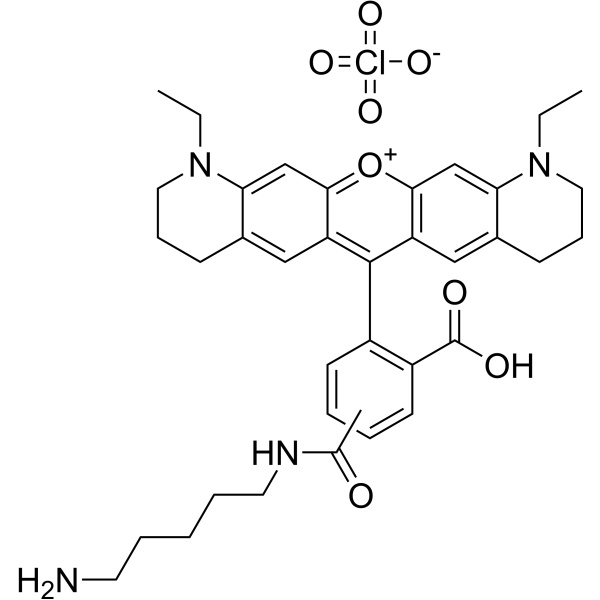
    ATTO 565 cadaverine is a new fluorescent marker based on the Rhodamine structure. It has strong absorption, high fluorescence quantum yield, high thermal stability and photochemical stability, and is suitable for single molecule detection and high-resolution microscopy. ATTO 565 cadaverine is a cadaverine derivative of ATTO 565, which can be used to label proteins or antibodies.
    ATTO 565 cadaverine
  • HY-D2772

    Biochemical Assay Reagents Others
    5-TAMRA cadaverine can used to modify carboxylic acid group in the presence of activators (e.g. EDC, or DCC) or activated esters (e.g. NHS esters) through a stable amide bond. It also can be reversibly coupled to aldehydes and ketones to form a Schiff base – which can be reduced to a generate stable amine derivative by sodium borohydride (NaBH4) or sodium cyanoborohydride (NaCNH3). Although the mixed isomers of 5(6)-TAMRA cadaverine is a preferred, routinely used orange-fluorescent dye for staining proteins, it is rearly used for labeling peptides and nucleotides. Purification of 5(6)-TAMRA labeled peptide and nucleotides might be troublesome due to significant signal broadening in HPLC purification. Peptides and nucleotides labeled with a single isomer TAMRA usually give better resolution in HPLC purification that is often required in the conjugation processes.
    5-TAMRA Cadaverine
  • HY-D1753

    LYC

    Fluorescent Dye Others
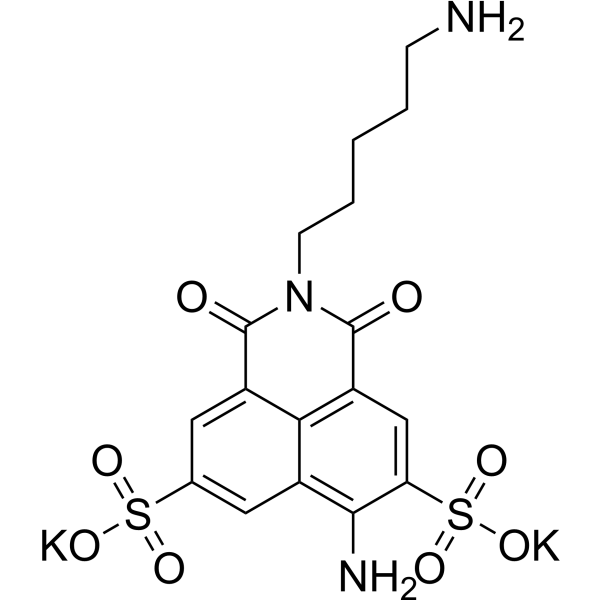
    Lucifer yellow cadaverine (LYC) can be used as a cell tracer. Lucifer yellow cadaverine can be used to label endocytic vacuoles in cells .
    Lucifer yellow cadaverine
  • HY-172284

    Fluorescent Dye Others
    6-TAMRA cadaverine has achieved prominence as a dye for oligonucleotide labeling and automated DNA sequencing applications. The amino group (NH2) is reactive with carboxylic acids, activated NHS esters, carbonyls (ketone, aldehyde), etc.
    6-TAMRA cadaverine
  • HY-D2764

    Fluorescent Dye Others
    Difluorocarboxyfluorescein cadaverine, 5-isomer is a carbonyl reactive building block used to modify carboxylic groups in the presence of activators (e.g. EDC, or DCC) or activated esters (e.g. NHS esters) through a stable amide bond.
    Difluorocarboxyfluorescein cadaverine, 5-isomer
  • HY-D2765

    Biochemical Assay Reagents Others
    BP Fluor 405 Cadaverine is a carbonyl-reactive building block used to modify carboxylic groups in the presence of activators (e.g. EDC or DCC) or activated esters (e.g. NHS esters) through a stable amide bond. Another common application for BP Fluor 405 Cadaverine is cell fixing by treatment with formaldehyde or glutaraldehyde. BP Fluor 405 is a water-soluble, blue-fluorescent dye that is often used in multi-color applications, including flow cytometry and super-resolution microscopy using STORM. Its excitation is ideally suited for the 407 nm spectral line of the krypton laser or the 408 nm violet laser diode.
    BP Fluor 405 cadaverine
  • HY-101403A

    Drug Metabolite Metabolic Disease
    Monoacetylcadaverine hydrochloride is a metabolite of the endogenous polyamine cadaverine .
    Monoacetylcadaverine hydrochloride
  • HY-D1970

    Fluorescent Dye Others
    ATTO 700 Cadaverin is a cadaverine derivative of ATTO 700 for reactions of carboxylic acids, aldehydes and ketones with maximum excitation/emission wavelengths: 700/716 nm.
    ATTO 700 Cadaverin
  • HY-D2055

    Fluorescent Dye Others
    ATTO 532 cadaverin is a cadaverine derivative of ATTO 532, used for carboxylic acid, aldehyde and ketone reactions, maximum excitation/emission wavelength: 532/552 nm.
    ATTO 532 cadaverin
  • HY-D2039

    Fluorescent Dye Others
    ATTO 550 cadaverin is a cadaverine derivative of ATTO 550, used for carboxylic acid, aldehyde and ketone reactions, maximum excitation/emission wavelength: 554/576 nm.
    ATTO 550 cadaverin
  • HY-D2070

    Fluorescent Dye Others
    ATTO 680 cadaverin is a cadaverine derivative of ATTO 680, used for carboxylic acid, aldehyde and ketone reactions, maximum excitation/emission wavelength: 681/698 nm.
    ATTO 680 cadaverin
  • HY-179872

    Others Metabolic Disease
    Cholyl-cadaverine is a polyamine bile amidate.
    Cholyl-cadaverine
  • HY-179870

    Others Metabolic Disease
    Chenodeoxycholyl-cadaverine is a polyamine bile amidate.
    Chenodeoxycholyl-cadaverine
  • HY-DY1080

    Monodansyl cadaverine (solution)

    Autophagy Others
    Dansylcadaverine (solution) (Monodansyl cadaverine (solution)) is an autofluorescent compound used for the labeling of autophagic vacuoles. Dansylcadaverine, a high affinity substrate of transglutaminases, can block the receptor-mediated endocytosis of many ligands .
    Solvent and concentration: DMSO: 10 mM
    Dansylcadaverine (solution)
  • HY-180691

    Drug Derivative Others
    Aminopropylcadaverine is an aminopropyl derivative of cadaverine .
    Aminopropylcadaverine
  • HY-E71002

    Biochemical Assay Reagents Metabolic Disease
    L-Lysine Decarboxylase, Bacterium cadaveris (EC 4.1.1.18) is an enzyme that converts lysine to cadaverine.
    L-Lysine Decarboxylase, Bacterium cadaveris

Inquiry Online

Your information is safe with us. * Required Fields.

Salutation


Country or Region *

Applicant Name *


Organization Name *

Department *


Email Address *


Product Name *

Cat. No.


Requested quantity *

Phone Number *


Remarks

Inquiry Online

Inquiry Information

Product Name:
Cat. No.:
Quantity:
MCE Japan Authorized Agent:

