12 Results for "

cryo-EM

" in MedChemExpress (MCE) Product Catalog:
Products (12)

12 Results for "cryo-EM" in MCE Product Catalog:

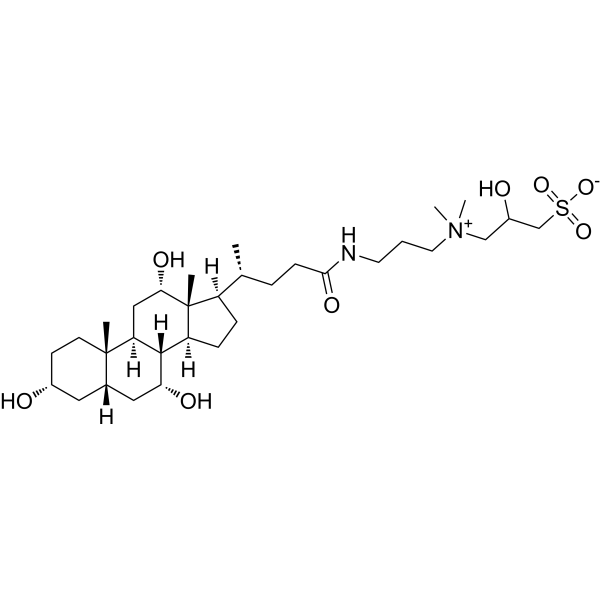
Cat. No.: HY-W040201
CAS No.: 82473-24-3
Synonyms: 3-[3-(Cholamidopropyl)dimethylammonio]-2-hydroxy-1-propanesulfonate
CHAPSO is a bile derivative. CHAPSO reduces protein adsorption, improves the cryo-EM imaging quality. CHAPSO can be used as a detergent, or as the membrane protein solubilization and reconstruction reagent in membrane protein structural studies .
loading...
    loading...
Cat. No.: HY-171978
Target:  

Adrenergic Receptor

Research Areas:  

Cardiovascular Disease

LM-189 is a β2-adrenergic receptor (β2AR) ligand and G protein-biased modulator with a human β2AR Ki of 0.063 nM.LM-189 promotes β2AR coupling to Gαs and Gαi heterotrimers, stabilizes distinct β2AR conformations including a TM6 outward state, and increases β2AR ICL2 dynamics.LM-189 restricts β2AR ligand-binding pocket conformational heterogeneity, stabilizes polar ligand-receptor interaction networks, and exhibits bias toward Gαi signaling over Gαs signaling.LM-189 enabled cryo-EM structural characterization of the β2AR-Gi complex.LM-189 can be used for the research of congestive heart failure .
loading...
    loading...
Cat. No.: HY-P11540
CAS No.: 2923120-30-1
CCKBR agonist-1 (Compound 3r1) is a Gq-protein-preferring cholecystokinin B receptor (CCKBR) agonist with an EC50 of 35 pM. CCKBR agonist-1 significantly increases the survival rate of neurons, with an EC50 of 37 pM. CCKBR agonist-1 can improve the cognitive decline in mice by upregulating α-secretase (ADAM10) and calcium signaling molecule PLCB4, reduce the number of amyloid β () plaques, and promote long-term potentiation (LTP). CCKBR agonist-1 can be used for the study of Alzheimer's disease .
loading...
    loading...
Cat. No.: HY-179240
Target:  

Dopamine Receptor

Research Areas:  

Neurological Disease

UNC9815 is a D1 dopamine receptor (D1R) orthosteric allosteric modulator (PAM). UNC9815 can dose-dependently enhance the functional efficacy of dopamine in β-inhibitory protein recruitment experiments and cAMP accumulation experiments. When used in combination with other PAMs, UNC9815 exhibits a significant synergistic enhancement effect. UNC9815 can be used to study neurological and psychiatric diseases such as Parkinson's disease and schizophrenia .
loading...
    loading...
Cat. No.: HY-182270
Target:  

Orphan GPCR

Research Areas:  

Metabolic Disease

GPR61 Inverse agonist 2 is a selective GPR61 inverse agonist with human IC50 of 6.2 nM and mouse IC50 of 20 nM, human Ki of 0.21 nM, and mouse Ki of 0.72 nM. GPR61 Inverse agonist 2 binds to an induced intracellular allosteric pocket of GPR61, disrupts receptor-Gαs interactions, and abolishes GPR61 constitutive activity. GPR61 Inverse agonist 2 does not alter food intake or body weight in healthy mice. GPR61 Inverse agonist 2 can be used for the research of cachexia/sarcopenia .
loading...
    loading...
Cat. No.: HY-145156
CAS No.: 2212020-93-2
Target:  

GLP Receptor

Research Areas:  

Metabolic Disease

CHU-128 is an effective and selective GLP-1R agonist. CHU-128 exhibits strong signal specificity and can activate the Gs/cAMP pathway, but it cannot activate the Gq/calcium signal, ERK phosphorylation, or recruit β-inhibitory proteins. CHU-128 can be used for research on type 2 diabetes .
loading...
    loading...
Cat. No.: HY-185334
CAS No.: 2222537-72-4
Target:  

Sodium Channel

Research Areas:  

Neurological Disease

GNE-3565 is an arylsulfonamide class NaV1.7 inhibitor with subnanomolar channel blockage and mixed subtype selectivity.GNE-3565 can be used for the research of pain .
loading...
    loading...
Cat. No.: HY-179721
CAS No.: 923714-61-8
Research Areas:  

Neurological Disease

CCKBR agonist-2 (Compound z-44) is a Gi-preferring CCKBR agonist. CCKBR agonist-2 effectively activates the CCKBR-Gi signaling pathway (EC50 = 0.27 nM), but has almost no activity on Gq and Gs signaling pathways. CCKBR agonist-2 shows no significant protective effect in the mouse Alzheimer's disease model, proving that the simple activation of the Gi signal pathway does not play a dominant role in the improvement of cognitive function .
loading...
    loading...
Cat. No.: HY-185061
CAS No.: 139361-84-5
Research Areas:  

Others

HEGA-10 is a mild detergent with a high critical micelle concentration (CMC), which can be used to dissolve and extract proteins (HIV-1 spike protein) from the membranes of virus-like particles (VLPs) .
loading...
    loading...
Cat. No.: HY-181878
Synonyms: Z7149
Z8779877149 (Z7149) is a blood-brain barrier-permeable multi-target ligand that targets SERT (Ki=198 nM), α2A adrenergic receptor (Ki=180 nM; EC50=440 nM) and 5-HT2A receptor (EC50=172 nM, Emax=76%). Z8779877149 inhibits 5-HT reuptake and activates Gi and Gq protein signaling pathways, respectively. Z8779877149 effectively alleviates pain responses as well as depression- and anxiety-like behaviors, while exhibiting favorable safety without inducing sedation or motor impairment. Z8779877149 is available for the research of pain, depression and anxiety disorders .
loading...
    loading...
Cat. No.: HY-180538A
Research Areas:  

Others

MRT-31619 formate is a molecular gel degrader (MGD) targeting CRBN. MRT-31619 formate drives the self-dimerization of the E3 ligase by mimicking the degradation subunit, and promotes its rapid, effective and selective degradation through the ubiquitin-proteasome system .
loading...
    loading...
Cat. No.: HY-P992301

Target:  

RSV

Research Areas:  

Infection

Anti-RSV F Antibody (R4.C6) is a monoclonal antibody against RSV F, with a Kd of 0.34 nM for the post-fusion RSV F trimer. Anti-RSV F Antibody (R4.C6) recognizes a unique neutralizing epitope spanning epitopes II and IV on both pre-fusion and post-fusion RSV F. Anti-RSV F Antibody (R4.C6) can be used in studies related to respiratory syncytial virus infection .
loading...
    loading...
  • 1

