
14 Results for "

fingerprints

" in MedChemExpress (MCE) Product Catalog:
Products (14)

14 Results for "fingerprints" in MCE Product Catalog:

10
10 Cited Publications
Cat. No.: HY-D0903
CAS No.: 54078-29-4
Synonyms: DFO
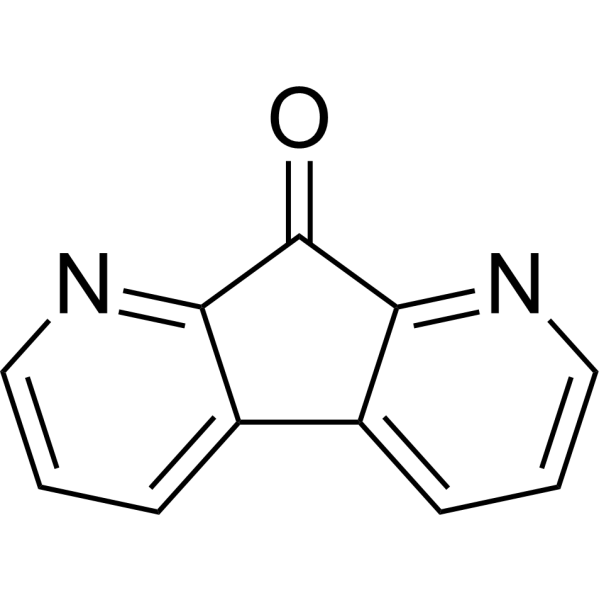
1,8-Diazafluoren-9-one (DFO) is a chemical that is used to find fingerprints on porous surfaces. 1,8-Diazafluoren-9-one reacts with amino acids present in the fingerprint to form highly fluorescent derivatives (Ex/Em = ~470/570).
loading...
    loading...
1
1 Cited Publications
Cat. No.: HY-N13015
CAS No.: 34199-21-8
Quercetin 5-O-β-D-glucopyranoside is a glycosylated flavonoid metabolite and flavonoid compound. Quercetin 5-O-β-D-glucopyranoside can be produced by microbial transformation of Quercetin (HY-18085) via Mucor hiemalis. Quercetin 5-O-β-D-glucopyranoside can be used in studies related to benign prostatic hyperplasia .
loading...
    loading...
Cat. No.: HY-W134423
CAS No.: 9002-18-0
Agar, microbiology tested, for cell culture (powder) is a jelly like substance that contains agarose and agar gel. Agar, microbiology tested, for cell culture (powder) can be isolated from the cell walls of red algae species such as Gelidium and Gracilaria (Ogonori). The gelation and melting of Agar, microbiology tested, for cell culture (powder) is based on the hydrogen bridge (physical gels), so the gelation is reversible. Agar, microbiology tested, for cell culture (powder) is widely used in food additives, plant tissue culture, microorganisms culture media, fingerprint recognition, and medical fields .
loading...
    loading...
Cat. No.: HY-D0233
CAS No.: 603-48-5
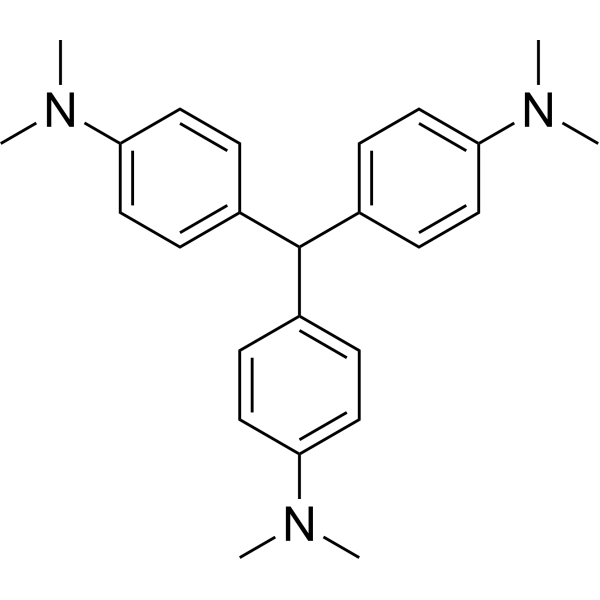
Leucocrystal violet is a cationic triarylmethane dye. Leucocrystal violet generates a colored purple product in the presence of hydrogen peroxide and horseradish peroxidase, or when oxidized by periodate under the catalysis of horseradish peroxidase. Leucocrystal violet serves as a chromogenic reagent for the determination of submicrogram-level hydrogen peroxide, with no interference from tryptophan, persulfate or chromate. Leucocrystal violet reacts with blood to produce a purple/violet color in the presence of hydrogen peroxide; it forms a very weak fluorophore when acting with whole blood in an unbuffered solution, with a maximum absorption wavelength of 630 nm and a maximum fluorescence emission wavelength of 665 nm upon excitation at 630 nm. Leucocrystal violet is widely used for staining blood residues on porous and non-porous materials .
loading...
    loading...
Cat. No.: HY-N1959
CAS No.: 130508-46-2
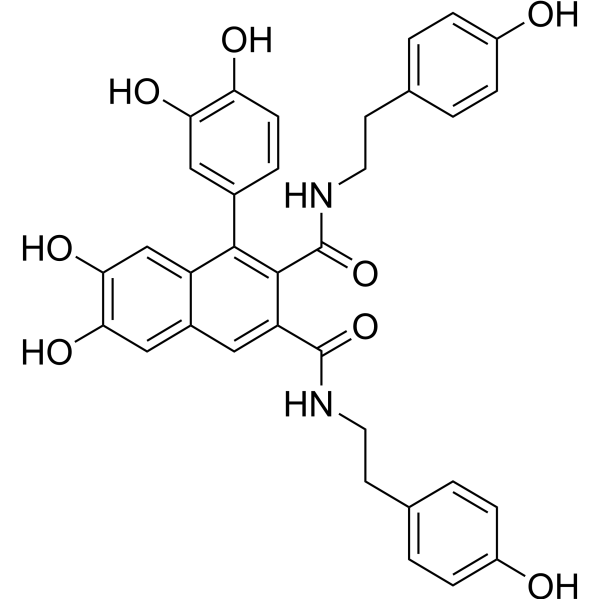
Cannabisin A is a natural product in seeds in sprouts .
loading...
    loading...
Cat. No.: HY-N7868R
CAS No.: 2433-97-8
Methyl tricosanoate (Standard) is the analytical standard of Methyl tricosanoate. This product is intended for research and analytical applications. Methyl tricosanoate is an ester form of eicosanoic acid. It has been found in samples of peanut butter and potential fingerprint residue.
loading...
    loading...
Cat. No.: HY-147036
CAS No.: 825647-78-7
Target:  

Orthopoxvirus

Research Areas:  

Infection

TTP-6171 is a non-covalent inhibitor of Monkeypox virus I7L protease, and it can be used for research on poxvirus infections .
loading...
    loading...
Cat. No.: HY-D1479
CAS No.: 6226-76-2
Target:  

Fluorescent Dye

Research Areas:  

Others

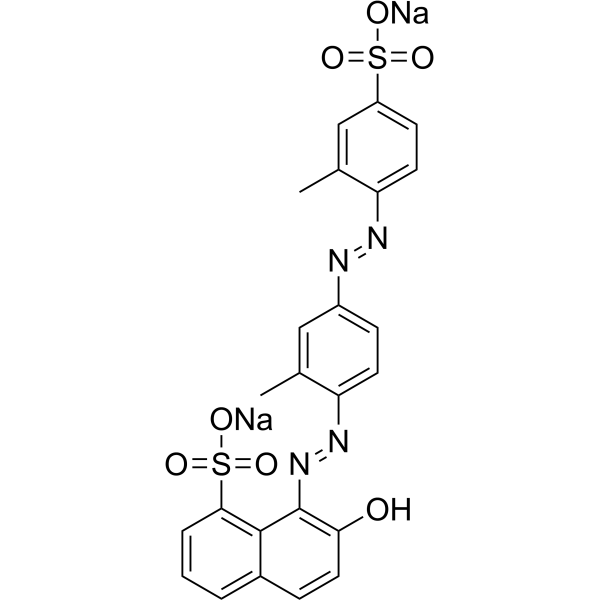
Crocein Scarlet 7B is a chemical dye and used to detect bloody fingerprints .
loading...
    loading...
Cat. No.: HY-L0107V
13,236 compounds
Natural products are small molecules produced naturally by any organism including primary and secondary metabolites. Nowadays, new drugs based on Natural products are successfully applied to treat tumors, viral and bacterial diseases, and nervous disorders. In response to the current drug discovery demand, we created this natural product-like compound library with 13,236 in-stock synthetic compounds similar to natural ones. The library was designed by 2D fingerprint similarity filtering, chemical descriptor-based and natural-likeness scoring selection. These compounds are useful tools for high throughput screening (HTS) and high content screening (HCS) programs.
Cat. No.: HY-N11435
CAS No.: 131623-14-8
Synonyms: Forbesoside
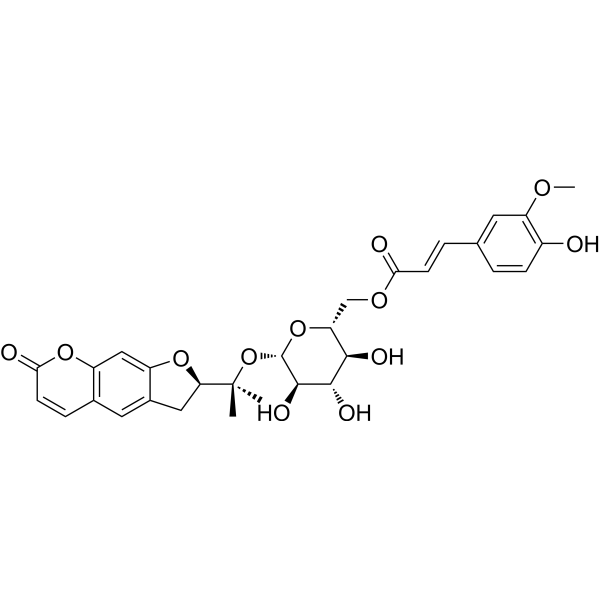
6'-O-trans-Feruloylnodakenin is a marker compound used for HPLC fingerprint of N. forbesii . 6'-O-trans-Feruloylnodakenin has antitumor activities (IC50 = 7.5x10⁻⁷ mol/L) in vitro.
loading...
    loading...
Cat. No.: HY-183056
P2X3 antagonist 40 is a P2X3 antagonist with a human P2X3 receptor pIC50 < 4.52. P2X3 antagonist 40 can be used for research on ATP-mediated proinflammatory fingerprint, including overactive bladder, pain, and chronic cough .
loading...
    loading...
Cat. No.: HY-L912V0
10,000,000 compounds
With MCE's 40,662 BBs, covering around 273 reaction types, more than 40 million molecules were generated. Compounds which comply with Ro5 criteria were selected. Inappropriate chemical structures, such as PAINS motifs and synthetically difficult accessible, were removed. Based on Morgan Fingerprint, molecular clustering analysis was carried out, and molecules close to each clustering center were extracted to form this drug-like and synthesizable diversity library. These selected molecules have 805,822 unique Bemis-Murcko Scaffolds (BMS) with diversified chemical space. This library is highly recommended for AI-based lead discovery, ultra-large virtual screening and novel lead discovery.
Cat. No.: HY-L910V
50,000 compounds
MegaUni 50K Virtual Diversity Library consists of 50,000 novel, synthetically accessible, lead-like compounds. With MCE's 40,662 Building Blocks, covering around 273 reaction types, more than 40 million molecules were generated. Based on Morgan Fingerprint and Tanimoto Coefficient, molecular clustering analysis was carried out, and molecules closest to each clustering center were extracted to form a drug-like and synthesizable diversity library. The selected 50,000 drug-like molecules have 46,744 unique Bemis-Murcko Scaffolds (BMS), each containing only 1-3 compounds. This diverse library is highly recommended for virtual screening and novel lead discovery.
Cat. No.: HY-L923
9000 compounds

Ion channels are key proteins on the cell membrane that regulate the flow of ions across membranes. They participate in nearly all physiological processes, including nerve conduction, muscle contraction, heart rhythm, and pain perception. Abnormalities in their function can lead to various serious diseases such as arrhythmia, epilepsy, hypertension, neuropathic pain, and cancer. Therefore, ion channels are highly valuable drug targets—over 15% of approved drugs target ion channels currently, demonstrating their irreplaceable therapeutic value in cardiovascular, neurological, and analgesic fields.

MCE has collected a library of over 5,000 reported ion channel-related bioactive compounds targeting major sites such as Na+ channels, K+ channels, Ca2+ channels, GABA receptors, iGluRs, and others. Using AI models, these compounds are characterized through both 2D representations (molecular fingerprints, pharmacophores) and 3D representations (3D conformation) to screen for a collection of lead-like compounds highly similar to known active molecules. Additionally, an hERG channel prediction algorithm integrating XGB and ISE mapping strategy is employed to assess and exclude potential cardiotoxicity in the library.. This step significantly reduces safety risks in subsequent screenings, particularly for ion channel drug development related to cardiovascular systems (e.g., Nav1.5, Cav1.2), effectively minimizing failures due to hERG inhibition and serving as a valuable tool for ion channel drug screening.

  • 1

