



Leucocrystal violet

Based on 1 Customer Validation
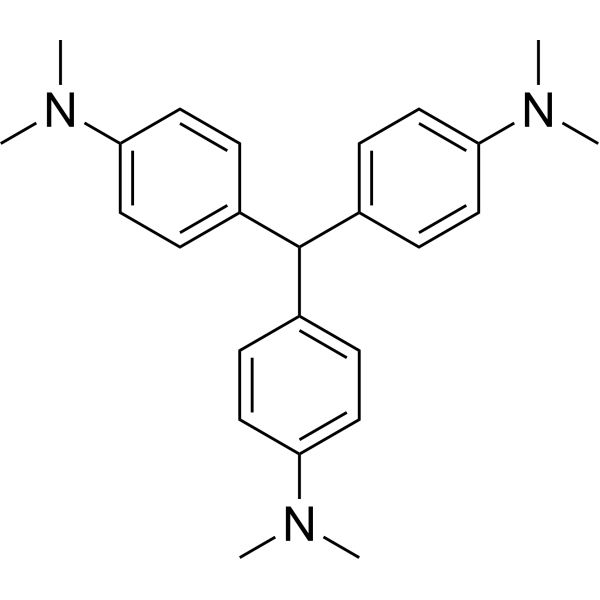
Leucocrystal violet is a cationic triarylmethane dye. Leucocrystal violet generates a colored purple product in the presence of hydrogen peroxide and horseradish peroxidase, or when oxidized by periodate under the catalysis of horseradish peroxidase. Leucocrystal violet serves as a chromogenic reagent for the determination of submicrogram-level hydrogen peroxide, with no interference from tryptophan, persulfate or chromate. Leucocrystal violet reacts with blood to produce a purple/violet color in the presence of hydrogen peroxide; it forms a very weak fluorophore when acting with whole blood in an unbuffered solution, with a maximum absorption wavelength of 630 nm and a maximum fluorescence emission wavelength of 665 nm upon excitation at 630 nm. Leucocrystal violet is widely used for staining blood residues on porous and non-porous materials.
For research use only. We do not sell to patients.
- Purity : 98.81%
- CAS No.: 603-48-5
- Formula: C25H31N3
- Molecular Weight:373.53
-
Storage:
4°C, protect from light
* In solvent : -80°C, 6 months; -20°C, 1 month (protect from light)

To place orders, for customer services and technical support, please contact: MedChemExpress USA
Tel: 609-228-6898 E-mail: [email protected] [email protected]


-
 Biological Activity
-
Chemical Information
-
Solvent & Solubility
- Purity & Documentation
- References
-
 Help & FAQs


-

HY-D0233R
Leucocrystal violet (Standard)Analytical Standard -
HY-B1571
Bromophenol bluepH Indicator -
HY-W110798
Bromophenol blue indicator (3.0-4.6)Biochemical Assay Reagent -
HY-D0300
Leucomalachite greenMalachite Green Metabolite -
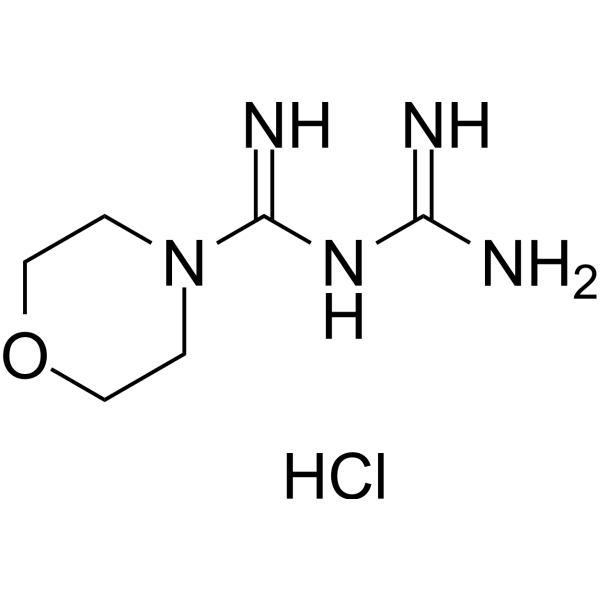
HY-B0420A
Moroxydine hydrochlorideBroad-spectrum Antiviral Agent -
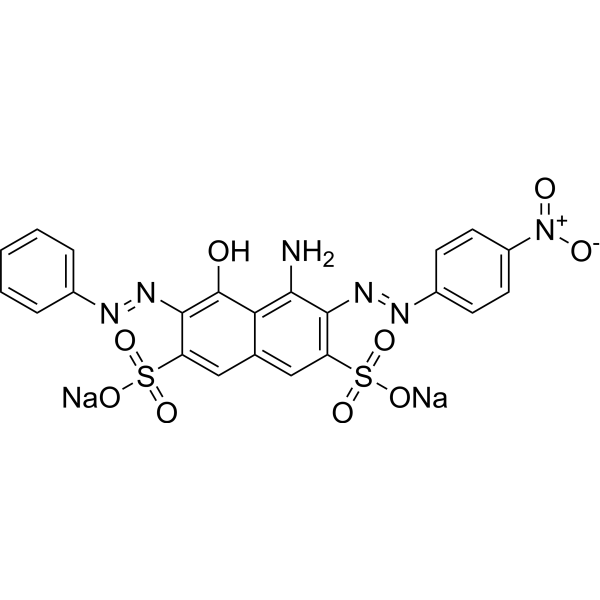
HY-Y0695
Amido Black 10BAzo Dye -
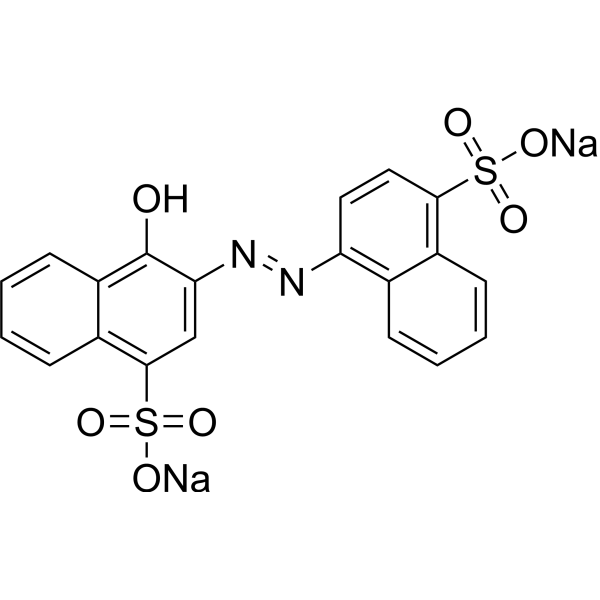
HY-128448
CarmoisineAzo Dye -

HY-D0300R
Leucomalachite green (Standard)Malachite Green Metabolite -

HY-128448R
Carmoisine (Standard)Azo Dye -

HY-B0420AR
Moroxydine hydrochloride (Standard)Antiviral Agent


Biological Activity
Description
In Vitro
Leucocrystal violet enables a highly sensitive, precise, and selective cell-free colorimetric assay for hydrogen peroxide, with a molar absorptivity of 75,000 M-1cm-1 for H2O2 detection, stable absorbance readings for at least 4 hours, and minimal interference from tested biological and chemical species[1].
Leucocrystal violet has a weak UV-Vis absorbance maximum at 590 nm; leucocrystal violet working solution has an absorbance maximum at 630 nm due to low pH-induced protonation of crystal violet impurities; unbuffered whole blood mixed with leucocrystal violet working solution produces a strong UV-Vis absorbance maximum at 630 nm[2].
Leucocrystal violet (0.6 g Leucocrystal violet in 450 mL deionized water + 9 g 5-sulfosalicylic acid + 45 mL 30% hydrogen peroxide)-treated blood-borne footwear impressions on dark green polypropylene carpet can be effectively enhanced via spectral methods, with optimal results using 400-600 nm excitation, a 695 nm barrier filter, and an integrated CCD IR colour video camera with image integration; maximum fluorescence intensity occurs at 665 nm emission when excited at 630 nm in the absence of substrate interference[2].
MedChemExpress (MCE) has not independently confirmed the accuracy of these methods. They are for reference only. .


Chemical Information
-
CAS No. 603-48-5
-
Appearance Solid
-
Molecular Weight 373.53
-
Formula C25H31N3
-
Color Blue to blue-green
-
SMILES
CN(C)C1=CC=C(C(C2=CC=C(N(C)C)C=C2)C3=CC=C(N(C)C)C=C3)C=C1
-
Shipping
Room temperature in continental US; may vary elsewhere.
-
Storage
4°C, protect from light
* In solvent : -80°C, 6 months; -20°C, 1 month (protect from light)


Solvent & Solubility
In Vitro:
DMSO : 12.5 mg/mL (33.46 mM; Need ultrasonic; Hygroscopic DMSO has a significant impact on the solubility of product, please use newly opened DMSO)
H2O : < 0.1 mg/mL (insoluble)
Please refer to the solubility information to select the appropriate solvent. Once prepared, please aliquot and store the solution to prevent product inactivation from repeated freeze-thaw cycles.
Storage method and period of stock solution: -80°C, 6 months; -20°C, 1 month (protect from light). When stored at -80°C, please use it within 6 months. When stored at -20°C, please use it within 1 month.
Please refer to the solubility information to select the appropriate solvent. Once prepared, please aliquot and store the solution to prevent product inactivation from repeated freeze-thaw cycles.
Storage method and period of stock solution: -80°C, 6 months; -20°C, 1 month (protect from light). When stored at -80°C, please use it within 6 months. When stored at -20°C, please use it within 1 month.
Concentration (start) × Volume (start) = Concentration (final) × Volume (final)


Purity & Documentation
-
Data Sheet (273 KB)
-
SDS (458 KB)
- English - EN (458 KB)
- Français - FR (458 KB)
- Deutsch - DE (458 KB)
- Norwegian - NO (458 KB)
- Español - ES (458 KB)
- Swedish - SV (458 KB)
- Italian - IT (458 KB)
- Korean - KR (458 KB)
- Portuguese - PT (458 KB)
-
Handling Instructions (2659 KB)
References


Complete Stock Solution Preparation Table
Please refer to the solubility information to select the appropriate solvent. Once prepared, please aliquot and store the solution to prevent product inactivation from repeated freeze-thaw cycles.
Storage method and period of stock solution: -80°C, 6 months; -20°C, 1 month (protect from light). When stored at -80°C, please use it within 6 months. When stored at -20°C, please use it within 1 month.
| Optional Solvent | Concentration Solvent Mass | 1 mg | 5 mg | 10 mg | 25 mg |
|---|---|---|---|---|---|
| DMSO | 1 mM | 2.6772 mL | 13.3858 mL | 26.7716 mL | 66.9290 mL |
| 5 mM | 0.5354 mL | 2.6772 mL | 5.3543 mL | 13.3858 mL | |
| 10 mM | 0.2677 mL | 1.3386 mL | 2.6772 mL | 6.6929 mL | |
| 15 mM | 0.1785 mL | 0.8924 mL | 1.7848 mL | 4.4619 mL | |
| 20 mM | 0.1339 mL | 0.6693 mL | 1.3386 mL | 3.3465 mL | |
| 25 mM | 0.1071 mL | 0.5354 mL | 1.0709 mL | 2.6772 mL | |
| 30 mM | 0.0892 mL | 0.4462 mL | 0.8924 mL | 2.2310 mL |


Leucocrystal violet Related Classifications
HY-D0233 Related Classifications
 Powered by Bioz