1. Search Result
Search Result
Results for "

fluorine atom

" in MedChemExpress (MCE) Product Catalog:

10

Inhibitors & Agonists

1

Fluorescent Dyes

2

Biochemical Assay Reagents

1

Isotope-Labeled Compounds

1

Click Chemistry

Cat. No. Product Name Target Research Areas Chemical Structure
  • HY-W012725

    Biochemical Assay Reagents Drug Intermediate Others
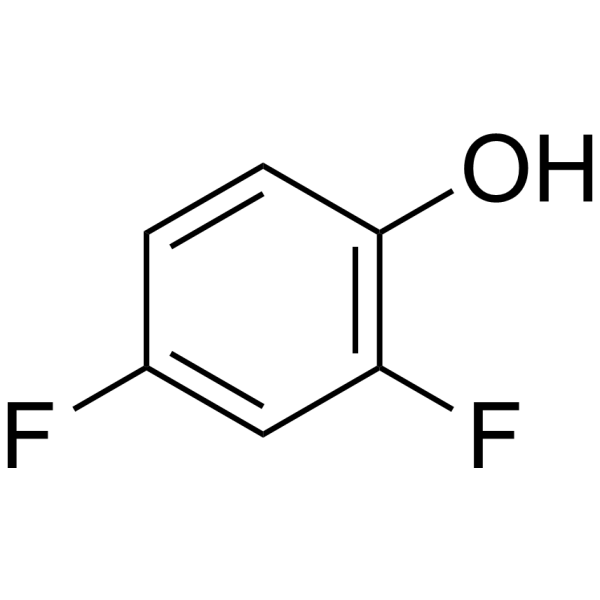
    2,4-Difluorophenol is a difluoro-substituted phenol that serves as a starting material for the synthesis of 4,6-difluoro-5,7-dihydroxytryptamine .
    2,4-Difluorophenol
  • HY-122607

    Mitochondrial Metabolism TSPO Inflammation/Immunology Cancer
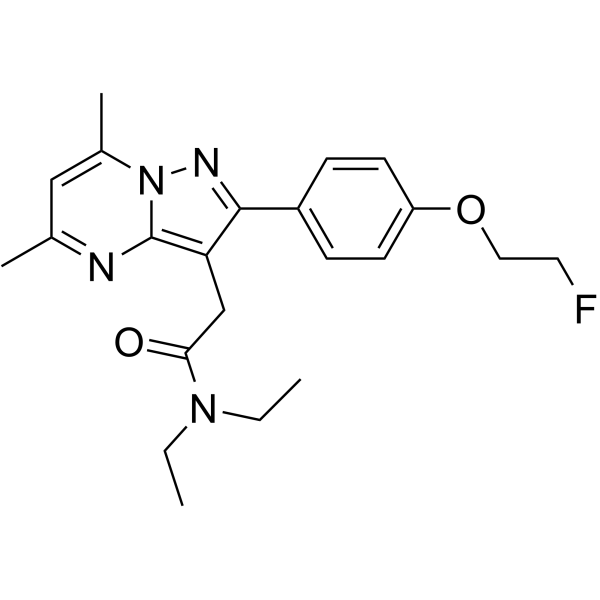
    DPA-714 is a high affinity translocator protein (TSPO) ligand (Ki=7 nM), which is designed with a fluorine atom in its structure, allowing labelling with fluorine -18 and in vivo imaging using positron emission tomography. 18FDPA-714 successfully evaluates for the specific imaging of inflammation in various models of neuroinflammation and in a brain tumor model .
    DPA-714
  • HY-76573

    Apoptosis Cardiovascular Disease Cancer
    ML-10 is a small molecule apoptosis probe. Due to the presence of fluorine atoms, ML-10 can be radiolabeled with 18F isotopes and can be used for apoptosis positron emission tomography imaging studies. ML-10 is selectively taken up and accumulated in apoptotic cells, while being excluded from live or necrotic cells. In addition, the uptake of ML-10 is associated with apoptotic features such as caspase activation, Annexin-V binding, and disruption of mitochondrial membrane potential .
    ML-10
  • HY-122607R

    Mitochondrial Metabolism Inflammation/Immunology Cancer
    DPA-714 (Standard) is the analytical standard of DPA-714. This product is intended for research and analytical applications. DPA-714 is a high affinity translocator protein (TSPO) ligand (Ki=7 nM), which is designed with a fluorine atom in its structure, allowing labelling with fluorine -18 and in vivo imaging using positron emission tomography. 18FDPA-714 successfully evaluates for the specific imaging of inflammation in various models of neuroinflammation and in a brain tumor model .
    DPA-714 (Standard)
  • HY-W036734

    Biochemical Assay Reagents Others
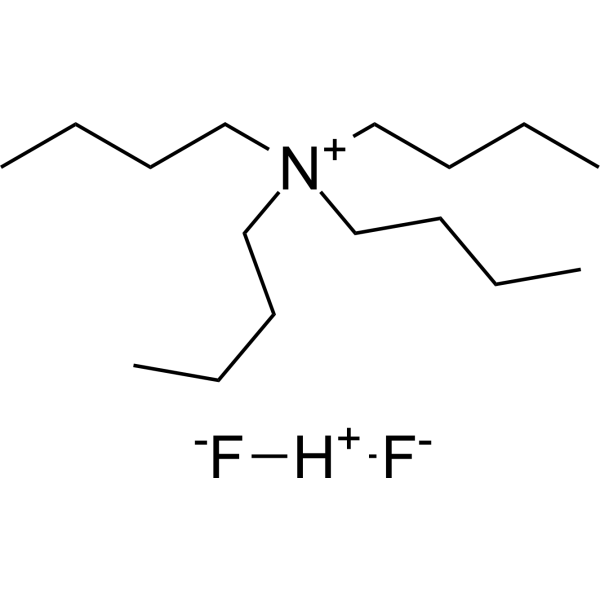
    Tetrabutylammonium (hydrogen difluoride) is a quaternary ammonium salt containing fluoride ions. It is a highly active and effective reagent, often used in organic synthesis reactions, especially for the modification of organic molecules with fluorine atoms. Tetrabutylammonium (hydrogen difluoride) is also used as a catalyst for various chemical reactions such as esterification and transesterification. Additionally, it is used in the production of specialty chemicals such as surfactants and detergents.
    Tetrabutylammonium hydrogen difluoride
  • HY-111654

    Glucocorticoid Receptor Metabolic Disease
    Diflucortolone is a fluorinated corticosteroid with fluorine atoms at the C6 and C9 positions .
    Diflucortolone
  • HY-122607S

    Isotope-Labeled Compounds Mitochondrial Metabolism TSPO Inflammation/Immunology Cancer
    DPA-714-d10 is the deuterium labeled DPA-714 (HY-122607). DPA-714 is a high affinity translocator protein (TSPO) ligand (Ki=7 nM), which is designed with a fluorine atom in its structure, allowing labelling with fluorine -18 and in vivo imaging using positron emission tomography. 18FDPA-714 successfully evaluates for the specific imaging of inflammation in various models of neuroinflammation and in a brain tumor model.
    DPA-714-d10
  • HY-W590575

    Biochemical Assay Reagents Others
    Azido-PEG3-flouride is a PEG linker containing a fluorine atom and an azide group. The hydrophilic PEG spacer increases solubility in aqueous media. The azide group can react with alkyne, BCN, DBCO via Click Chemistry to yield a stable triazole linkage.
    Azido-PEG3-flouride
  • HY-D3174

    Fluorescent Dye Metabolic Disease Inflammation/Immunology
    PiF is a fluorescent probe with high specificity for pancreatic β-cells (Ex/Em = 535 nm/565 nm), and its fluorescence signal increases significantly with elevated insulin concentrations in in vitro experiments. PiF enables visualization of rat and human islets transplanted via the portal vein in mouse livers with low liver background signals. The fluorine atom of PiF can be replaced by radioactive 18F to prepare a PET tracer. PiF can be used for research on type 1 diabetes .
    PiF
  • HY-182361

    AMPK JAK Cadherin Cancer
    NUAK1-IN-3 is a potent and selective NUAK1 inhibitor with an IC50 of 0.49 nM. NUAK1-IN-3 also inhibits NUAK2 and JAK3 with IC50 values of 265 and 225 nM. NUAK1-IN-3 engages Glu139 of NUAK1, forms a salt bridge between its bicyclic ring nitrogen and Asp142, and uses a fluorine atom to enhance hydrophobic binding interactions. NUAK1-IN-3 attenuates MYPT1 phosphorylation, suppresses the NUAK1-MYPT1 signaling axis, and inhibits proliferation, migration, and invasion of triple-negative breast cancer cells. NUAK1-IN-3 reverses TGF-β1-induced epithelial-mesenchymal transition (EMT) marker alterations, downregulates Snail and N-cadherin, and upregulates E-cadherin in tumor tissues. NUAK1-IN-3 suppresses tumor growth in triple-negative breast cancer xenograft models. NUAK1-IN-3 can be used for the research of triple-negative breast cancer .
    NUAK1-IN-3

Inquiry Online

Your information is safe with us. * Required Fields.

Salutation


Country or Region *

Applicant Name *


Organization Name *

Department *


Email Address *


Product Name *

Cat. No.


Requested quantity *

Phone Number *


Remarks

Inquiry Online

Inquiry Information

Product Name:
Cat. No.:
Quantity:
MCE Japan Authorized Agent:

