


1. Search Result
Search Result
Results for "

helical structure

" in MedChemExpress (MCE) Product Catalog:

9

Inhibitors & Agonists

5

Peptides

3

Natural
Products

Cat. No. Product Name Target Research Areas Chemical Structure
  • HY-N6708
    Alamethicin
    2 Publications Verification

    Antibiotic Bacterial Infection
    Alamethicin is a linear 20-amino acid antibiotic, which can induce voltage-gated conductance in model and cell membranes. Alamethicin exhibits antimicrobial activity against Gram-positive bacteria, but not Gram-negative bacteria. Alamethicin can form an amphipathic α-helical structure in biological membranes .
    Alamethicin
  • HY-W018678

    Others PROTAC Linkers Neurological Disease
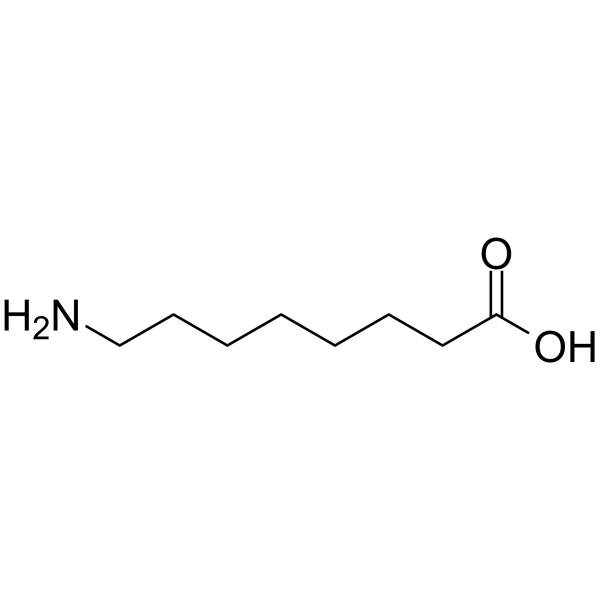
    8-Aminooctanoic acid is an omega-amino fatty acid that is octanoic acid which carries an amino group at position 8. 8-aminooctanoic acid has a role as a human metabolite .
    8-Aminooctanoic acid
  • HY-118773

    A22 hydrochloride

    Bacterial Infection
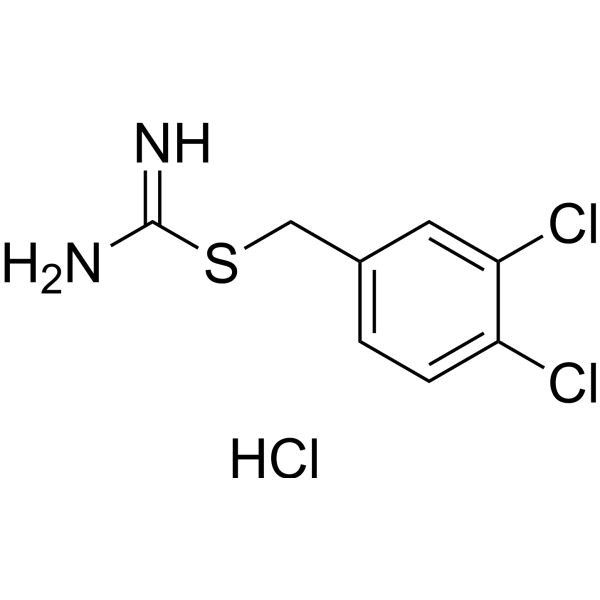
    MreB Perturbing Compound A22 hydrochloride (A22 hydrochloride) is a reversible MreB inhibitor and antimicrobial agent that exhibits bacteriostatic activity against Escherichia coli, with low activity against Gram-positive bacteria. MreB Perturbing Compound A22 hydrochloride rapidly and reversally delocalizes MreB from the helical/circular structures in cells, impairs MreB function, and reduces the binding of MreB to the chromosomal region proximal to the replication origin. MreB Perturbing Compound A22 hydrochloride alters the cell morphology of caulobacters to round/lemon-shaped, slows caulobacter growth, blocks their cell division, and induces the formation of spherical morphology, asymmetric division, and anucleate cells in Escherichia coli. MreB Perturbing Compound A22 hydrochloride is used for studies related to bacterial rod-shaped morphology determination, chromosome segregation, and cell division mechanisms .
    MreB Perturbing Compound A22 hydrochloride
  • HY-P5557

    Bacterial Necroptosis Infection Inflammation/Immunology
    TP4 (Nile tilapia piscidin) is an orally active amphipathic α-helical cationic antimicrobial peptide. TP4 (Nile tilapia piscidin) exerts broad-spectrum bactericidal activity against Gram-positive and Gram-negative bacteria by disrupting cell membrane structures, and also exhibits certain hemolytic activity. TP4 (Nile tilapia piscidin) regulates the innate immune system and enhances the expression of lysozymes, cytokines and antioxidant enzymes to resist bacterial infection. TP4 (Nile tilapia piscidin) also stimulates the proliferation of keratinocytes and fibroblasts, and significantly promotes the healing of wounds infected with MRSA. TP4 (Nile tilapia piscidin) can be used in research related to bacterial infection, peritonitis, wound healing and other fields .
    TP4 (Nile tilapia piscidin)
  • HY-W006886

    Amino Acid Derivatives Others
    Fmoc-(R)-2-(7-octenyl) Ala-OH is an unnatural Fmoc-protected amino acid and modification module. Fmoc-(R)-2-(7-octenyl) Ala-OH serves as a key building block for all-hydrocarbon cross-linking modification of antimicrobial peptides, and facilitates the generation of stapled peptide derivatives. When introduced into specific sites of the parent peptide, Fmoc-(R)-2-(7-octenyl) Ala-OH effectively increases the α-helix content of the peptide chain, thereby significantly enhancing its antimicrobial activity and proteolytic stability. Fmoc-(R)-2-(7-octenyl) Ala-OH is widely used in research on bacterial infections and the development of related antimicrobial agents . Stapled peptide is a specially chemically modified polypeptide. It locks the peptide chain into a stable α-helical structure by introducing a "staple"-like chemical bridge (usually an all-carbon backbone) at specific positions of the peptide chain.
    Fmoc-(R)-2-(7-octenyl)Ala-OH
  • HY-W018678R

    Reference Standards Biochemical Assay Reagents Neurological Disease
    8-Aminooctanoic acid (Standard) is the analytical standard of 8-Aminooctanoic acid. This product is intended for research and analytical applications. 8-Aminooctanoic acid is an omega-amino fatty acid that is octanoic acid which carries an amino group at position 8. 8-aminooctanoic acid has a role as a human metabolite[1].
    8-Aminooctanoic acid (Standard)
  • HY-150536

    HIV HIV Protease Infection
    EP39 is a potent HIV-1 maturation inhibitor. EP39 interacts with the SP1 domain of Gag. EP39 decreases the dynamics of CA-SP1 junction, by binding to the QVT motif of the SP1 domain, and perturbs the natural coil-helix equilibrium on both sides of the SP1 domain by stabilizing the transient alpha helical structure. EP39 acts by arresting maturation of HIV-1 thereby blocking its infectivity .
    EP39
  • HY-118773R

    A22 hydrochloride (Standard)

    Reference Standards Bacterial Infection
    MreB Perturbing Compound A22 hydrochloride (Standard) is the analytical standard for MreB Perturbing Compound A22 hydrochloride (HY-118773). This product is intended for research and analytical applications. MreB Perturbing Compound A22 hydrochloride (A22 hydrochloride) is a reversible MreB inhibitor and antimicrobial agent that exhibits bacteriostatic activity against Escherichia coli, with low activity against Gram-positive bacteria. MreB Perturbing Compound A22 hydrochloride rapidly and reversally delocalizes MreB from the helical/circular structures in cells, impairs MreB function, and reduces the binding of MreB to the chromosomal region proximal to the replication origin. MreB Perturbing Compound A22 hydrochloride alters the cell morphology of caulobacters to round/lemon-shaped, slows caulobacter growth, blocks their cell division, and induces the formation of spherical morphology, asymmetric division, and anucleate cells in Escherichia coli. MreB Perturbing Compound A22 hydrochloride is used for studies related to bacterial rod-shaped morphology determination, chromosome segregation, and cell division mechanisms .
    MreB Perturbing Compound A22 hydrochloride (Standard)
  • HY-180334

    Calcium Channel Cardiovascular Disease
    S-312 is a calcium antagonist with a bicyclic dihydrothienopyridine structure. S-312 can relax the helical strips of various isolated rabbit arteries procontracted with high potassium depolarizaiton. S-312 competitively imhibits calcium-induced contractions in depolarized basilar and femoral arteries. S-312 increases AV nodal conduction time in Langenedorff-perfused isolated rabbit hearts. S-312 exhibits vasculoselectivity, particularly for cerebral vessel .
    S-312

Inquiry Online

Your information is safe with us. * Required Fields.

Salutation


Country or Region *

Applicant Name *


Organization Name *

Department *


Email Address *


Product Name *

Cat. No.


Requested quantity *

Phone Number *


Remarks

Inquiry Online

Inquiry Information

Product Name:
Cat. No.:
Quantity:
MCE Japan Authorized Agent:

