



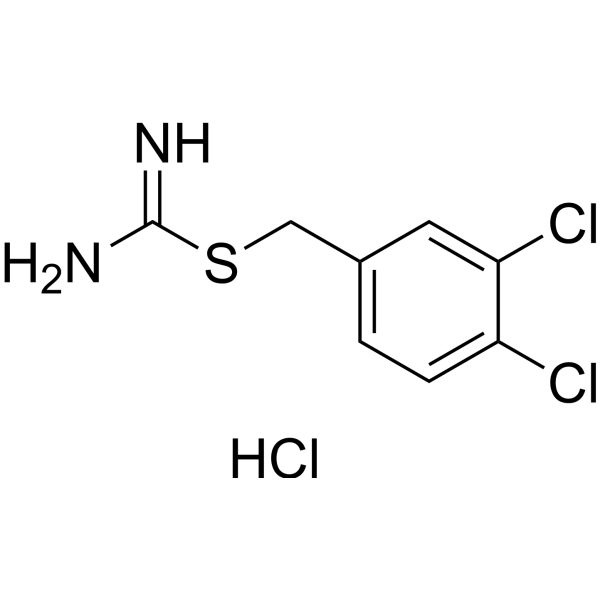
MreB Perturbing Compound A22 hydrochloride

Based on 1 Customer Validation
MreB Perturbing Compound A22 hydrochloride (A22 hydrochloride) is a reversible MreB inhibitor and antimicrobial agent that exhibits bacteriostatic activity against Escherichia coli, with low activity against Gram-positive bacteria. MreB Perturbing Compound A22 hydrochloride rapidly and reversally delocalizes MreB from the helical/circular structures in cells, impairs MreB function, and reduces the binding of MreB to the chromosomal region proximal to the replication origin. MreB Perturbing Compound A22 hydrochloride alters the cell morphology of caulobacters to round/lemon-shaped, slows caulobacter growth, blocks their cell division, and induces the formation of spherical morphology, asymmetric division, and anucleate cells in Escherichia coli. MreB Perturbing Compound A22 hydrochloride is used for studies related to bacterial rod-shaped morphology determination, chromosome segregation, and cell division mechanisms.
For research use only. We do not sell to patients.
- Purity : 99.97%
- CAS No.: 22816-60-0
- Formula: C8H9Cl3N2S
- Molecular Weight:271.59
-
Storage:
-20°C, sealed storage, away from moisture
* In solvent : -80°C, 6 months; -20°C, 1 month (sealed storage, away from moisture)

To place orders, for customer services and technical support, please contact: MedChemExpress USA
Tel: 609-228-6898 E-mail: [email protected] [email protected]


-
 Biological Activity
-
Chemical Information
-
Solvent & Solubility
- Purity & Documentation
- References
-
 Help & FAQs




Biological Activity
Description
Cellular Effect
|
Cell Line

|
Type | Value | Description | References |
|---|---|---|---|---|
| A-431 | IC50 |
7.3 μM
Compound: 3s
|
Inhibition of indoleamine-2,3-dioxygenase in human A431 cells assessed as inhibition of IFN-gamma-stimulated kynurenine production
Inhibition of indoleamine-2,3-dioxygenase in human A431 cells assessed as inhibition of IFN-gamma-stimulated kynurenine production
|
[PMID: 20688518] |
In Vitro
MreB Perturbing Compound A22 (0.1-100 μg/mL; up to 6 h) hydrochloride slows Caulobacter crescentus growth in a dose-dependent manner and causes a bacteriostatic block in cell division at concentrations of 10 μg/mL and higher[1].
MreB Perturbing Compound A22 (0.1-10 μg/mL; 0-8 h) hydrochloride induces dose-dependent morphological changes in Caulobacter crescentus cells, converting crescent-shaped cells to rounded, lemon-shaped cells at 0.1, 1, and 10 μg/mL after 6 h of treatment[1].
MreB Perturbing Compound A22 (10 mg/mL; 24 h) hydrochloride induces anucleate cell production and growth inhibition in Escherichia coli K-12 strain SH3210 as detected by the anucleate cell blue assay[2].
MreB Perturbing Compound A22 hydrochloride shows antibacterial activity with an MIC of 3.1 μg/mL for Escherichia coli, 12.5 μg/mL for Staphylococcus aureus, and >100 μg/mL for Bacillus subtilis[2].
MedChemExpress (MCE) has not independently confirmed the accuracy of these methods. They are for reference only.
-
Cell Line:Escherichia coli
-
Concentration:10 μg/mL (A22 alone; A22 + 10 μg/mL cephalexin)
-
Incubation Time:0-6 h
-
Result:Slowed cell growth but did not induce lysis when used alone.
Slowed growth further but also did not induce cell lysis when used in combination with 10 μg/mL cephalexin.


Chemical Information
-
CAS No. 22816-60-0
-
Appearance Solid
-
Molecular Weight 271.59
-
Formula C8H9Cl3N2S
-
Color White to off-white
-
SMILES
ClC1=CC(CSC(N)=N)=CC=C1Cl.Cl
-
Synonyms
A22 hydrochloride
-
Shipping
Room temperature in continental US; may vary elsewhere.
-
Storage
-20°C, sealed storage, away from moisture
* In solvent : -80°C, 6 months; -20°C, 1 month (sealed storage, away from moisture)


Solvent & Solubility
In Vitro:
DMSO : ≥ 20 mg/mL (73.64 mM; Hygroscopic DMSO has a significant impact on the solubility of product, please use newly opened DMSO)
DMF : ≥ 20 mg/mL (73.64 mM)
Ethanol : ≥ 1 mg/mL (3.68 mM)
* "≥" means soluble, but saturation unknown.
Please refer to the solubility information to select the appropriate solvent. Once prepared, please aliquot and store the solution to prevent product inactivation from repeated freeze-thaw cycles.
Storage method and period of stock solution: -80°C, 6 months; -20°C, 1 month (sealed storage, away from moisture). When stored at -80°C, please use it within 6 months. When stored at -20°C, please use it within 1 month.
Please refer to the solubility information to select the appropriate solvent. Once prepared, please aliquot and store the solution to prevent product inactivation from repeated freeze-thaw cycles.
Storage method and period of stock solution: -80°C, 6 months; -20°C, 1 month (sealed storage, away from moisture). When stored at -80°C, please use it within 6 months. When stored at -20°C, please use it within 1 month.
Concentration (start) × Volume (start) = Concentration (final) × Volume (final)


Purity & Documentation
-
Data Sheet (273 KB)
-
SDS (396 KB)
- English - EN (396 KB)
- Français - FR (396 KB)
- Deutsch - DE (396 KB)
- Norwegian - NO (396 KB)
- Español - ES (396 KB)
- Swedish - SV (396 KB)
- Italian - IT (396 KB)
- Korean - KR (396 KB)
- Portuguese - PT (396 KB)
-
Handling Instructions (2659 KB)
References
[1]. Gitai Z, et al. MreB actin-mediated segregation of a specific region of a bacterial chromosome. Cell. 2005;120(3):329-341. [Content Brief]
[2]. Iwai N, et al. Novel S-benzylisothiourea compound that induces spherical cells in Escherichia coli probably by acting on a rod-shape-determining protein(s) other than penicillin-binding protein 2. Biosci Biotechnol Biochem. 2002;66(12):2658-2662. [Content Brief]


Complete Stock Solution Preparation Table
Please refer to the solubility information to select the appropriate solvent. Once prepared, please aliquot and store the solution to prevent product inactivation from repeated freeze-thaw cycles.
Storage method and period of stock solution: -80°C, 6 months; -20°C, 1 month (sealed storage, away from moisture). When stored at -80°C, please use it within 6 months. When stored at -20°C, please use it within 1 month.
| Optional Solvent | Concentration Solvent Mass | 1 mg | 5 mg | 10 mg | 25 mg |
|---|---|---|---|---|---|
| Ethanol / DMSO / DMF | 1 mM | 3.6820 mL | 18.4101 mL | 36.8202 mL | 92.0505 mL |
| DMSO / DMF | 5 mM | 0.7364 mL | 3.6820 mL | 7.3640 mL | 18.4101 mL |
| 10 mM | 0.3682 mL | 1.8410 mL | 3.6820 mL | 9.2051 mL | |
| 15 mM | 0.2455 mL | 1.2273 mL | 2.4547 mL | 6.1367 mL | |
| 20 mM | 0.1841 mL | 0.9205 mL | 1.8410 mL | 4.6025 mL | |
| 25 mM | 0.1473 mL | 0.7364 mL | 1.4728 mL | 3.6820 mL | |
| 30 mM | 0.1227 mL | 0.6137 mL | 1.2273 mL | 3.0684 mL | |
| 40 mM | 0.0921 mL | 0.4603 mL | 0.9205 mL | 2.3013 mL | |
| 50 mM | 0.0736 mL | 0.3682 mL | 0.7364 mL | 1.8410 mL | |
| 60 mM | 0.0614 mL | 0.3068 mL | 0.6137 mL | 1.5342 mL |


MreB Perturbing Compound A22 hydrochloride Related Classifications
HY-118773 Related Classifications
 Powered by Bioz
Keywords
- MreB Perturbing Compound A22
- 22816-60-0
- A22
- MreB Perturbing Compound A 22
- MreB Perturbing Compound A-22
- A 22
- A-22
- Bacterial
- Staphylococcus aureus
- Bacillus subtilis
- Gram-positive bacteria
- Caulobacter
- origin-distal loci
- origin-proximal chromosomal regions
- MreB
- Escherichia coli
- origin-proximal chromosomal loci
- Caulobacter crescentus
- Inhibitor
- inhibitor
- inhibit