9 Results for "

hemocytes

" in MedChemExpress (MCE) Product Catalog:
Products (9)

9 Results for "hemocytes" in MCE Product Catalog:

1
1 Cited Publications
Cat. No.: HY-W011215
CAS No.: 84-75-3
Dihexyl phthalate is an orally active phthalate ester (PAEs) widely used as a plasticizer, and it acts as an environmental endocrine disruptor. Dihexyl phthalate exhibits endocrine-disrupting and reproductive toxic properties, induces oxidative stress and inflammation, and ultimately causes apoptosis and damage to reproductive organs such as the testes. Dihexyl phthalate can be used in studies related to developmental toxicity, embryonic lethality, teratogenicity, and abnormal development of the male reproductive system .
loading...
    loading...
Cat. No.: HY-W041608
CAS No.: 26172-55-4
Methylchloroisothiazolinone is a widely used fungicide and also an aquatic pollutant with pro-inflammatory activity and neurotoxicity. Methylchloroisothiazolinone induces the production of pro-inflammatory cytokines (such as IL-1β, TNF-α, IL-6) by activating the NF-κB signaling pathway and upregulating TLR4 expression, thereby triggering allergic contact dermatitis. Methylchloroisothiazolinone reduces cholinesterase activity and exacerbates oxidative stress by impairing catalase activity and disrupting redox balance. Methylchloroisothiazolinone poses significant harm to Mediterranean mussels, reducing the viability of hemocytes and digestive gland cells, inhibiting immune phagocytic function, and disrupting osmoregulatory capacity. Methylchloroisothiazolinone is used in studies on allergic contact dermatitis and related immunotoxicity mechanisms .
loading...
    loading...
Cat. No.: HY-B1870
CAS No.: 108-62-3
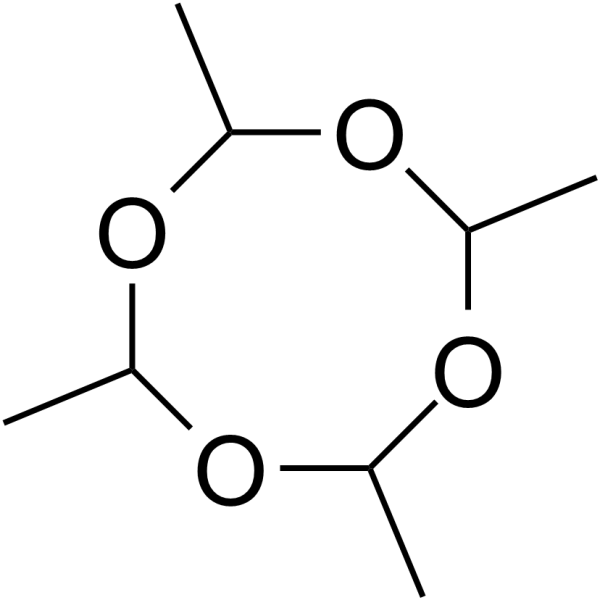
Metaldehyde is an orally active molluscicide. Metaldehyde acts as a feeding inhibitor. Metaldehyde disrupts the feeding cycle, impairs righting ability, delays fecal excretion, induces toxic symptoms in slugs, reduces the concentrations of neurotransmitters (Noradrenaline, 5-HT (HY-B1473A)) in the mouse brain, and induces lethal clonic-tonic convulsions in mice .
loading...
    loading...
Cat. No.: HY-W011215S
CAS No.: 1015854-55-3
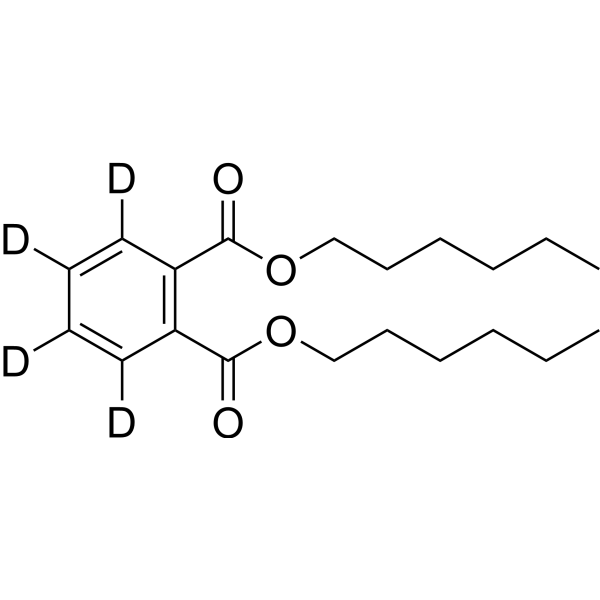
Dihexyl phthalate-3,4,5,6-d4 is the deuterated-labeled Dihexyl phthalate (HY-W011215). Dihexyl phthalate is an orally active phthalate ester (PAEs) widely used as a plasticizer, and it acts as an environmental endocrine disruptor. Dihexyl phthalate exhibits endocrine-disrupting and reproductive toxic properties, induces oxidative stress and inflammation, and ultimately causes apoptosis and damage to reproductive organs such as the testes. Dihexyl phthalate can be used in studies related to developmental toxicity, embryonic lethality, teratogenicity, and abnormal development of the male reproductive system .
loading...
    loading...
Cat. No.: HY-P10684
CAS No.: 125139-68-6
Target:  

Bacterial

Research Areas:  

Infection

Polyphemusin II is an antimicrobial peptide which can be isolated from Limulus polyphemus hemocytes. Polyphemusin II exhibits antimicrobial activities against various Gram (+)/(-) bacteria and fungi .
loading...
    loading...
Cat. No.: HY-175485
Target:  

Bacterial

Research Areas:  

Infection

GaSal-2 is a water-soluble anti-pseudomonal agent that targets the extracellular hemocyte HasAp. It binds tightly to HasAp, blocks the transcriptional activation of the bacterial cell surface signaling cascade, and inhibits the growth of Pseudomonas aeruginosa .
loading...
    loading...
Cat. No.: HY-W011215R
CAS No.: 84-75-3
Dihexyl phthalate (Standard) is the analytical standard of Dihexyl phthalate (HY-W011215). This product is intended for research and analytical applications. Dihexyl phthalate is an orally active phthalate ester (PAEs) widely used as a plasticizer, and it acts as an environmental endocrine disruptor. Dihexyl phthalate exhibits endocrine-disrupting and reproductive toxic properties, induces oxidative stress and inflammation, and ultimately causes apoptosis and damage to reproductive organs such as the testes. Dihexyl phthalate can be used in studies related to developmental toxicity, embryonic lethality, teratogenicity, and abnormal development of the male reproductive system .
loading...
    loading...
Cat. No.: HY-P11180A
Target:  

Antibiotic Bacterial

Research Areas:  

Infection

Clavanin A acetate is a peptide Antibiotic and membrane permeabilizer. Clavanin A acetate permeabilizes cytoplasmic membranes and unilamellar lipid bilayers, and dissipates membrane potential. Clavanin A acetate inserts into phospholipid monolayers via hydrophobic interactions under physiologically relevant surface pressures. Clavanin A acetate exhibits antibacterial activity against Micrococcus flavus. Clavanin A acetate can be used in studies related to Micrococcus flavus infection .
loading...
    loading...
Cat. No.: HY-P11180
CAS No.: 185518-51-8
Target:  

Antibiotic Bacterial

Research Areas:  

Infection

Clavanin A is a peptide Antibiotic and membrane permeabilizer. Clavanin A permeabilizes cytoplasmic membranes and unilamellar lipid bilayers, and dissipates membrane potential. Clavanin A inserts into phospholipid monolayers via hydrophobic interactions under physiologically relevant surface pressures. Clavanin A exhibits antibacterial activity against Micrococcus flavus. Clavanin A can be used in studies related to Micrococcus flavus infection .
loading...
    loading...

