19 Results for "

iridium

" in MedChemExpress (MCE) Product Catalog:
Products (19)

19 Results for "iridium" in MCE Product Catalog:

Cat. No.: HY-160523
CAS No.: 2695594-15-9
Research Areas:  

Others

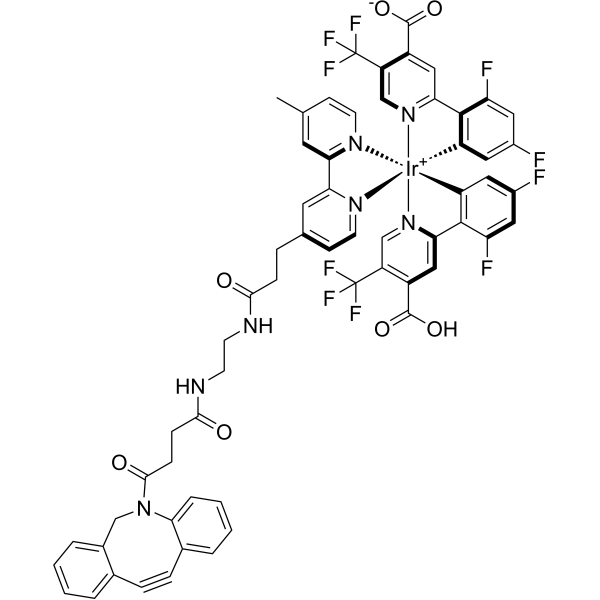
DBCO Ir catalyst is an iridium catalyst labeled with DBCO. DBCO Ir catalyst can be used for in situ labeling and imaging of biomolecules (e.g., proteins, nucleic acids) in living organisms or for constructing targeted drug delivery systems .
loading...
    loading...
Cat. No.: HY-W008260
CAS No.: 12112-67-3
Synonyms: Chloro-1,5-cyclooctadiene iridium(I) dimer
[Ir(cod)Cl]2 is a biochemical reagent that can be used as a biological material or organic compound for life science related research.
loading...
    loading...
Cat. No.: HY-W007596
CAS No.: 94928-86-6
Synonyms: Ir(ppy)3; Tris[2-(pyridin-2-yl)phenyl]iridium
Research Areas:  

Others

Tris(2-phenylpyridinato-C2,N)iridium(III) (Ir(ppy)3) is an iridium(III) containing organometallic complex, which is used as a phosphorescent light-emitting material. Tris(2-phenylpyridinato-C2,N)iridium(III) exhibits high luminous efficiency and good thermal stability, that can be used in organic optoelectronics, especially in improving the luminescence efficiency and stability of organic light-emitting diodes (OLEDs) .
loading...
    loading...
Cat. No.: HY-W021022
CAS No.: 14996-61-3
Synonyms: iridium trichloride hydrate
Iridium(III) chloride (hydrate) (Iridium trichloride (hydrate)) is a biochemical reagent. Iridium(III) can be used in the research of colon cancer .
loading...
    loading...
Cat. No.: HY-W020887
CAS No.: 12246-51-4
Synonyms: Chlorobis(cyclooctene)iridium(I)dimer
[IrCl(COE)2]2 (Chlorobis(cyclooctene)iridium(I)dimer) is a transition metal catalyst with remarkable catalytic activity. It is widely used in catalyzing a variety of organic reactions, especially in the synthesis of unsaturated compounds. In addition, [IrCl(COE)2]2 has shown potential anti-tumor properties in biochemical research.
loading...
    loading...
Cat. No.: HY-148365
Purity:  98.02%
Research Areas:  

Cancer

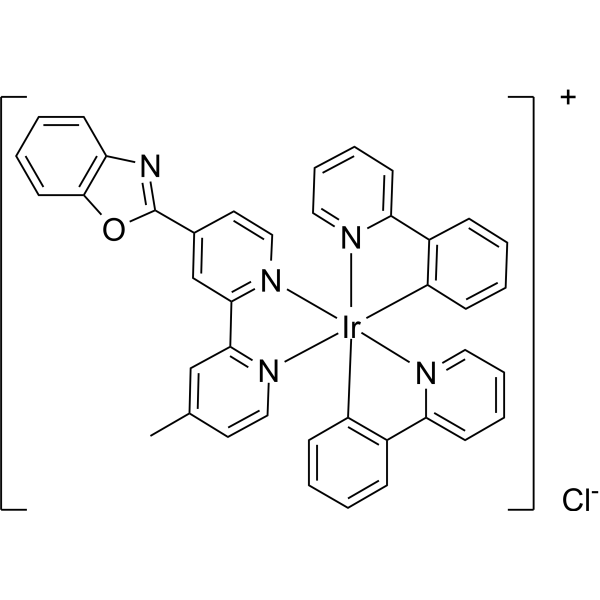
NecroIr1 is an iridium(III) complex, serves as necroptosis inducers in Cisplatin (HY-17394)-resistant lung cancer cells (A549R). NecroIr1 selectively accumulates in mitochondria, leading to oxidative stress and loss of mitochondrial membrane potential (MMP). NecroIr1 activates receptor-interacting serine-threonine kinase 3 (RIPK3) and Mixed Lineage Kinase (MLKL), and regulates CDK4 expression .
loading...
    loading...
Cat. No.: HY-148366
Purity:  98.99%
Research Areas:  

Cancer

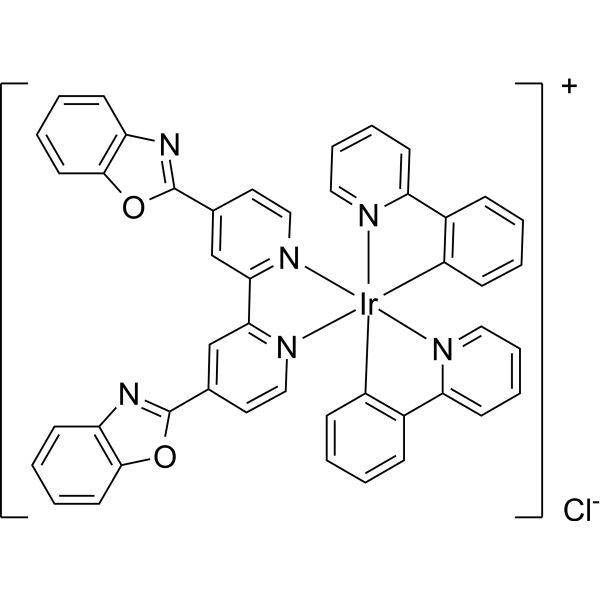
NecroIr2 is an iridium(III) complex, serves as necroptosis inducers in Cisplatin (HY-17394)-resistant lung cancer cells (A549R). NecroIr2 selectively accumulates in mitochondria, leading to oxidative stress and loss of mitochondrial membrane potential (MMP). NecroIr2 activates receptor-interacting serine-threonine kinase 3 (RIPK3) and mixed lineage kinase domain-like pseudokinase (MLKL), and regulates CDK4 expression .
loading...
    loading...
Cat. No.: HY-W035155
CAS No.: 38465-86-0
(1,5-Cyclooctadiene)bis(methyldiphenylphosphine)iridium(I) hexafluorophosphate is a highly efficient catalyst with excellent hydrogenation activity. It can catalyze the reaction of hydrogen and organic substrates in various chemical reactions. This compound is often used to synthesize important chemical intermediates and compounds.
loading...
    loading...
Cat. No.: HY-W034041
CAS No.: 370878-69-6
Synonyms: Tris(2-(4-fluorophenyl)pyridine)iridium; Tris[5-fluoro-2-(2-pyridinyl-kN)phenyl-kC]iridium(III)
Target:  

Endogenous Metabolite

Ir(pF-ppy)3 (Tris(2-(4-fluorophenyl)pyridine)iridium) is a compound that catalyzes photoreactions and has excellent photocatalytic activity. Ir(pF-ppy)3 can be used as a catalyst in organic reactions, especially in photocatalytic synthesis. Ir(pF-ppy)3 shows its unique advantages in promoting electron transfer and improving reaction selectivity. Ir(pF-ppy)3 is also used to improve the efficiency of displays and solar cells.
loading...
    loading...
Cat. No.: HY-W009022
CAS No.: 1251-85-0
Diantipyrylmethane is a chromogenic reagent commonly used for the determination of the contents of metals such as Au (III), Ti (IV), Ir, Fe (III), molybdenum, neodymium, U (IV), iridium, platinum and rhenium via spectrophotometry and extraction photometry. Diantipyrylmethane can also form a fluorescent complex with Er (III) ions, which is applied to the determination of erbium .
loading...
    loading...
Cat. No.: HY-W035599
CAS No.: 1311386-93-2
Synonyms: Tris(2-(3-tert-butylphenyl)-4-tert-butylpyridine)iridium
Ir[pF(t-Bu)-ppy]3 (Tris(2-(3-tert-butylphenyl)-4-tert-butylpyridine)iridium) is an effective photocatalyst with excellent catalytic activity. Ir[pF(t-Bu)-ppy]3 can promote organic reactions, especially showing significant potential in the synthesis of new organic compounds. Ir[pF(t-Bu)-ppy]3 can be used to develop green chemical processes and reduce the impact of traditional catalysts on the environment. Ir[pF(t-Bu)-ppy]3 also has broad prospects in photoelectrochemical applications.
loading...
    loading...
Cat. No.: HY-162820
Target:  

Bcl-2 Family

Research Areas:  

Cancer

Bcl-2-IN-21 (compound C1) is an iridium compound with anticancer activity that targets and inhibits Bcl-2. Bcl-2-IN-21 inhibits colony formation of cancer cells and induces elevated levels of Bax and caspase 3 .
loading...
    loading...
Cat. No.: HY-162463
CAS No.: 3033235-42-3
Target:  

PD-1/PD-L1

Research Areas:  

Cancer

Ir-UA is an usnic acid-derived iridium(III) complex that enhances PD-L1 expression and converts "cold tumors" into "hot tumors." Ir-UA stimulates PD-L1 expression by explicitly regulating the PD-L1 transcription factor .
loading...
    loading...
Cat. No.: HY-W072530
CAS No.: 106294-60-4
[Ir (ppy)2 (bpy)]PF6 is a cyclometalated iridium (III) photosensitizer. [Ir (ppy)2 (bpy)]PF6 can be used in homogeneous photocatalytic systems to achieve visible light-induced water splitting for hydrogen production. [Ir (ppy)2 (bpy)]PF6 functions in homogeneous photocatalytic systems for visible light-driven water splitting to produce hydrogen .
loading...
    loading...
Cat. No.: HY-W034053
CAS No.: 808142-88-3
Ir[p-F (Me) ppy]2 (dtbbpy) PF6 is a cyclometalated iridium (III) complex. Ir[p-F (Me) ppy]2 (dtbbpy) PF6 absorbs visible light (460 nm) to form a long-lived charge-separated excited state. Ir[p-F (Me) ppy]2 (dtbbpy) PF6 is applicable to visible light-mediated photocatalytic organic transformation reactions .
loading...
    loading...
Cat. No.: HY-W075731
CAS No.: 2030437-90-0
(Ir[dF (F) ppy]2 (dCF3)) PF6 is a cyclometalated iridium (III) complex that is used in visible light-mediated photocatalytic organic transformations .
loading...
    loading...
Cat. No.: HY-W074187
CAS No.: 1449110-90-0
Research Areas:  

Others

(Ir[Fppy]2(dtbpy))PF6 is an iridium-based compound that can be used as a visible light photo-redox catalyst and is applied in organic synthesis and photochemical reactions.
loading...
    loading...
Cat. No.: HY-W040267
CAS No.: 92220-65-0
Research Areas:  

Others

Dichlorotetrakis(2-(2-pyridinyl)phenyl)diiridium(III) is a precursor for certain OLED Iridium compounds. Dichlorotetrakis(2-(2-pyridinyl)phenyl)diiridium(III) can be used as a catalyst. Dichlorotetrakis(2-(2-pyridinyl)phenyl)diiridium(III) can also be used in the synthesis of 3,3′-([2,2′-bipyridine]-5,5′-diylbis(methylene))bis(1-ethyl-1H-imidazol-3-ium) functionalized receptor Ir-1 .
loading...
    loading...
Cat. No.: HY-182066
Target:  

PANoptosis

Research Areas:  

Cancer

Photosensitizer-9 is an iridium (III)-based photosensitizer with anti-melanoma activity. Photosensitizer-9 exhibits significant phototoxicity (IC50=0.98 μM) and an ideal phototoxicity index (PI=3.05). Under light irradiation, Photosensitizer-9 generates large amounts of intracellular •OH in an oxygen-independent manner. Photosensitizer-9 mediates photodynamic therapy under hypoxic conditions and synergistically activates PANoptosis (by upregulating cleaved Caspase-3, GSDMD-N, p-MLKL), ferroptosis (by disrupting the GSH-GPX4-LPO axis), apoptosis, pyroptosis and necroptosis in melanoma cells. Photosensitizer-9 induces immunogenic cell death by promoting the release of damage-associated molecular patterns under hypoxic conditions and increases the maturation rate of dendritic cells. Photosensitizer-9 reduces tumor volume in melanoma-bearing mice. Photosensitizer-9 is applicable to relevant studies on melanoma .
loading...
    loading...
  • 1