


13 Results for "

malignant B-cells

" in MedChemExpress (MCE) Product Catalog:
Products (13)

13 Results for "malignant B-cells" in MCE Product Catalog:

3
3 Cited Publications
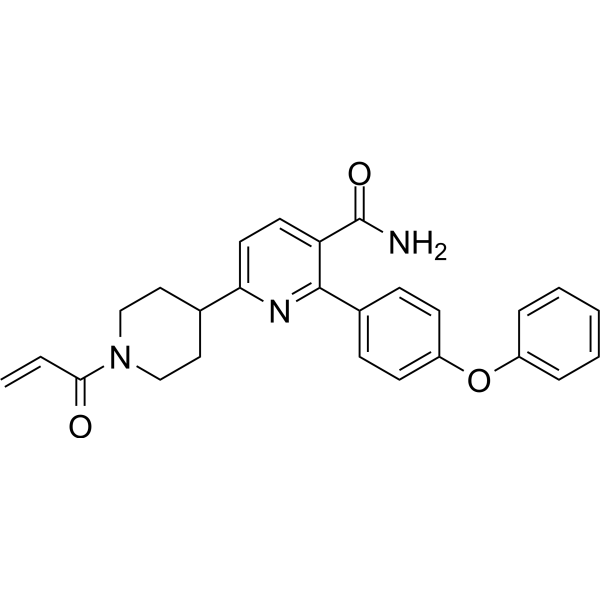
Cat. No.: HY-129390
CAS No.: 1655504-04-3
Purity:  99.97%
Synonyms: ICP-022
Target:  

Btk

Research Areas:  

Cancer

Orelabrutinib (ICP-022) is a potent, orally active, and irreversible Bruton's tyrosine kinase (BTK) inhibitor with potential antineoplastic activity. Orelabrutinib prevents both the activation of the B-cell antigen receptor (BCR) signaling pathway and BTK-mediated activation of downstream survival pathways, inhibiting the growth of malignant B-cells that overexpress BTK .
loading...
    loading...
2
2 Cited Publications
Cat. No.: HY-147308
CAS No.: 1215011-08-7
Purity:  99.05%
Synonyms: PCLX-001
Research Areas:  

Cancer

Zelenirstat is an orally acitve, small-molecule, dual N-myristoyltransferase (NMT) inhibitor, with IC50s of 5 nM (NMT1) and 8 nM (NMT2), respectively. Zelenirstat can induce cell apoptosis, has anti-cancer activity, inhibits early B cell receptor (BCR) signaling, and can be used to study malignant lymphoma .
loading...
    loading...
1
1 Cited Publications
Cat. No.: HY-P99033
CAS No.: 1905409-39-3
Synonyms: BTCT-4465A; RG-7828; RO7030816

Target:  

CD20 CD3

Research Areas:  

Inflammation/Immunology Cancer

Mosunetuzumab (BTCT-4465A) is a full-length, fully humanized immunoglobulin G1 (IgG1) T-cell-dependent bispecific (TDB) antibody targeting CD20 (B cells) and CD3 (T cells). Mosunetuzumab redirects T cells to engage and eliminate malignant B cells and can be used for the research of relapsed or refractory (R/R) B-cell non-Hodgkin lymphomas (B-NHLs) .
loading...
    loading...
1
1 Cited Publications
Cat. No.: HY-P99024
CAS No.: 2229047-91-8
Synonyms: RO7082859; RG-6026

Target:  

CD20 CD3

Research Areas:  

Inflammation/Immunology Cancer

Glofitamab (RO7082859) is a T-cell-engaging bispecific antibody possessing a novel 2:1 structure with bivalency for CD20 on B cells and monovalency for CD3 on T cells. Glofitamab leads to T-cell activation, proliferation, and tumor cell killing upon binding to CD20 on malignant cells. Glofitamab induces durable complete remissions in relapsed or refractory B-Cell non-Hodgkin lymphoma (B-NHL) .
loading...
    loading...
1
1 Cited Publications
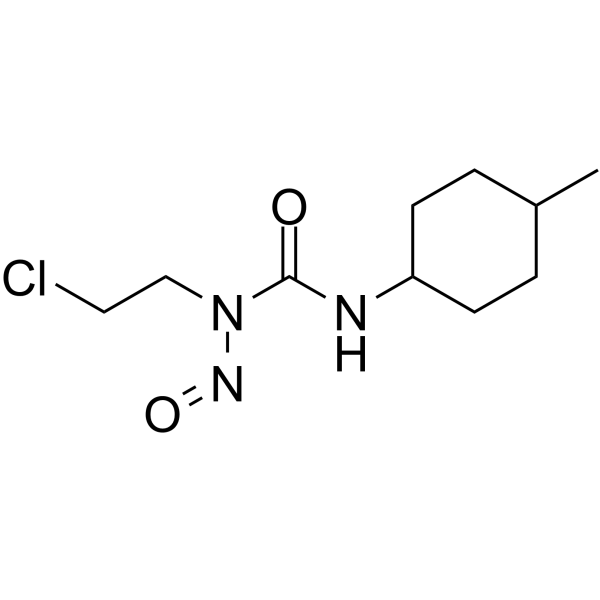
Cat. No.: HY-13747
CAS No.: 13909-09-6
Purity:  ≥98.0%
Research Areas:  

Cancer

Semustine is an orally active, blood-brain barrier permeable antitumor alkylating agent with a binding affinity of 1.53 × 10 3 M -1 for guanine and thymine residues in bovine DNA. Semustine undergoes major groove-directed alkylation at guanine residues to form O6-chloroethylguanine and N1-O6-ethanoguanine adducts, and generates dG-dC interstrand crosslinks. Semustine induces partial B- to C-type transition of DNA, base stacking and helical structure distortion, mild dehydration, as well as partial DNA double-strand unwinding. Semustine can be used in research related to Lewis lung cancer, leukemia, Hodgkin's lymphoma, malignant melanoma, glioma, and diffuse large B-cell lymphoma .
loading...
    loading...
Cat. No.: HY-P99034
CAS No.: 1622075-65-3

Target:  

CD22

Research Areas:  

Cancer

Moxetumomab is a CD22-targeting monoclonal antibody that forms the component of Moxetumomab Pasudotox, a recombinant CD22-targeting immunotoxin. Moxetumomab binds to CD22 on malignant B cells and delivers the PE38 toxin domain to tumor cells. Moxetumomab can be used in research on relapsed or refractory hairy cell leukemia .
loading...
    loading...
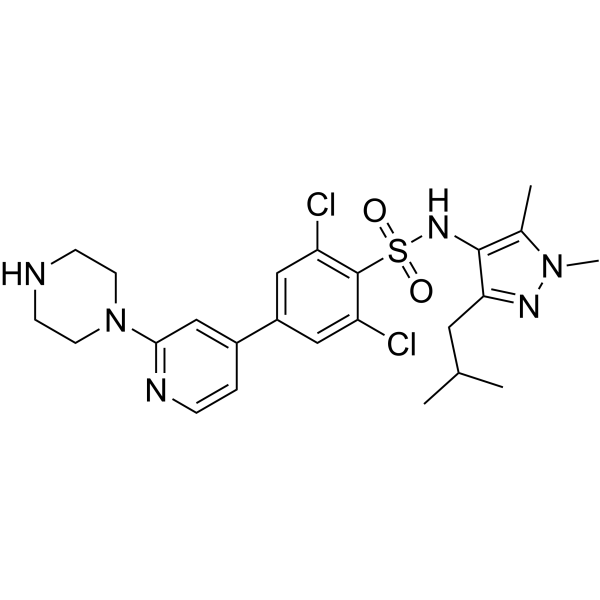
Cat. No.: HY-136531
CAS No.: 2031152-08-4
Purity:  95.69%
Target:  

Btk Apoptosis

Research Areas:  

Cancer

XMU-MP-3 is a potent non-covalent BTK inhibitor with IC50s of 10.7 nM and 17.0 nM for BTK WT and BTK C481S mutation in the presence of 10 μM ATP, respectively. XMU-MP-3 also induces apoptosis .
loading...
    loading...
Cat. No.: HY-P991225

Target:  

Fc Receptor (FcR) CD20

Research Areas:  

Inflammation/Immunology Cancer

BI-1206 is a recombinant and antagonistic human monoclonal antibody targeting FcγRIIB (CD32B). BI-1206 can block CD20 internalization induced by Rituximab (HY-P9913) itself or combined with others including Ibrutinib (HY-10997), Venetoclax (HY-15531), and CHOP. BI-1206 can enhance or recover the activity of Rituximab or other anti-CD20 monoclonal antibodies. BI-1206 has cytolytic activity against malignant B cells. BI-1206 can be studied for cancer research such as mantle cell lymphoma (MCL) .
loading...
    loading...
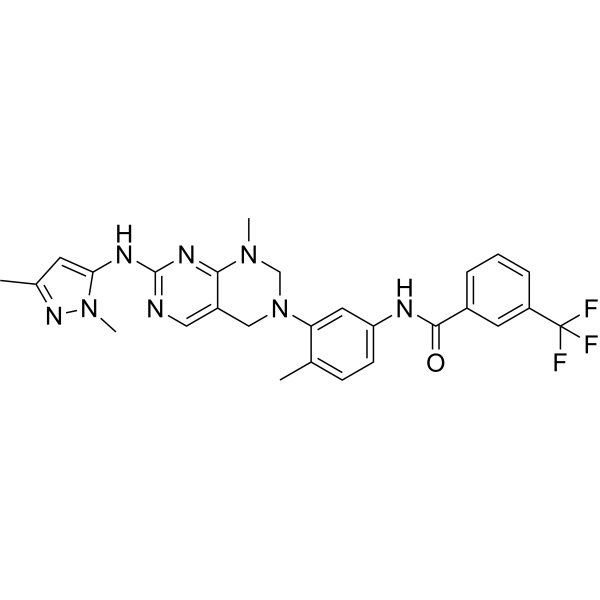
Cat. No.: HY-136268
CAS No.: 1619983-52-6
Purity:  99.19%
Target:  

Phosphatase Apoptosis

Research Areas:  

Inflammation/Immunology

AQX-435 is a potent SHIP1 phosphatase activator. AQX-435 reduces PI3K activation downstream of the B-cell receptor (BCR) and induces apoptosis of malignant B cells, and reduces lymphoma growth .
loading...
    loading...
Cat. No.: HY-163607
CAS No.: 3033533-25-1
Target:  

Apoptosis NF-κB

Research Areas:  

Cancer

SpiD3, a spirocyclic dimer, is an anticancer agent. SpiD3 markedly inhibits malignant B-cell proliferation and suppressed NF-κB activation independent of TME-associated stimuli. SpiD3 induces apoptosis and inhibits protein synthesis in chronic lymphocytic leukemia cells. SpiD3 can be used for study of chronic lymphocytic leukemia (CLL) .
loading...
    loading...
Cat. No.: HY-P99660
CAS No.: 2573121-53-4
Synonyms: IGM-2323

Target:  

CD20 CD3

Research Areas:  

Inflammation/Immunology Cancer

Imvotamab (IGM-2323) is a CD20 and CD3 bispecific IGM antibody with dual action mechanism. Imvotamab is used to induce physiological T cell activation to prevent over-stimulation and subsequent down-regulation of immune function. Imvotamab can be used for the study of B-cell malignant tumors, multiple myeloma (MM) and non-Hodgkin's lymphoma (NHL) .
loading...
    loading...
Cat. No.: HY-P991542
CAS No.: 1931954-95-8

Target:  

CD19

Research Areas:  

Cancer

GBR-401 is a humanized anti-CD19 monoclonal antibody with high affinity for FcγRIIIa. GBR-401 exerts a potent in vitro and in vivo cytotoxic activity against various B-cell malignancies. GBR-401 induces cell death by antibody dependent cellular cytotoxicity (ADCC) and direct killing effect. GBR-401 demonstrates potent activity of depleting malignant B cells and prolongs mice survival in multiple xenograft severe combined immunodeficiency (SCID) mice models .
loading...
    loading...
Cat. No.: HY-P11280A
Target:  

Melanocortin Receptor

Research Areas:  

Cancer

PRAME peptide (425-433) acetate is a proteasome-degraded peptide derived from the cancer-testis antigen PRAME (Preferentially Expressed Antigen in Melanoma). PRAME peptide (425-433) acetate is restricted by HLA-A*02:01 and can serve as a target for bispecific T cell engager therapy in the context of major histocompatibility complex I presentation. PRAME peptide (425-433) acetate shows application potential in various malignant tumors and is widely suitable for research related to solid tumors, melanoma, ovarian cancer, endometrial cancer, and lung cancer (including lung adenocarcinoma and lung squamous cell carcinoma). PRAME peptide (425-433) acetate can be used to explore disease of triple-negative breast cancer, diffuse large B-cell lymphoma, and head and neck squamous cell carcinoma .
loading...
    loading...
  • 1

