7 Results for "

mitochondria complex II

" in MedChemExpress (MCE) Product Catalog:
Products (7)

7 Results for "mitochondria complex II" in MCE Product Catalog:

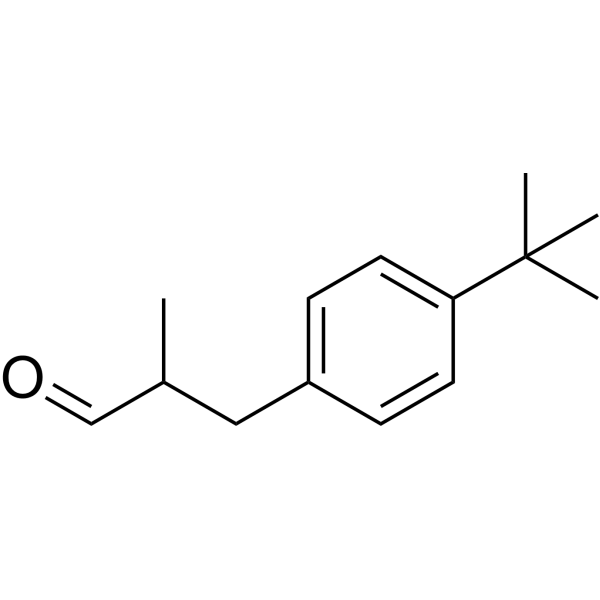
Cat. No.: HY-W014684
CAS No.: 80-54-6
Lilial is a widely used synthetic fragrance and ester in consumer products. Lilial possesses estrogenic activity in vitro. Lilial can induce a toxic effect on mitochondria that causes a decrease in the viability of HaCaT cells. Lilial can increase NRF2 protein level in vitro. Lilial is able to target respiratory chain complexes, inhibit complexes I and II of the electron transport chain, increase the generation of reactive oxygen species, and decrease the level of intracellular ATP. Lilial can induce systemic toxicity in vivo. Lilial induces significant DNA strand breaks .
loading...
    loading...
Cat. No.: HY-W663938
CAS No.: 400882-07-7
Cyflumetofen is a non-systemic acylacetonitrile Acaricide. Cyflumetofen interferes with the Wnt/β-catenin signaling pathway, induces Apoptosis, and reduces the level of tight junction proteins. Cyflumetofen upregulates the expression of Pink1, Parkin and Lrrk2 genes associated with the pathogenesis of Parkinson's disease in zebrafish larvae. Cyflumetofen induces developmental toxicity and oxidative stress in zebrafish larvae, damages neurons, reduces motor activity, alters brain tissue structure, and disrupts blood-brain barrier structure. Cyflumetofen exhibits acaricidal activity against spider mites. Cyflumetofen can be used in studies related to Parkinson's disease and infestations by spider mites (Tetranychus urticae, Tetranychus kanzawai, Panonychus citri) .
loading...
    loading...
Cat. No.: HY-W014684R
CAS No.: 80-54-6
Lilial (Standard) is the analytical standard of Lilial. This product is intended for research and analytical applications. Lilial is a widely used synthetic fragrance and ester in consumer products. Lilial possesses estrogenic activity in vitro. Lilial can induce a toxic effect on mitochondria that causes a decrease in the viability of HaCaT cells. Lilial can increase NRF2 protein level in vitro. Lilial is able to target respiratory chain complexes, inhibit complexes I and II of the electron transport chain, increase the generation of reactive oxygen species, and decrease the level of intracellular ATP. Lilial can induce systemic toxicity in vivo. Lilial induces significant DNA strand breaks .
loading...
    loading...
Cat. No.: HY-W663938R
CAS No.: 400882-07-7
Cyflumetofen (Standard) is the analytical standard of Cyflumetofen (HY-W663938). This product is intended for research and analytical applications. Cyflumetofen is a non-systemic acylacetonitrile Acaricide. Cyflumetofen interferes with the Wnt/β-catenin signaling pathway, induces Apoptosis, and reduces the level of tight junction proteins. Cyflumetofen upregulates the expression of Pink1, Parkin and Lrrk2 genes associated with the pathogenesis of Parkinson's disease in zebrafish larvae. Cyflumetofen induces developmental toxicity and oxidative stress in zebrafish larvae, damages neurons, reduces motor activity, alters brain tissue structure, and disrupts blood-brain barrier structure. Cyflumetofen exhibits acaricidal activity against spider mites. Cyflumetofen can be used in studies related to Parkinson's disease and infestations by spider mites (Tetranychus urticae, Tetranychus kanzawai, Panonychus citri) .
loading...
    loading...
Cat. No.: HY-D3269
CAS No.: 2088127-60-8
Mito-Cu (II) is a mitochondria-targeted fluorescent probe (Ex/Em = 370/450 nM). Mito-Cu (II) specifically accumulates in mitochondria of living cells and enables real-time detection of exogenous Cu 2+ within mitochondria of living cells. Mito-Cu (II) achieves "on-off-on" fluorescence switching through sequential exposure to Cu 2+ and ethylenediaminetetraacetic acid (EDTA) (HY-Y0682). Its fluorescence is quenched after forming a 1:1 complex with Cu 2+, and the fluorescence recovers when Cu 2+ is chelated by EDTA .
loading...
    loading...
Cat. No.: HY-P11743
Mitochondrial penetrating peptide is a peptide sequence (FrFKFrFK-CONH2) that selectively transports cargo into mitochondria. Mitochondrial penetrating peptide possesses special physicochemical properties, enabling it to selectively translocate dinuclear Ru (II) polypyridine complexes into mitochondria of living mammalian cells without the aid of solvents or membrane permeabilization treatments, thus achieving precise mitochondrial localization and enrichment of the complexes while excluding their distribution in the nucleus. Mitochondrial penetrating peptide enables dynamic monitoring of mitochondrial oxygen concentration and ROS production in living mammalian cells via changes in the luminescence lifetime of the coupled Ru (II) complex .
loading...
    loading...
Cat. No.: HY-W019824
CAS No.: 762-29-8
Farnesylacetone acts as a transcriptional regulator, RNA synthesis modulator, and male hormone. Farnesylacetone can be extracted from the androgenic glands of the green crab (Carcinus maenas). Farnesylacetone modulates transcriptional processes, inhibits uridine incorporation into all types of RNA and leucine incorporation into ovaries, while stimulating uridine incorporation into tRNA/poly (A) + RNA and leucine incorporation into testes. It suppresses electron transport in mitochondrial Complex I and Complex II. Farnesylacetone inhibits vitellogenesis in crustacean ovaries and stimulates uridine incorporation in crustacean intestines. It functions as an androgen in crustaceans .
loading...
    loading...

