



Lilial (Standard)

Based on 1 Customer Validation
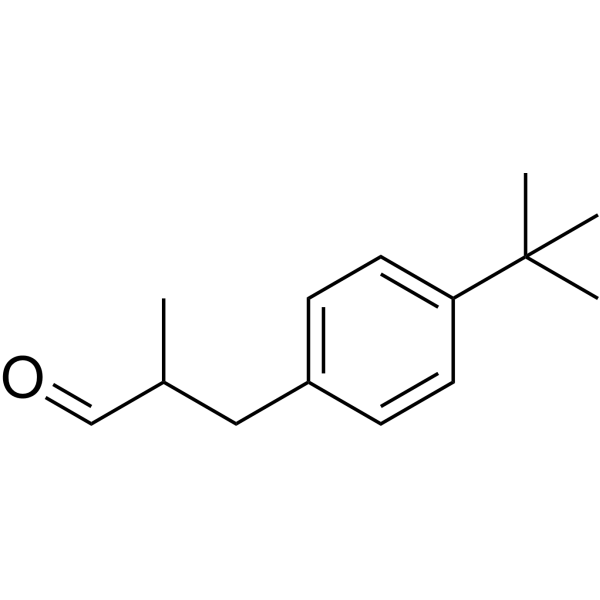
Lilial (Standard) is the analytical standard of Lilial. This product is intended for research and analytical applications. Lilial is a widely used synthetic fragrance and ester in consumer products. Lilial possesses estrogenic activity in vitro. Lilial can induce a toxic effect on mitochondria that causes a decrease in the viability of HaCaT cells. Lilial can increase NRF2 protein level in vitro. Lilial is able to target respiratory chain complexes, inhibit complexes I and II of the electron transport chain, increase the generation of reactive oxygen species, and decrease the level of intracellular ATP. Lilial can induce systemic toxicity in vivo. Lilial induces significant DNA strand breaks.
Nos produits utilisent uniquement pour la recherche. Nous ne vendons pas aux patients.
- Pureté : 96.55%
- CAS No.: 80-54-6
- Formule: C14H20O
- Masse moléculaire:204.31
-
Stockage:
Please store the product under the recommended conditions in the Certificate of Analysis.


To place orders, for customer services and technical support, please contact: MedChemExpress USA
Tel: 609-228-6898 E-mail: [email protected] [email protected]


-
 Product Information
-
Chemical Information
- Pureté et documentation
-
 Help & FAQs




Product Information
Information
Application
The compound is the grade of analytical standard, which is the reference standard supplied assay. It is commonly used in qualitative, quantitative and methodological research experiments in HPLC, GC and MS.


Chemical Information
-
CAS No. 80-54-6
-
Appearance Liquid
-
Masse moléculaire 204.31
-
Formule C14H20O
-
Color Colorless to light yellow
-
SMILES
O=CC(C)CC1=CC=C(C(C)(C)C)C=C1
-
Livraison
Room temperature in continental US; may vary elsewhere.
-
Stockage
Please store the product under the recommended conditions in the Certificate of Analysis.


Pureté et documentation
-
SDS (252 KB)
- Français - FR (252 KB)
- Deutsch - DE (252 KB)
- Norwegian - NO (252 KB)
- Español - ES (252 KB)
- Swedish - SV (252 KB)
- Italian - IT (252 KB)
- Korean - KR (252 KB)
- Portuguese - PT (252 KB)
-
Instruction de manipulation (2659 KB)
Références
[1]. Arnau EG, et al. Identification of Lilial as a fragrance sensitizer in a perfume by bioassay-guided chemical fractionation and structure-activity relationships. Contact Dermatitis. 2000 Dec;43(6):351-8. [Content Brief]
[2]. Charles, A. K., & Darbre, P. D. (2009). Oestrogenic activity of benzyl salicylate, benzyl benzoate and butylphenylmethylpropional (Lilial) in MCF7 human breast cancer cells in vitro. Journal of applied toxicology : JAT, 29(5), 422–434. [Content Brief]
[3]. Jablonská, E., et al., (2023). Toxicological investigation of lilial. Scientific reports, 13(1), 18536. [Content Brief]
[4]. Usta, J., et al., (2013). Fragrance chemicals lyral and lilial decrease viability of HaCat cells' by increasing free radical production and lowering intracellular ATP level: protection by antioxidants. Toxicology in vitro : an international journal published in association with BIBRA, 27(1), 339–348. [Content Brief]

Calculators
Concentration (start) × Volume (start) = Concentration (final) × Volume (final)


Lilial (Standard) Related Classifications
HY-W014684R Related Classifications
 Powered by Bioz