



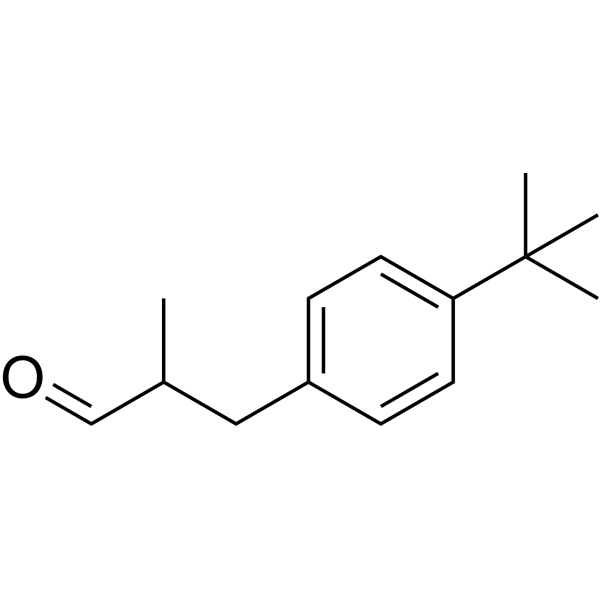
Lilial

Based on 1 Customer Validation
Lilial is a widely used synthetic fragrance and ester in consumer products. Lilial possesses estrogenic activity in vitro. Lilial can induce a toxic effect on mitochondria that causes a decrease in the viability of HaCaT cells. Lilial can increase NRF2 protein level in vitro. Lilial is able to target respiratory chain complexes, inhibit complexes I and II of the electron transport chain, increase the generation of reactive oxygen species, and decrease the level of intracellular ATP. Lilial can induce systemic toxicity in vivo. Lilial induces significant DNA strand breaks.
Nur für Forschungszwecke. Wir verkaufen nicht an Patienten.
- Reinheit : 99.49%
- CAS. Nr.: 80-54-6
- Formel: C14H20O
- Molecular Weight:204.31
-
Speicherung:
-20°C, stored under nitrogen
* In solvent : -80°C, 6 months; -20°C, 1 month (stored under nitrogen)

To place orders, for customer services and technical support, please contact: MedChemExpress USA
Tel: 609-228-6898 E-mail: [email protected] [email protected]


-
 Biologische Aktivität
-
Chemical Information
-
Lösungsmittel & Löslichkeit
- Protokoll
- Reinheit & Dokumentation
- Verweise
-
 Help & FAQs




Biologische Aktivität
Beschreibung
In Vitro
Lilial (Compound Butylphenylmethylpropional) (100 mM, 24 h) increases the expression of pS2mRNA in MCF7 cell line[2].
Lilial (0-100 mM, 7 d) increases the growth of MCF7 cells in a dose-dependent manner[2].
Lilial (1 mM, 4 h) indicates good solubility and low metabolism by the Caco-2 cells[3].
Lilial (1 nM-100 μM, 1 d) significantly reduces the relative viability of HeLa9903 cells at 100 nM, but has no cytotoxicity[3].
Lilial (5 nM-500 μM, 1 d) significantly decreases the relative viability of CHO-K1 cells approximately by 55% and 95% at 250 and 500 μM[3].
Lilial (100 μM, 4 h) has genotoxicity in HeLa cells indicated by a fold change above 1.5[3].
Lilial (100 μM, 48 h) significantly decreases the expression of the TIMP1 and CST3 genes[3].
Lilial (650 μM, 5 h) significantly increases the level of NRF2 protein in THP-1 cells[3].
Lilial (100 μM) exerts the maximum decrease in NBT level, indicating an increase in ROS level in HaCat cells[4].
MedChemExpress (MCE) has not independently confirmed the accuracy of these methods. They are for reference only.


Chemical Information
-
CAS. Nr. 80-54-6
-
Appearance Liquid (Density: 0.939 g/cm3)
-
Molecular Weight 204.31
-
Formel C14H20O
-
Color Colorless to light yellow
-
SMILES
O=CC(C)CC1=CC=C(C(C)(C)C)C=C1
-
Versand
Room temperature in continental US; may vary elsewhere.
-
Speicherung
-20°C, stored under nitrogen
* In solvent : -80°C, 6 months; -20°C, 1 month (stored under nitrogen)


Lösungsmittel & Löslichkeit
In Vitro:
DMSO : 100 mg/mL (489.45 mM; Need ultrasonic; Hygroscopic DMSO has a significant impact on the solubility of product, please use newly opened DMSO)
Please refer to the solubility information to select the appropriate solvent. Once prepared, please aliquot and store the solution to prevent product inactivation from repeated freeze-thaw cycles.
Storage method and period of stock solution: -80°C, 6 months; -20°C, 1 month (stored under nitrogen). When stored at -80°C, please use it within 6 months. When stored at -20°C, please use it within 1 month.
Please refer to the solubility information to select the appropriate solvent. Once prepared, please aliquot and store the solution to prevent product inactivation from repeated freeze-thaw cycles.
Storage method and period of stock solution: -80°C, 6 months; -20°C, 1 month (stored under nitrogen). When stored at -80°C, please use it within 6 months. When stored at -20°C, please use it within 1 month.
Konzentration (Stammlösung) × Volumen (Stammlösung) = Konzentration (Ziellösung) × Volumen (Ziellösung)
In Vivo:
Select the appropriate dissolution method based on your experimental animal and administration route.
- For the following dissolution methods, please ensure to first prepare a clear stock solution using an In Vitro approach and then sequentially add co-solvents:
- To ensure reliable experimental results, the clarified stock solution can be appropriately stored based on storage conditions. As for the working solution for In Vivo experiments, it is recommended to prepare freshly and use it on the same day.
- The percentages shown for the solvents indicate their volumetric ratio in the final prepared solution. If precipitation or phase separation occurs during preparation, heat and/or sonication can be used to aid dissolution.
Add each solvent one by one: 10% DMSO 40% PEG300 5% Tween-80 45% Saline
Solubility: ≥ 2.5 mg/mL (12.24 mM); Clear solution
This protocol yields a clear solution of ≥ 2.5 mg/mL (saturation unknown).
Taking 1 mL working solution as an example, add 100 μL DMSO stock solution (25.0 mg/mL) to 400 μL PEG300, and mix evenly; then add 50 μL Tween-80 and mix evenly; then add 450 μL Saline to adjust the volume to 1 mL.
Preparation of Saline: Dissolve 0.9 g sodium chloride in ddH₂O and dilute to 100 mL to obtain a clear Saline solution.
Add each solvent one by one: 10% DMSO 90% (20% SBE-β-CD in Saline)
Solubility: ≥ 2.5 mg/mL (12.24 mM); Clear solution
This protocol yields a clear solution of ≥ 2.5 mg/mL (saturation unknown).
Taking 1 mL working solution as an example, add 100 μL DMSO stock solution (25.0 mg/mL) to 900 μL 20% SBE-β-CD in Saline, and mix evenly.
Preparation of 20% SBE-β-CD in Saline (4°C, storage for one week): 2 g SBE-β-CD powder is dissolved in 10 mL Saline, completely dissolve until clear.
In Vivo Dissolution Calculator
Please enter the basic information of animal experiments:
-
-
-
-
Recommended: Prepare an additional quantity of animals to account for potential losses during experiments.
Please enter your animal formula composition:
-
%DMSO +
Recommended: Keep the proportion of DMSO in working solution below 2% if your animal is weak.
-
%+
-
+%Tween-80 + +
-
%Saline +
The co-solvents required include: DMSO, . All of co-solvents are available by MedChemExpress (MCE). , Tween 80. All of co-solvents are available by MedChemExpress (MCE).
Working solution concentration: 0.22 mg/mL
Method for preparing stock solution: mg drug dissolved in μL DMSO. Stock solution concentration: mg/mL. * In solvent : -80°C, 6 months; -20°C, 1 month (stored under nitrogen)
1. Take μL DMSO stock solution;
2. Add μL .
μL , mix evenly;
3. Then add μL Tween 80, mix evenly;
4. Then add μL
Please ensure that the stock solution in the first step is dissolved to a clear state, and add co-solvents in sequence. You can use ultrasonic heating (ultrasonic cleaner, recommended frequency 20-40 kHz), vortexing, etc. to assist dissolution.


Reinheit & Dokumentation
-
Data Sheet (273 KB)
-
SDS (558 KB)
- English - EN (558 KB)
- Français - FR (558 KB)
- Deutsch - DE (558 KB)
- Norwegian - NO (558 KB)
- Español - ES (558 KB)
- Swedish - SV (558 KB)
- Italian - IT (558 KB)
- Korean - KR (558 KB)
- Portuguese - PT (558 KB)
-
Handling Instructions (2659 KB)
Verweise
[1]. Arnau EG, et al. Identification of Lilial as a fragrance sensitizer in a perfume by bioassay-guided chemical fractionation and structure-activity relationships. Contact Dermatitis. 2000 Dec;43(6):351-8. [Content Brief]
[2]. Charles, A. K., & Darbre, P. D. (2009). Oestrogenic activity of benzyl salicylate, benzyl benzoate and butylphenylmethylpropional (Lilial) in MCF7 human breast cancer cells in vitro. Journal of applied toxicology : JAT, 29(5), 422–434. [Content Brief]
[3]. Jablonská, E., et al., (2023). Toxicological investigation of lilial. Scientific reports, 13(1), 18536. [Content Brief]
[4]. Usta, J., et al., (2013). Fragrance chemicals lyral and lilial decrease viability of HaCat cells' by increasing free radical production and lowering intracellular ATP level: protection by antioxidants. Toxicology in vitro : an international journal published in association with BIBRA, 27(1), 339–348. [Content Brief]


Complete Stock Solution Preparation Table
Please refer to the solubility information to select the appropriate solvent. Once prepared, please aliquot and store the solution to prevent product inactivation from repeated freeze-thaw cycles.
Storage method and period of stock solution: -80°C, 6 months; -20°C, 1 month (stored under nitrogen). When stored at -80°C, please use it within 6 months. When stored at -20°C, please use it within 1 month.
| Optional Solvent | Concentration Solvent Mass | 1 mg | 5 mg | 10 mg | 25 mg |
|---|---|---|---|---|---|
| DMSO | 1 mM | 4.8945 mL | 24.4726 mL | 48.9452 mL | 122.3631 mL |
| 5 mM | 0.9789 mL | 4.8945 mL | 9.7890 mL | 24.4726 mL | |
| 10 mM | 0.4895 mL | 2.4473 mL | 4.8945 mL | 12.2363 mL | |
| 15 mM | 0.3263 mL | 1.6315 mL | 3.2630 mL | 8.1575 mL | |
| 20 mM | 0.2447 mL | 1.2236 mL | 2.4473 mL | 6.1182 mL | |
| 25 mM | 0.1958 mL | 0.9789 mL | 1.9578 mL | 4.8945 mL | |
| 30 mM | 0.1632 mL | 0.8158 mL | 1.6315 mL | 4.0788 mL | |
| 40 mM | 0.1224 mL | 0.6118 mL | 1.2236 mL | 3.0591 mL | |
| 50 mM | 0.0979 mL | 0.4895 mL | 0.9789 mL | 2.4473 mL | |
| 60 mM | 0.0816 mL | 0.4079 mL | 0.8158 mL | 2.0394 mL | |
| 80 mM | 0.0612 mL | 0.3059 mL | 0.6118 mL | 1.5295 mL | |
| 100 mM | 0.0489 mL | 0.2447 mL | 0.4895 mL | 1.2236 mL |


Lilial Related Classifications
HY-W014684 Related Classifications
 Powered by Bioz