10 Results for "

neuroactive compound

" in MedChemExpress (MCE) Product Catalog:
Products (10)

10 Results for "neuroactive compound" in MCE Product Catalog:

Cat. No.: HY-14537
CAS No.: 97657-92-6
Purity:  99.65%
Synonyms: Dimebolin dihydrochloride
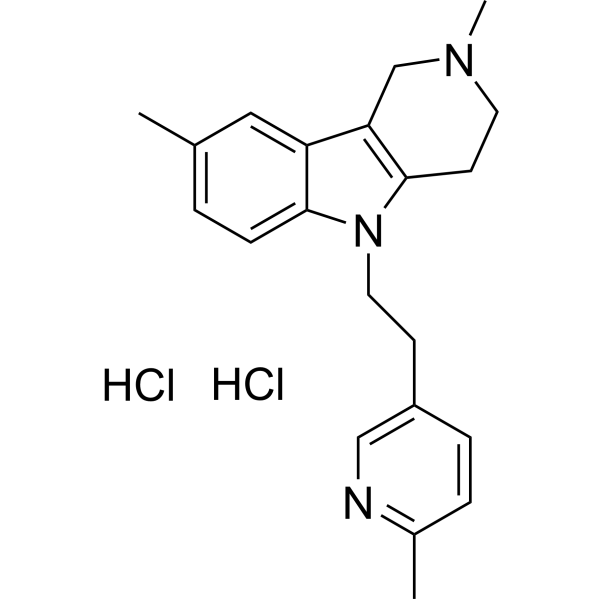
Latrepirdine dihydrochloride is a neuroactive compound with antagonist activity at histaminergic, α-adrenergic, and serotonergic receptors. Latrepirdine stimulates amyloid precursor protein (APP) catabolism and amyloid-β () secretion.
loading...
    loading...
Cat. No.: HY-14862
CAS No.: 3613-73-8
Synonyms: Dimebolin; Dimebone
Latrepirdine is a neuroactive compound with antagonist activity at histaminergic, α-adrenergic, and serotonergic receptors. Latrepirdine stimulates amyloid precursor protein (APP) catabolism and amyloid-β () secretion.
loading...
    loading...
Cat. No.: HY-W587827
CAS No.: 3475-65-8
Synonyms: Thiamine triphosphate
Target:  

Endogenous Metabolite

Research Areas:  

Metabolic Disease

Thiamine triphosphoric acid ester (Thiamine triphosphate) is a neuroactive compound and a triphosphate derivative of vitamin thiamine. Thiamine triphosphoric acid ester exists in microorganisms, animal organs and plants. In E. coli, Thiamine triphosphoric acid ester is transiently produced under amino acid deficiency, while in mammalian cells, it is continuously produced at a low rate. Thiamine triphosphoric acid ester can be synthesized by two distinct enzymes (cytosolic AK1 and FoF1-ATP synthase in brain mitochondria). Thiamine triphosphoric acid ester plays a fundamental role in cellular metabolism or cellular signal transduction .
loading...
    loading...
Cat. No.: HY-116105
CAS No.: 14461-91-7
Target:  

Drug Derivative

Research Areas:  

Neurological Disease

Cyclazodone is a neuroactive compound .
loading...
    loading...
Cat. No.: HY-P11082
CAS No.: 126675-52-3
Target:  

Endogenous Metabolite

Research Areas:  

Neurological Disease

APGW-amide is a neuropeptide. APGW-amide controls the growth of imposex structures and promotes growth in Haliotis asinina. APGW-amide inhibits Achatina neurons and modulates neuronal currents induced by neuroactive compounds. APGW-amide induces a rapid increase in [Ca 2+]i in Fura-2/AM-loaded PC12 cells. APGW-amide is useful for research on the nervous system .
loading...
    loading...
Cat. No.: HY-139388
CAS No.: 1364933-64-1
Target:  

Drug Derivative

Research Areas:  

Neurological Disease

Para-fluoro methylaminorex is a neuroactive compound .
loading...
    loading...
Cat. No.: HY-W072274
CAS No.: 188398-87-0
Synonyms: (S)-2-Diphenylmethylpyrrolidine hydrochloride
Target:  

Drug Derivative

Research Areas:  

Neurological Disease

(S)-Desoxy-D2PM ((S)-2-Diphenylmethylpyrrolidine) hydrochloride is a neuroactive compound.
loading...
    loading...
Cat. No.: HY-14537R
CAS No.: 97657-92-6
Synonyms: Dimebolin dihydrochloride (Standard)
Latrepirdine (dihydrochloride) (Standard) is the analytical standard of Latrepirdine (dihydrochloride). This product is intended for research and analytical applications. Latrepirdine dihydrochloride is a neuroactive compound with antagonist activity at histaminergic, α-adrenergic, and serotonergic receptors. Latrepirdine stimulates amyloid precursor protein (APP) catabolism and amyloid-β (Aβ) secretion.
loading...
    loading...
Cat. No.: HY-177738
CAS No.: 2102591-12-6
Target:  

Drug Derivative

6'Nicotinate Ac4ManNAz (Compound 2) is a brain-penetrant carbohydrate-neuroactive heteromer conjugating Ac4ManNAz (HY-W728531) and Nicotinic acid (HY-B0143). 6'Nicotinate Ac4ManNAz can be used for the development of glycosylation-regulating agents or diagnostic probes that cross the BBB .
loading...
    loading...
Cat. No.: HY-L062
2,566 compounds

Neurotransmitter (NT) receptors, also known as neuroreceptors, are a broadly diverse group of membrane proteins that bind neurotransmitters for neuronal signaling. There are two major types of neurotransmitter receptors: ionotropic and metabotropic. Ionotropic receptors are ligand-gated ion channels, meaning that the receptor protein includes both a neurotransmitter binding site and an ion channel. The binding of a neurotransmitter molecule (the ligand) to the binding site induces a conformational change in the receptor structure, which opens, or gates, the ion channel. The term “metabotropic receptors” is typically used to refer to transmembrane G-protein-coupled receptors. Metabotropic receptors trigger second messenger-mediated effects within cells after neurotransmitter binding.

In some neurological diseases, the neurotransmitter receptor itself appears to be the target of the disease process. Many neuroactive drugs act by modifying neurotransmitter receptors. A better understanding of neurotransmitter receptor changes in disease may lead to improvements in therapy.

MCE designs a unique collection of 2,566 compounds targeting a variety of neurotransmitter receptors. MCE Neurotransmitter Receptor Compound Library is a useful tool for neurological diseases drug discovery.

