



Latrepirdine

Based on 1 Customer Validation
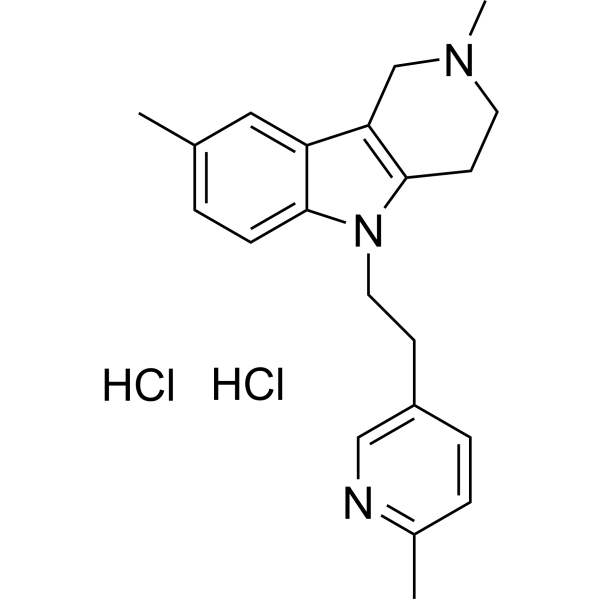
Latrepirdine is a neuroactive compound with antagonist activity at histaminergic, α-adrenergic, and serotonergic receptors. Latrepirdine stimulates amyloid precursor protein (APP) catabolism and amyloid-β (Aβ) secretion.
For research use only. We do not sell to patients.
- Purity : 99.51%
- CAS No.: 3613-73-8
- Formula: C21H25N3
- Molecular Weight:319.44
-
Storage:Powder -20°C, 3 years , 4°C, 2 years ; In solvent -80°C, 6 months , -20°C, 1 month


To place orders, for customer services and technical support, please contact: MedChemExpress USA
Tel: 609-228-6898 E-mail: [email protected] [email protected]


-
 Biological Activity
-
Chemical Information
-
Solvent & Solubility
- Protocols
- Purity & Documentation
- References
-
 Help & FAQs




All Histamine Receptor Isoforms
MoreAll Adrenergic Receptor Isoforms
MoreAll 5-HT Receptor Isoforms
More

Biological Activity
Description
IC50 & Target
Amyloid-β (Aβ), Histaminergic receptor, α-adrenergic receptor, Serotonergic receptor[1]
Cellular Effect
|
Cell Line

|
Type | Value | Description | References |
|---|---|---|---|---|
| HEK293 | IC50 |
0.89 μM
Compound: 3{1}, I, Dimebone, dimebolin
|
Antagonist activity at human recombinant 5-HT6 receptor expressed in HEK293 cells assessed as inhibition of serotonin-induced intracellular cAMP accumulation by LANCE technique
Antagonist activity at human recombinant 5-HT6 receptor expressed in HEK293 cells assessed as inhibition of serotonin-induced intracellular cAMP accumulation by LANCE technique
|
[PMID: 19443217] |
| HEK293 | IC50 |
0.89 μM
Compound: Dimebolin
|
Antagonist activity at human recombinant 5HT6 receptor expressed in HEK293 cells assessed as inhibition of serotonin-induced cAMP production by LANCE assay
Antagonist activity at human recombinant 5HT6 receptor expressed in HEK293 cells assessed as inhibition of serotonin-induced cAMP production by LANCE assay
|
[PMID: 19939513] |
| HEK293 | IC50 |
1.16 μM
Compound: Dimebolin
|
Antagonist activity at human recombinant 5HT6 receptor expressed in HEK293 cells assessed as inhibition of serotonin-induced increase in intracellular cAMP level by cAMP-LANCE method
Antagonist activity at human recombinant 5HT6 receptor expressed in HEK293 cells assessed as inhibition of serotonin-induced increase in intracellular cAMP level by cAMP-LANCE method
|
[PMID: 19945877] |
| SK-N-SH | IC50 |
0.158 μM
Compound: Dimebolin
|
Antagonist activity at histamine H1 receptor in human SK-N-SH cells assessed as histamine-induced maximum intracellular calcium spike at phase 1 treated 10 to 15 seconds before histamine challenge
Antagonist activity at histamine H1 receptor in human SK-N-SH cells assessed as histamine-induced maximum intracellular calcium spike at phase 1 treated 10 to 15 seconds before histamine challenge
|
[PMID: 19945877] |
| SK-N-SH | IC50 |
0.16 μM
Compound: 3{1}, I, Dimebone, dimebolin
|
Antagonist activity at human histamine H1 receptor in SK-N-SH cells assessed as inhibition of histamine-induced calcium level increase during phase-1 compound incubated before histamine addition by Fura-2 based fluorometric assay
Antagonist activity at human histamine H1 receptor in SK-N-SH cells assessed as inhibition of histamine-induced calcium level increase during phase-1 compound incubated before histamine addition by Fura-2 based fluorometric assay
|
[PMID: 19443217] |
| SK-N-SH | IC50 |
1.58 μM
Compound: 3{1}, I, Dimebone, dimebolin
|
Antagonist activity at human histamine H1 receptor in SK-N-SH cells assessed as inhibition of histamine-induced calcium flow during phase-II compound dosed after histamine addition by Fura-2 based fluorometric assay
Antagonist activity at human histamine H1 receptor in SK-N-SH cells assessed as inhibition of histamine-induced calcium flow during phase-II compound dosed after histamine addition by Fura-2 based fluorometric assay
|
[PMID: 19443217] |
| SK-N-SH | IC50 |
1.58 μM
Compound: Dimebolin
|
Antagonist activity at histamine H1 receptor in human SK-N-SH cells assessed as reduction of histamine-induced intracellular calcium spike at phase 2 treated 20 to 30 seconds after histamine challenge
Antagonist activity at histamine H1 receptor in human SK-N-SH cells assessed as reduction of histamine-induced intracellular calcium spike at phase 2 treated 20 to 30 seconds after histamine challenge
|
[PMID: 19945877] |
In Vitro
Latrepirdine has been reported to possess several properties that are potentially relevant to the treatment of neurodegenerative diseases: (1) protection of cultured cells from the cytotoxicity of amyloid-β (Aβ) peptide; (2) stabilization of mitochondrial function and calcium homeostasis; (3) modulation of Aβ release from cultured cells, isolated intact nerve terminals, and from hippocampal neurons in living mouse brain; and (4) promotion of neurogenesis in the murine hippocampus. Treatment of cultured mammalian cells with Latrepirdine leads to enhanced mTOR- and Atg5-dependent autophagy. Latrepirdine modulates Atg5-dependent autophagic activity in a dose-dependent manner and via the mTOR-signaling pathway. HeLa cells stably expressing LC3 fused are treated with EGFP (eGFP-LC3) for 3 or 6 hours in the absence or presence of 50 μM Latrepirdine. Treatment with Latrepirdine for 3 or 6 hours markedly enhances the number of eGFP-LC3 punctae, indicating that Latrepirdine induces formation of autophagosomes. Next, mouse N2a neuroblastoma cells are treated in the absence (vehicle) or presence of 5 nM, 500 nM or 50 μM Latrepirdine for 3 or 6 hours in order to determine the effects of acute drug treatment on the regulation of autophagy. A significant and dose-dependent increase is observed in LC3-II levels in N2a cells following 3- or 6-hour treatment with either 500 nM or 50 μM Latrepirdine. A significant decrease of p-mTOR and p-S6K from N2a cells treated with 50 μM Latrepirdine for 3 hours is observed, whereas the total mTOR and p70S6K levels remain relatively constant[1].
MedChemExpress (MCE) has not independently confirmed the accuracy of these methods. They are for reference only.
In Vivo
MedChemExpress (MCE) has not independently confirmed the accuracy of these methods. They are for reference only.
Clinical Trial
| NCT Number | Sponsor | Condition | Start Date |
Phase
|
|---|---|---|---|---|
| NCT01329991 | 2011-05 | PHASE1 |


Chemical Information
-
CAS No. 3613-73-8
-
Appearance Solid
-
Molecular Weight 319.44
-
Formula C21H25N3
-
Color White to off-white
-
SMILES
CC1=CC=C(CCN2C3=C(CN(C)CC3)C4=C2C=CC(C)=C4)C=N1
-
Synonyms
Dimebolin; Dimebone
-
Shipping
Room temperature in continental US; may vary elsewhere.
-
Storage
Powder -20°C 3 years 4°C 2 years In solvent -80°C 6 months -20°C 1 month


Solvent & Solubility
In Vitro:
Ethanol : 25 mg/mL (78.26 mM; Need ultrasonic)
Please refer to the solubility information to select the appropriate solvent. Once prepared, please aliquot and store the solution to prevent product inactivation from repeated freeze-thaw cycles.
Storage method and period of stock solution: -80°C, 6 months; -20°C, 1 month. When stored at -80°C, please use it within 6 months. When stored at -20°C, please use it within 1 month.
Please refer to the solubility information to select the appropriate solvent. Once prepared, please aliquot and store the solution to prevent product inactivation from repeated freeze-thaw cycles.
Storage method and period of stock solution: -80°C, 6 months; -20°C, 1 month. When stored at -80°C, please use it within 6 months. When stored at -20°C, please use it within 1 month.
Concentration (start) × Volume (start) = Concentration (final) × Volume (final)
In Vivo:
Select the appropriate dissolution method based on your experimental animal and administration route.
- For the following dissolution methods, please ensure to first prepare a clear stock solution using an In Vitro approach and then sequentially add co-solvents:
- To ensure reliable experimental results, the clarified stock solution can be appropriately stored based on storage conditions. As for the working solution for In Vivo experiments, it is recommended to prepare freshly and use it on the same day.
- The percentages shown for the solvents indicate their volumetric ratio in the final prepared solution. If precipitation or phase separation occurs during preparation, heat and/or sonication can be used to aid dissolution.
Add each solvent one by one: 10% EtOH 90% (20% SBE-β-CD in Saline)
Solubility: ≥ 2.5 mg/mL (7.83 mM); Clear solution
This protocol yields a clear solution of ≥ 2.5 mg/mL (saturation unknown).
Taking 1 mL working solution as an example, add 100 μL EtOH stock solution (25.0 mg/mL) to 900 μL 20% SBE-β-CD in Saline, and mix evenly.
Preparation of 20% SBE-β-CD in Saline (4°C, storage for one week): 2 g SBE-β-CD powder is dissolved in 10 mL Saline, completely dissolve until clear.
Add each solvent one by one: 10% EtOH 90% Corn Oil
Solubility: ≥ 2.5 mg/mL (7.83 mM); Clear solution
This protocol yields a clear solution of ≥ 2.5 mg/mL (saturation unknown). If the continuous dosing period exceeds half a month, please choose this protocol carefully.
Taking 1 mL working solution as an example, add 100 μL EtOH stock solution (25.0 mg/mL) to 900 μL Corn oil, and mix evenly.
In Vivo Dissolution Calculator
Please enter the basic information of animal experiments:
-
-
-
-
Recommended: Prepare an additional quantity of animals to account for potential losses during experiments.
Working solution concentration: 0.22 mg/mL


Purity & Documentation
-
Data Sheet (280 KB)
-
SDS (393 KB)
- English - EN (393 KB)
- Français - FR (393 KB)
- Deutsch - DE (393 KB)
- Norwegian - NO (393 KB)
- Español - ES (393 KB)
- Swedish - SV (393 KB)
- Italian - IT (393 KB)
- Korean - KR (393 KB)
- Portuguese - PT (393 KB)
-
Handling Instructions (2659 KB)
References


Complete Stock Solution Preparation Table
Please refer to the solubility information to select the appropriate solvent. Once prepared, please aliquot and store the solution to prevent product inactivation from repeated freeze-thaw cycles.
Storage method and period of stock solution: -80°C, 6 months; -20°C, 1 month. When stored at -80°C, please use it within 6 months. When stored at -20°C, please use it within 1 month.
| Optional Solvent | Concentration Solvent Mass | 1 mg | 5 mg | 10 mg | 25 mg |
|---|---|---|---|---|---|
| Ethanol | 1 mM | 3.1305 mL | 15.6524 mL | 31.3048 mL | 78.2620 mL |
| 5 mM | 0.6261 mL | 3.1305 mL | 6.2610 mL | 15.6524 mL | |
| 10 mM | 0.3130 mL | 1.5652 mL | 3.1305 mL | 7.8262 mL | |
| 15 mM | 0.2087 mL | 1.0435 mL | 2.0870 mL | 5.2175 mL | |
| 20 mM | 0.1565 mL | 0.7826 mL | 1.5652 mL | 3.9131 mL | |
| 25 mM | 0.1252 mL | 0.6261 mL | 1.2522 mL | 3.1305 mL | |
| 30 mM | 0.1043 mL | 0.5217 mL | 1.0435 mL | 2.6087 mL | |
| 40 mM | 0.0783 mL | 0.3913 mL | 0.7826 mL | 1.9565 mL | |
| 50 mM | 0.0626 mL | 0.3130 mL | 0.6261 mL | 1.5652 mL | |
| 60 mM | 0.0522 mL | 0.2609 mL | 0.5217 mL | 1.3044 mL |


Latrepirdine Related Classifications
HY-14862 Related Classifications
 Powered by Bioz