10 Results for "

nonmalignant

" in MedChemExpress (MCE) Product Catalog:
Products (10)

10 Results for "nonmalignant" in MCE Product Catalog:

Cat. No.: HY-B0926B
CAS No.: 131-49-7
Synonyms: N-Methyl-D-glucamine diatrizoate
Diatrizoate meglumine (N-Methyl-D-glucamine diatrizoate) is an orally active, water-soluble, poorly absorbable iodinated contrast agent. Diatrizoate meglumine is widely used as an adjuvant for radiological diagnosis and can also be applied to studies of small bowel obstruction in non-malignant conditions .
loading...
    loading...
Cat. No.: HY-115970
Target:  

Microtubule/Tubulin

Research Areas:  

Cancer

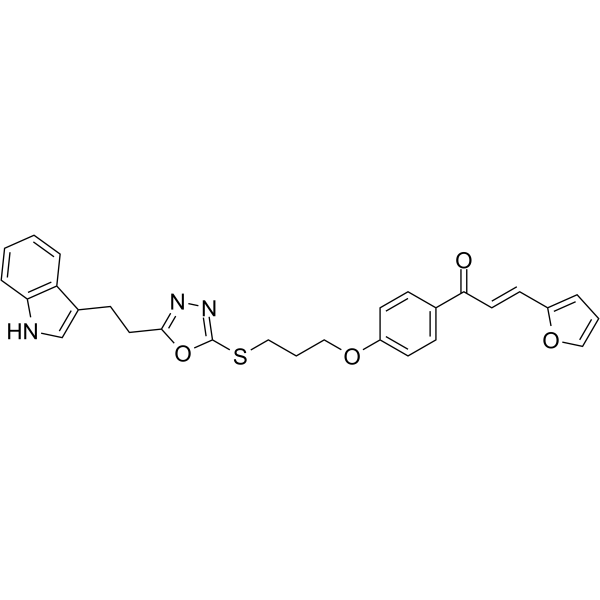
Tubulin inhibitor 21 (compound 6f), a chalcone- and melatonin- based hybrid, is a potent tubulin inhibitor. Tubulin inhibitor 21 induces a remarkable cytotoxic activity toward SW480 cells (IC50=0.26 μM) with lower effect against nonmalignant cells .
loading...
    loading...
Cat. No.: HY-145379
CAS No.: 3039491-16-9
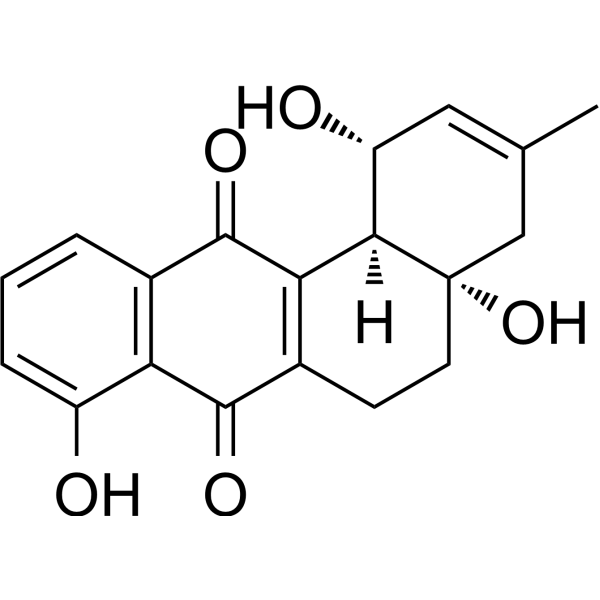
Miaosporone A, an angucyclic quinone, exhibits antimalarial activity against Plasmodium falciparum K1 and antibacterial activity against Mycobacterium tuberculosis with respective IC50 values of 2.5 and 2.4 μM and displays cytotoxic activities against both cancerous (MCF-7 and NCI-H187) and nonmalignant (Vero) cells .
loading...
    loading...
Cat. No.: HY-P991425

Research Areas:  

Cardiovascular Disease Cancer

AT-1413 is a monoclonal antibody targeting CD43s that recognizes a unique sialylated CD43 epitope spanning amino acid residues 133-165. AT1413 induces antibody-dependent cell-mediated cytotoxicity (ADCC) and complement-dependent cytotoxicity (CDC) in AML cells, with EC50 values of 1.1 nM and 12.4 nM, respectively. AT-1413 binds to a variety of cancer cells, shows weak binding to non-malignant myeloid cells and endothelial cells, and does not bind to healthy lymphoid cells or normal non-hematopoietic cells. AT1413 clears CD43s-expressing leukemic blasts in vivo without affecting non-malignant myeloid cells. AT-1413 can be used in research related to acute myeloid leukemia, myelodysplastic syndrome, melanoma, and breast cancer .
loading...
    loading...
Cat. No.: HY-162721
Research Areas:  

Cancer

Anticancer agent 242 (7) possesses anticancer activity in A2780 (IC50 = 0.24 μM, ovarian adenocarcinoma), A2780cis (IC50 = 0.45 μM, resistant derivative of A2780), CCD18Co (IC50 = 0.59 μM, non-malignant human fibroblasts), A549 (IC50 = 0.32 μM, lung carcinoma), HT29 (IC50 = 0.26 μM, colorectal adenocarcinoma), and MCF7 (IC50 = 0.55 μM, breast adenocarcinoma) .
loading...
    loading...
Cat. No.: HY-180260
Research Areas:  

Cancer

Anticancer agent 289 is a H2O2-responsive anticancer prodrug. Anticancer agent 289 exhibits H2O2-inducible DNA-alkylating activity, selectively inhibits the proliferation of high ROS-expressing cancer cells over nonmalignant cells, markedly suppresses tumor growth without observable toxicity in vivo. Anticancer agent 289 can be used for triple-negative breast cancer (TNBC) research .
loading...
    loading...
Cat. No.: HY-181284
CAS No.: 2563902-57-6
BYBC‑1 is a selective G4‑RNA‑targeting ligand with high affinity forKRAS and NRAS G4‑RNAs (Kd = 0.05-0.28 μM). BYBC‑1 stabilizes G4‑RNA structures in KRAS and NRAS mRNA, blocks thePI3K/AKT and MAPK/ERK pathways, activates the DNA damage response (DDR), suppresses energy metabolism, and induces S‑phase arrest and apoptosis. BYBC‑1 exhibits high selectivity over non‑malignant fibroblasts and significantly inhibits the growth of HCT‑116 xenograft tumors in vivo. BYBC‑1 can be used for the study of colorectal cancer .
loading...
    loading...
Cat. No.: HY-184870
CAS No.: 31621-87-1
Target:  

Others

Research Areas:  

Inflammation/Immunology

Polydioxanone is a colorless, crystalline semi-crystalline thermoplastic poly (ether-ester) bioabsorbable polymer. Polydioxanone serves as a hemostatic agent, biodegradable agent, degradant, lumen patency maintainer, as well as a temporary inducer of tracheal tissue injury and inflammation. Polydioxanone controls bone bleeding in biocompatible matrices, degrades via random hydrolytic scission and end-chain scission, with accelerated degradation occurring at pH <1.67, maintains tracheal lumen patency, and induces reversible tracheal epithelial necrosis, inflammation, fibrous tissue hyperplasia, and goblet cell hyperplasia. Polydioxanone can be used in research on bone bleeding, non-malignant tracheal stenosis, tracheobronchial stenosis, tracheobronchomalacia, and airway obstruction associated with vascular compression .
loading...
    loading...
Cat. No.: HY-P11901
Target:  

Ras HDAC Apoptosis

Research Areas:  

Cancer

KH-1 is a KRAS G12D/HDAC2 dual-target inhibitor with Kd values of 11.63 nM and 20.17 nM, respectively. KH-1 induces pancreatic cell apoptosis, cell cycle arrest, and inhibits cell proliferation, invasion and migration, as well as suppresses tumor growth in pancreatic cancer xenograft models. KH-1 can be used for the research of pancreatic cancer .
loading...
    loading...
Cat. No.: HY-122670
CAS No.: 1627962-21-3
Research Areas:  

Cancer

VS-II-173 is a pan-Pim kinase inhibitor with IC50 values ​​of 0.07 μM and 0.02 μM for Pim1 and Pim3, respectively, and a residual activity of 46% for Pim2 at 1 μM. VS-II-173 also inhibits kinases such as HIPK2, PRK2, RSK1, DYRK1a and AMPKα1, selectively inhibiting acute myeloid leukemia (AML) cells with significantly lower toxicity to non-malignant cells (EC50 > 30 μM). VS-II-173 weakens the phosphorylation of substrates such as Stat5 (Y694), MDM2 (S166), Bad (S112), and 4E-BP1 (T37/46) by inhibiting Pim kinase-mediated signaling pathways, blocking pro-survival signals in AML cells and inducing apoptosis. VS-II-173 synergistically enhances anti-AML activity when combined with Daunorubicin (HY-13062A). VS-II-173 can be used in AML research, especially for AML with FLT3-ITD mutations and NPM1 mutations .
loading...
    loading...

