1. Search Result
Search Result
Results for "

physiological pH probe

" in MedChemExpress (MCE) Product Catalog:

12

Inhibitors & Agonists

8

Fluorescent Dyes

Targets Recommended:
Cat. No. Product Name Target Research Areas Chemical Structure
  • HY-150086
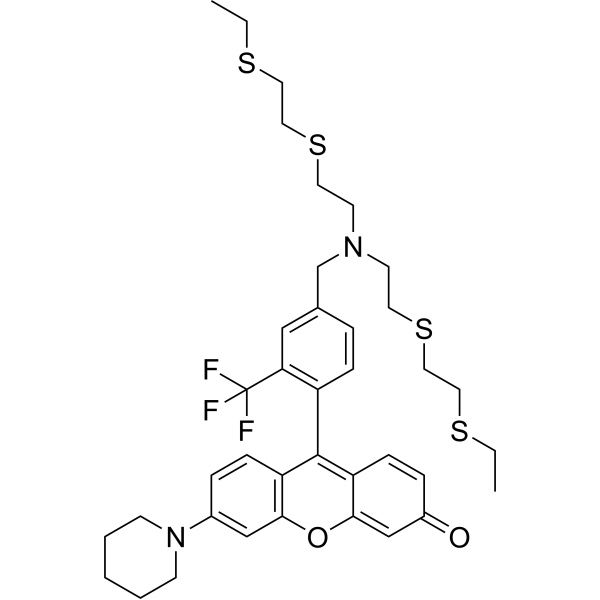
    Copper Fluor-4
    3 Publications Verification

    CF4

    Fluorescent Dye Others
    Copper Fluor-4 (CF4) is a Cu +-specific fluorescent probe based on a rhodol dye scaffold. Copper Fluor-4 has high copper selectivity with a Kd value of 2.9×10 −13 M, particularly over zinc and iron, as well as abundant cellular alkali and alkaline earth metals. Copper Fluor-4 is stable in a physiologically relevant pH regime between 6 and 8 (wavelengths of 415 nm for excitation and 660 nm for emission) .
    Copper Fluor-4
  • HY-D0077

    Oregon green 488

    Fluorescent Dye Others
    2',7'-Difluorofluorescein (Oregon green 488) is a fluorescein derivative and a pH-sensitive fluorescent probe (pKa ~4.7). Upon excitation at 488 nm, 2',7'-Difluorofluorescein exhibits pH-sensitive fluorescence intensity through the formation of dianions, while its pH sensitivity decreases under excitation at 450 nm, allowing its use in ratiometric pH analysis. 2',7'-Difluorofluorescein can be used for the quantitative analysis of pH values in the range of 2-7 in submicron aerosol particles. 2',7'-Difluorofluorescein undergoes buffer-mediated and buffer-free excited-state proton transfer between different protonated forms, and its cationic form undergoes rapid excited-state deprotonation. 2',7'-Difluorofluorescein is resistant to photodegradation, maintains stable absorption and fluorescence properties within the physiological pH range, and serves as a fluorescent protein label, a component of Ca 2+ indicators, a fluorescent imaging agent, and an anisotropy probe .
    2',7'-Difluorofluorescein
  • HY-150175

    Fluorescent Dye Inflammation/Immunology
    HKSOX-1 and its derivatives (HKSOX-1r and HKSOX-1m) are novel fluorescent probes designed for highly sensitive and selective detection of the superoxide anion radical (O2 •−) in cellular environments. These probes utilize an aryl trifluoromethanesulfonate group that undergoes O2 •−-mediated cleavage, releasing a free phenol and emitting fluorescence. They demonstrate excellent specificity and sensitivity across various pH ranges, withstand interference from strong oxidants and reductants typical in cellular contexts. HKSOX-1r, optimized for cellular retention, has been effectively employed in diverse assays including confocal imaging, flow cytometry, and zebrafish embryo studies, highlighting its utility in investigating O2 •− roles in inflammation, mitochondrial stress, and other physiological processes .
    HKSOX-1
  • HY-D1463

    Fluorescent Dye Others
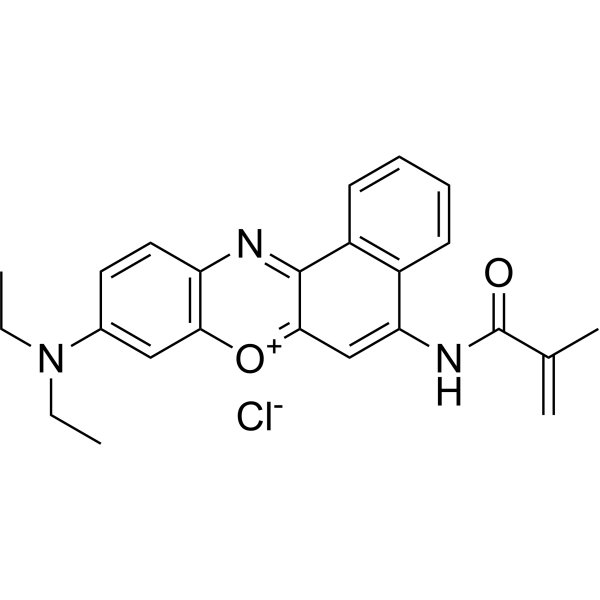
    Nile Blue Methacrylamide is a pH-responsive probe. Nile Blue Methacrylamide exhibits pH-sensitive absorption and fluorescence emission in the physiological pH range, with spectral shifts occurring between acidic and near-physiological pH conditions . (Ex/Em = 590/670-700 nm)
    Nile Blue Methacrylamide
  • HY-D2379

    Fluorescent Dye Endocrinology Cancer
    HMRG is a type of hydroxymethyl rhodamine green fluorescent scaffold, featuring an open non-cyclic structure. HMRG can produce significant dynamic fluorescence changes through a one-step enzymatic reaction at physiological pH, which is useful for developing various probes. Fluorescent probes based on HMRG can be used for fluorescence detection of diseases such as tumors and diabetic nephropathy .
    HMRG
  • HY-145576

    Fluorescent Dye Others
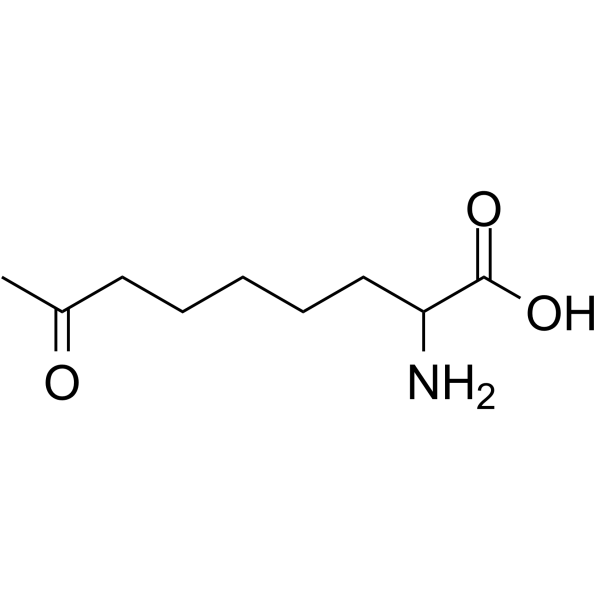
    2-Amino-8-oxononanoic acid is an amino acid, incorporation into proteins in E.coli in genetic. 2-Amino-8-oxononanoic acid is efficient in labeling of proteins with different probes with a site-specific manner under a mild condition close to the physiological pH .
    2-Amino-8-oxononanoic acid
  • HY-145576B

    Fluorescent Dye Others
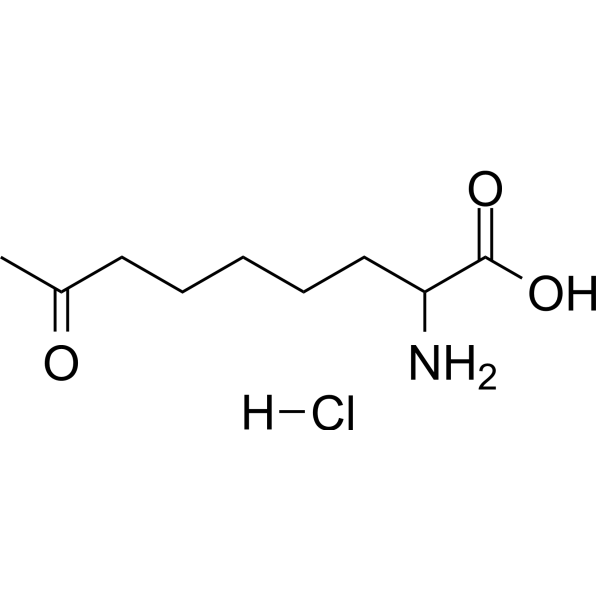
    2-Amino-8-oxononanoic acid (hydrochloride) is the hydrochloride form of 2-Amino-8-oxononanoic acid. 2-Amino-8-oxononanoic acid is an amino acid, incorporation into proteins in E.coli in genetic. 2-Amino-8-oxononanoic acid is efficient in labeling of proteins with different probes with a site-specific manner under a mild condition close to the physiological pH .
    2-Amino-8-oxononanoic acid hydrochloride
  • HY-D3003

    Fluorescent Dye Others
    M-H2S is an endoplasmic reticulum-targeted ratio-type near-infrared fluorescent probe (Ex/Em : 480 nm/560 nm) specifically designed for the detection of hydrogen sulfide (H2S) in living cells and zebrafish. M-H2S exhibits detection limit for H2S of 39.1 nM, and the fluorescence intensity ratio (F₆₅₀/F₅₆₀) within the range of 0-40 μM shows a linear relationship with the H2S concentration. M-H2S responds best under pH = 7.2 (the normal physiological pH of the endoplasmic reticulum) conditions, making it suitable for the detection of the microenvironment of the endoplasmic reticulum. M-H2S can be used to study the role of H2S in endoplasmic reticulum function, stress response, and related diseases .
    M-H2S
  • HY-D2977

    Fluorescent Dye Autophagy Fungal Infection
    AF-1 is a azole-based near-infrared fluorescence diagnostic probe with an emission wavelength of 632 nm. AF-1 selectively accumulates in fungal cell membranes at physiological pH. AF-1 targets and induces Autophagy. AF-1 exhibits antifungal activity and sensitivity to autophagy-related pH .
    AF-1
  • HY-D2998

    Fluorescent Dye Others
    ONOO-LysopH is a new Rhodamine-based near-infrared fluorescent probe. ONOO-LysopH is acid-sensitive, exhibiting rapid near-infrared fluorescence enhancement around 686 nm under acidic pH conditions. ONOO-LysopH also displays a rapid NIR turn-on fluorescence around 678 nm for ONOO− at physiological pH. ONOO-LysopH can target lysosomes to track lysosomal pH changes and image endogenous/exogenous ONOO− in live cells. ONOO-LysopH is applicable for cell imaging ONOO− and tracking lysosomal pH changes .
    ONOO-LysopH
  • HY-DY1104

    CF4 (solution)

    Fluorescent Dye Others
    Copper Fluor-4 (solution) (CF4 (solution)) is a Cu +-specific fluorescent probe based on a rhodol dye scaffold. Copper Fluor-4 solution has high copper selectivity with a Kd value of 2.9×10 ?13 M, particularly over zinc and iron, as well as abundant cellular alkali and alkaline earth metals. Copper Fluor-4 solution is stable in a physiologically relevant pH regime between 6 and 8 (wavelengths of 415 nm for excitation and 660 nm for emission) .
    Solvent and concentration: DMSO: 5 mM
    Copper Fluor-4 (solution)
  • HY-172754

    Fluorescent Dye Cancer
    ICAAc is a solvatochromic fluorophore with reduced basicity. ICAAc demonstrates significant solvatochromic behavior across solvents of varying polarity, with a large dipole moment difference and low quantum yield in water, making it a tunable solvatochromic fluorophore. ICAAc enables pH sensing via UV-vis/fluorescence detection and in microenvironments including sodium lauryl sulfate micelle Stern layers. ICAAc acts as a supravital cell stain for epifluorescence imaging of live cancer cells .
    ICAAc

Inquiry Online

Your information is safe with us. * Required Fields.

Salutation


Country or Region *

Applicant Name *


Organization Name *

Department *


Email Address *


Product Name *

Cat. No.


Requested quantity *

Phone Number *


Remarks

Inquiry Online

Inquiry Information

Product Name:
Cat. No.:
Quantity:
MCE Japan Authorized Agent:

